

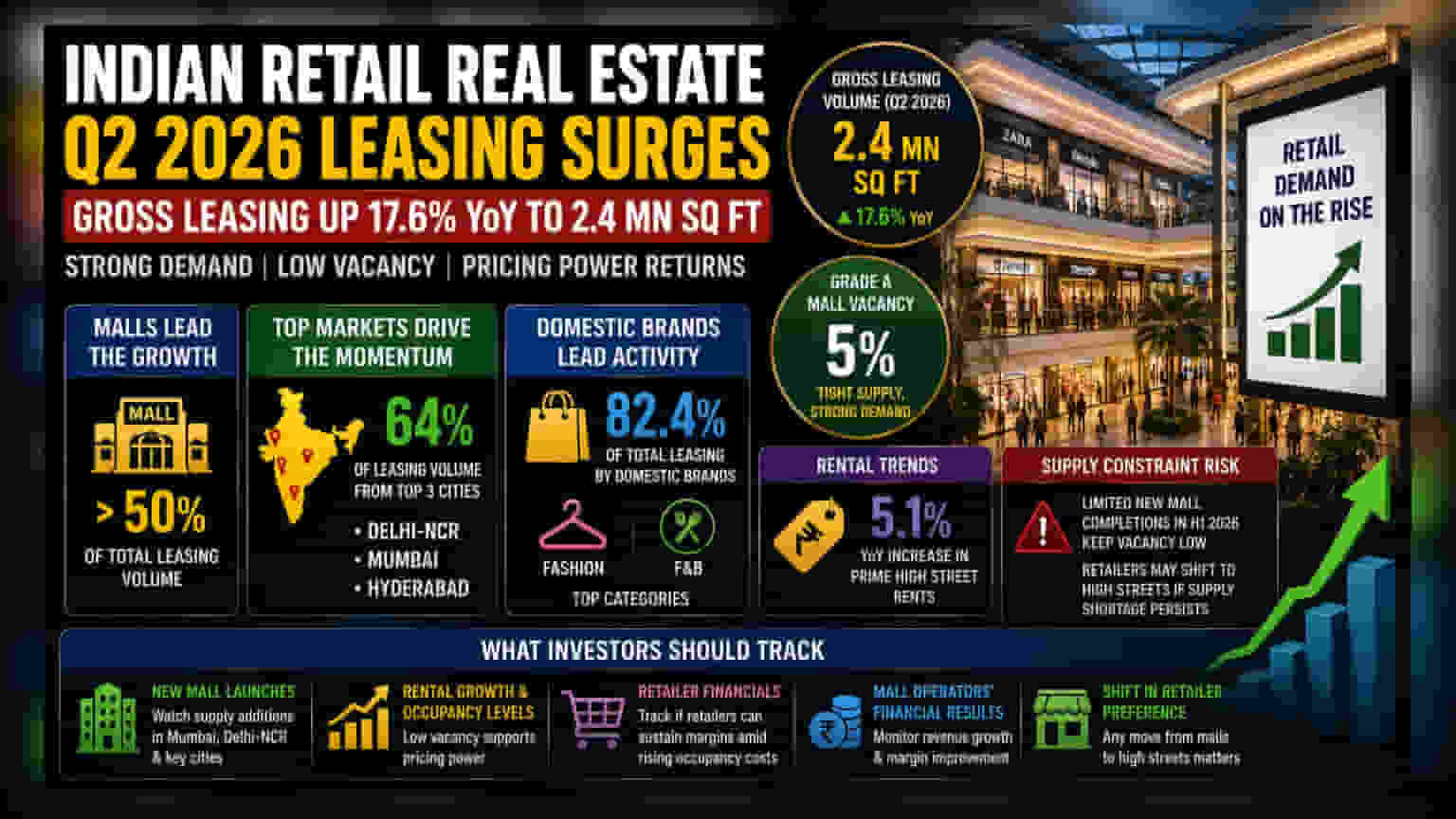
India’s retail leasing market grew 17.6% in Q2 2026, totaling 2.4 million square feet. With Grade A mall vacancy dropping to 5%, demand is outpacing supply, favoring property owners. This trend highlights strong expansion confidence among domestic retailers and signals potential rental growth for major real estate developers and retail-focused REITs.
What Happened
The Indian retail real estate sector recorded a strong performance in the second quarter of 2026, with gross leasing volumes rising 17.6% year-on-year to 2.4 million square feet. Shopping malls were the primary engine of this growth, accounting for over half of all activity. The demand was concentrated in major hubs, with Delhi-NCR, Mumbai, and Hyderabad together contributing 64% of the total leasing volume. Grade A mall space is becoming harder to find, as vacancy rates have tightened to 5%, largely due to limited new project completions in the first half of the year.
Why This Matters for Real Estate Investors
For real estate developers and Real Estate Investment Trusts (REITs) with large portfolios of retail malls, this data points to pricing power. When vacancy is low (at 5%) and demand is steady, property owners are often in a better position to negotiate higher rental rates for new contracts or renewals. The fact that Grade A mall space is limited suggests that existing premium assets may see stable or rising rental income, which is a core metric for evaluating the health of commercial property investments.
The Retailer Perspective
Domestic brands are currently the most active participants, responsible for 82.4% of total leasing activity. Their focus on high streets (54% of their activity) indicates that local retailers are confident in consumer footfall and are actively expanding their physical presence. While fashion and food and beverage (F&B) continue to be the dominant categories for space absorption, the sustained demand from these sectors provides a steady stream of revenue for mall operators.
The Rental and Vacancy Trade-off
While high demand is a positive signal for revenue, the tightening supply poses a potential risk. If the shortage of quality retail space persists, it may force retailers to seek alternative high-street locations, which may not always offer the same footfall consistency as well-managed malls. Furthermore, prime high-street rents have already seen a 5.1% year-on-year increase. For retailers, this rising cost of occupancy can pressure profit margins, especially if consumer spending does not grow at a matching pace. Investors should monitor whether retailers can pass these higher costs on to customers or if profitability begins to shrink.
What Investors Should Track
To understand the long-term impact of this trend, investors may watch for updates on new mall launches in key cities like Mumbai and Delhi-NCR. A significant supply of new space could ease the current 5% vacancy rate, potentially tempering rental growth. Additionally, tracking the financial results of major retail chains and mall operators will be essential to see if this leasing volume is translating into actual revenue growth and improved margins. Finally, monitor if the preference for high streets among domestic retailers changes, as this would shift the dynamics for mall owners who are currently enjoying high occupancy levels.