

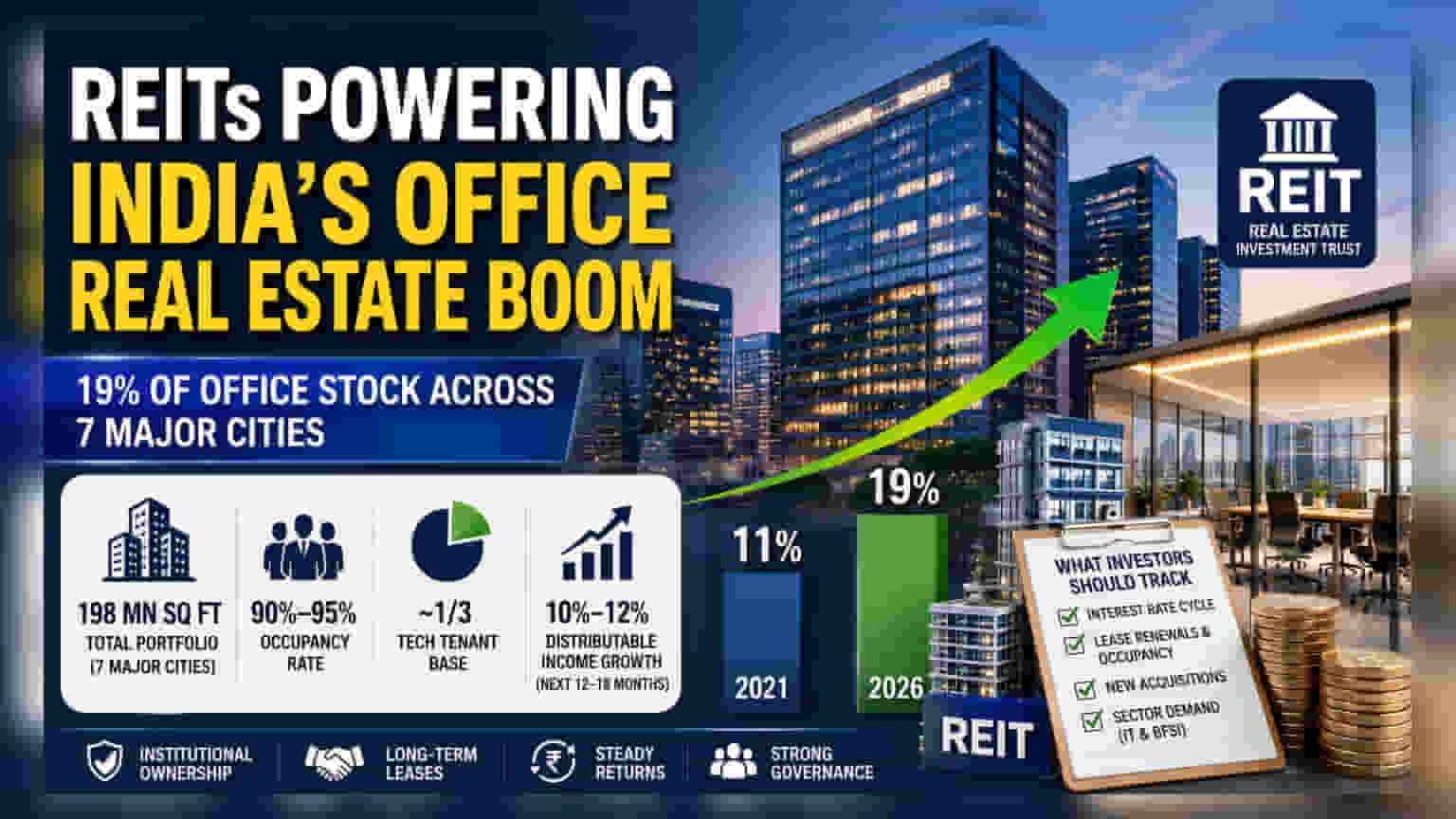
India’s listed Office REITs now cover 19% of top-tier city office stock, up from 11% in 2021. With occupancy levels exceeding 90% and stable rentals from tech and financial firms, this sector offers a distinct model for rental yield generation. However, investors should track interest rate trends and office supply levels as they influence returns.
What Happened
Real Estate Investment Trusts (REITs) are becoming a dominant force in India’s office real estate sector. According to recent market data, these trusts now manage 19% of the total office stock across the country's seven major cities, a significant jump from 11% in 2021. Out of a total portfolio of 198 million square feet in these top hubs, 168 million square feet is currently operational and occupied. This shift indicates a move toward institutional ownership, where properties are managed by professional entities rather than individual landlords.
The Shift to Institutional Ownership
The growth of REITs is reshaping how office spaces are leased in India. Traditional office leasing was often fragmented, but REITs bring a structured approach with long-term lease agreements and standardized corporate governance. This setup is attracting international investors who look for steady, predictable rental yields. The high occupancy rates, currently sitting between 90% and 95%, demonstrate the resilience of Grade A office spaces—buildings that offer modern amenities, safety, and efficient design—despite broader economic fluctuations.
Where the Demand Comes From
Tenant demand remains the engine of this growth. Technology firms remain the largest users of these spaces, accounting for about one-third of the tenant base. Banking and financial services (BFSI) follow, making up 15% to 20% of the tenants, while the remaining demand is driven by engineering and manufacturing companies. Because these sectors often commit to long-term contracts, REITs can provide a level of income stability that is often missing in the unorganized real estate market.
Financial Health and Growth Projections
For investors, the primary appeal of REITs lies in their distributable income—the cash generated from rents that is paid out to unitholders. Current trends show year-on-year rental growth of 4% to 8%, with listed REITs projecting a 10% to 12% growth in distributable income over the next 12 to 18 months. This indicates that the underlying assets are not only holding their value but are also capable of generating incremental cash flows as leases are renewed at higher market rates.
The Risk Factors
While the sector shows strength, it is not without risks. REITs are highly sensitive to interest rates. When interest rates rise, the yield offered by REITs may look less attractive compared to fixed-income instruments like government bonds, which can pressure their unit prices. Additionally, while occupancy is currently high, any significant downturn in the technology sector or a sudden increase in new office supply in specific micro-markets could lead to higher vacancy levels. Investors should also be aware that the liquidity of these units can vary compared to traditional equities.
What Investors Should Track
Moving forward, the performance of these trusts will depend on a few key factors. Investors should track the interest rate cycle, as it directly impacts the cost of capital and the attractiveness of REIT yields. Management commentary regarding new acquisitions, lease renewal rates, and capital expenditure on upgrading older buildings will also be important. Finally, keeping an eye on sector-specific demand, particularly from the IT and BFSI sectors, will help in assessing whether high occupancy levels can be maintained in the coming quarters.