 Whalesbook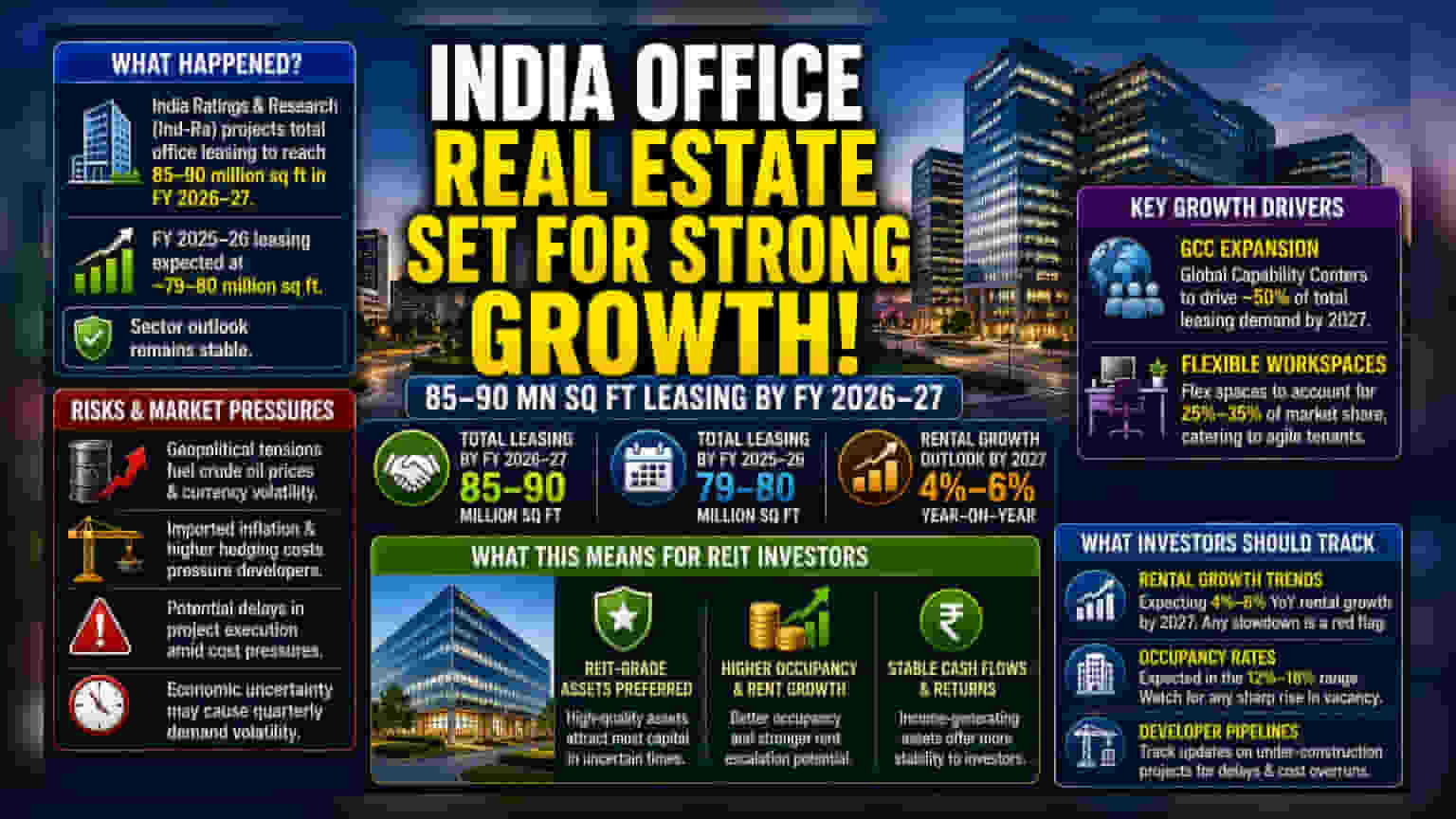


India's office real estate expects steady demand growth, targeting 85-90 million sq ft in leasing by 2027. Driven by Global Capability Centers and flex-workspaces, the sector remains resilient. Investors should watch for risks like rising construction costs and inflation, which could impact project timelines and REIT performance.
What Happened
India's office real estate market is projected to see significant growth over the next two years, according to a recent report by India Ratings and Research (Ind-Ra). The agency forecasts that total leasing activity will climb to 85-90 million square feet by the fiscal year 2026-27. This follows an expected increase to roughly 79-80 million square feet for 2025-26. The report highlights that while the overall sector outlook remains stable, growth is being supported by specific business trends rather than broad market expansion alone.
Why GCCs and Flex Spaces Matter
The primary engine behind this demand is the continued expansion of Global Capability Centers (GCCs), which are expected to contribute nearly half of the total office leasing demand by 2027. GCCs are corporate hubs set up by multinational companies in India for research, engineering, and back-office operations. Because these centers focus on high-value work, they tend to provide stable, long-term occupancy.
Alongside this, there is a clear trend toward flexible workspaces. Companies are increasingly moving away from owning or leasing long-term, rigid office setups. Instead, they prefer flexible arrangements, which allow them to scale up or down based on immediate business needs. Flexible workspaces are projected to take up 25%-35% of the market share, offering developers a way to improve rental yields by servicing smaller, more agile tenants.
Risks and Market Pressures
While the demand outlook is positive, the report identifies several factors that could complicate the picture. Global geopolitical tensions, although not directly stopping current leasing, have introduced variables like higher crude oil prices and currency volatility. For real estate developers, these factors often translate into imported inflation and increased hedging costs.
Perhaps most importantly for investors, these economic pressures can lead to delays in the execution of under-construction projects. If construction costs continue to rise or if budget visibility for multinational corporations remains cloudy, developers might become more cautious. This could lead to quarterly volatility, meaning we might see demand fluctuate throughout the year rather than moving in a straight, predictable line.
What This Means for REIT Investors
For retail investors, the most direct way to participate in the office real estate market is through Real Estate Investment Trusts (REITs). REITs own and manage large, completed, and high-quality office assets. The data suggests that REIT-grade assets will likely remain the preferred choice for capital investment. These assets typically maintain higher occupancy rates and have the ability to increase rents more effectively than non-institutional grade properties. When market conditions are uncertain, investors often favor these established, income-generating assets because they offer more stability compared to under-construction speculative projects.
What Investors Should Track
Moving forward, investors should monitor a few specific indicators. First, track rental growth trends; the market is currently anticipating a 4%-6% year-on-year increase in rentals by 2027. If this growth stalls, it could indicate weaker demand. Second, observe occupancy rates, which are expected to stay in the 12%-18% range; a significant increase in vacancy could signal an oversupply of office space. Finally, keep an eye on management commentary from listed real estate companies regarding their under-construction pipelines, as this will provide a clearer picture of whether development timelines are being met or if rising costs are forcing delays.