

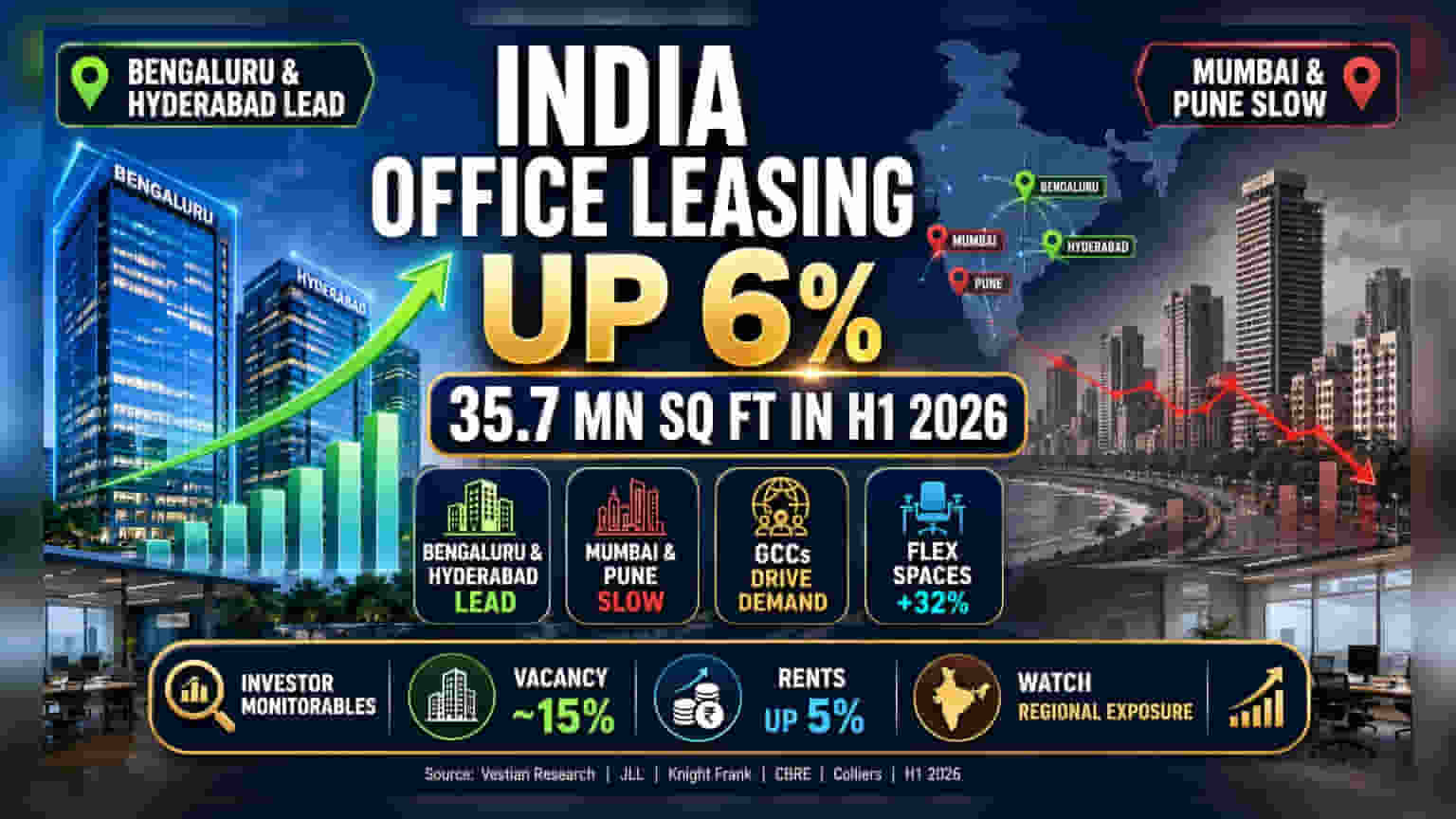
India’s office leasing grew 6% in the first half of 2026, reaching 35.7 million sq ft. While Global Capability Centres (GCCs) and flexible offices drove strong demand in Bengaluru and Hyderabad, markets like Mumbai and Pune showed signs of cooling. This regional trend is crucial for investors tracking commercial real estate developers and Office REITs.
What Happened
India’s commercial real estate market saw a steady start to 2026, with gross office leasing rising 6% year-on-year to 35.7 million square feet in the first half. This growth was largely supported by strong demand for Grade A office space—premium, well-managed buildings often preferred by large corporate tenants. While the overall numbers are positive, the market is showing a distinct regional split.
Global Capability Centres (GCCs)—the Indian offices of multinational corporations—remained the primary engine for demand. They are expected to account for nearly half of all office space uptake this year. Flexible workspace operators also expanded aggressively, with a 32% rise in leasing, proving that companies are increasingly opting for hybrid or scalable office arrangements rather than locking into long-term leases for their entire workforce.
The Regional Split
There is a notable difference in performance across India's top cities. Bengaluru and Hyderabad are the clear winners, together accounting for nearly 50% of the total office space absorbed in the country. Bengaluru remains the leader, while Hyderabad recorded a significant 47% annual jump in leasing activity. These cities continue to attract global firms due to the availability of skilled talent and relatively lower operating costs compared to global peers.
In contrast, the market sentiment in Mumbai and Pune appears to be softening. In the second quarter of 2026, these cities saw leasing activity drop by 25-30% compared to the previous year. Furthermore, the number of large office deals—typically those exceeding 100,000 square feet—has decreased in these regions. This suggests that while demand in the South is robust, occupiers in the West are adopting a more cautious approach to expanding their office footprints.
What This Means for Listed Players
For investors, these trends directly impact the performance of commercial real estate developers and Office REITs (Real Estate Investment Trusts) listed on the stock exchanges. REITs generate income through rental agreements and property management. When leasing is strong, vacancy rates stay low, and landlords have more power to increase rents.
However, the slowdown in Mumbai and Pune poses a risk. If a real estate company or REIT has a heavy concentration of assets in these regions, a decline in leasing could impact their rental growth and ability to maintain high occupancy levels. Conversely, players with strong exposure to the Bengaluru and Hyderabad markets are currently benefiting from the high demand environment.
Risks and Market Pressures
While leasing is up, new supply of office space fell by 9% in the first half of 2026. A reduction in new supply can sometimes keep rentals high, but it also reflects developer caution. High interest rates remain a broader risk, as they increase the cost of capital for developers and can affect the capitalization rates—a measure of property return—for commercial assets.
Additionally, the reliance on Tech and BFSI (Banking, Financial Services, and Insurance) sectors for over 60% of demand means the office market is highly sensitive to the hiring and growth plans of these two industries. If global tech spending slows down, it could eventually impact office absorption rates.
What Investors Should Track
Investors looking at commercial real estate should focus on a few key metrics in upcoming company reports:
Vacancy Levels: Nationally, vacancies are stable at around 15%. Investors should watch if this number rises in the second half of the year.
Rental Growth: With rents up 5% in high-activity pockets, the ability of landlords to pass on costs to tenants will be a key factor for profitability.
WALE (Weighted Average Lease Expiry): This represents the remaining duration of lease agreements. A higher WALE provides more stability for rental income.
Regional Exposure: Check the geographic breakdown of developer portfolios to understand if they are over-exposed to regions where leasing activity is slowing down.