

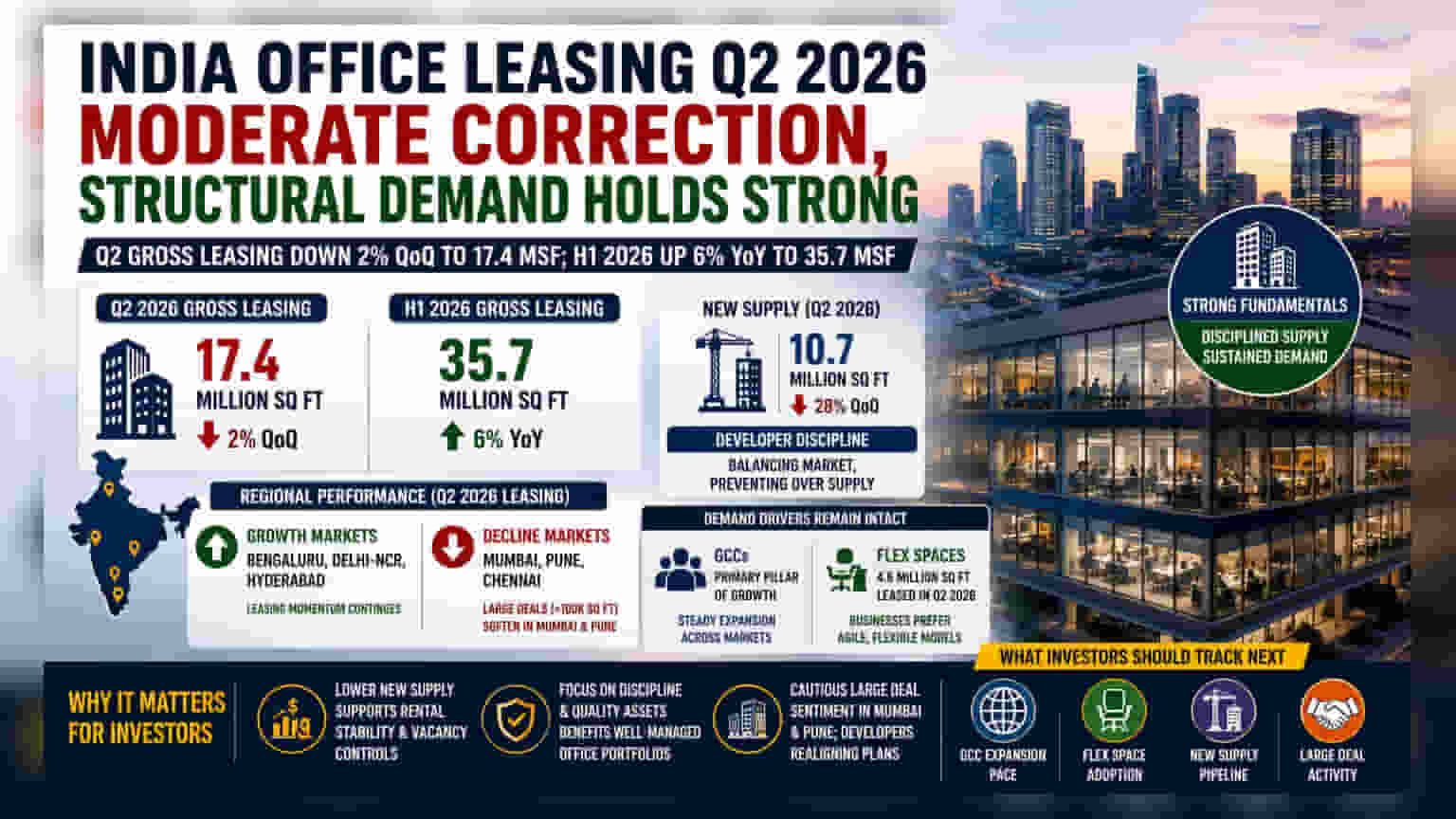
Office leasing across India's top seven cities slipped 2% to 17.4 million sq ft in the April-June quarter as new office supply fell by 28%. Despite this quarterly dip, the market remains firm, with leasing in the first half of 2026 showing 6% growth compared to last year. While demand in Bengaluru and Hyderabad stays strong, large corporate deals in Mumbai and Pune have moderated.
What Happened
India’s office leasing market saw a modest correction in the second quarter (April–June) of 2026, with gross leasing across the top seven metropolitan cities declining by 2% to 17.4 million square feet. This moderation followed a stronger first quarter, bringing the total leasing for the first half of 2026 to 35.7 million square feet, which is still 6% higher than the same period in 2025.
A key driver of this quarterly slowdown was a sharp 28% reduction in new office supply, which fell to 10.7 million square feet. This suggests that developers are becoming more disciplined with construction timelines, potentially balancing the market by preventing an oversupply of office space.
Regional Differences in Demand
The office market is seeing a split in performance across regions. Bengaluru, Delhi-NCR, and Hyderabad continue to drive momentum, recording growth in leasing activity. In contrast, major financial hubs like Mumbai, Pune, and Chennai reported a decline in leasing volume. In Mumbai and Pune, the slowdown was particularly evident in the segment for large-sized deals (over 100,000 square feet), as corporate occupiers have turned more cautious about their immediate expansion plans.
The Role of GCCs and Flex Spaces
Despite the caution in large office deals, structural demand remains intact. Global Capability Centers (GCCs)—offices set up by multinational companies in India for research, development, and support—continue to be a primary pillar of growth. Their steady expansion supports occupancy levels across key markets.
Furthermore, the flexible workspace sector has emerged as a significant growth driver. In the second quarter alone, companies leased 4.6 million square feet of flexible office space. This shift suggests that businesses are increasingly opting for agile leasing models to manage their real estate portfolios, rather than committing to large, traditional long-term leases during periods of economic uncertainty.
Why This Matters for Investors
For investors in commercial real estate or Real Estate Investment Trusts (REITs), the decline in new supply is a double-edged sword. On one hand, it limits the total volume of new space that can generate rental income in the short term. On the other hand, it helps prevent a supply glut, which supports rental stability and keeps vacancy rates in check.
The cautious sentiment among large corporate occupiers in Mumbai and Pune suggests that developers are recalibrating their projects to match actual demand rather than speculative building. This focus on discipline and quality often benefits well-managed, high-grade office assets that continue to attract tenants even when the broader market is hesitant.
What Investors Should Track Next
Investors should monitor the following factors to gauge the health of the commercial real estate sector:
- GCC Expansion Pace: Continued demand from global companies setting up operations in India remains the most critical support for office occupancy.
- Flex Space Adoption: The speed at which large companies integrate flexible workspaces into their portfolios can indicate broader trends in corporate real estate strategies.
- New Supply Pipeline: Watch for whether developers continue to keep supply additions in check, as this directly influences rental yields and vacancy levels in prime office corridors.
- Large Deal Activity: A recovery in large-format leasing in Mumbai and Pune would signal that corporate occupiers are moving past their current cautious stance and resuming expansion plans.