 Whalesbook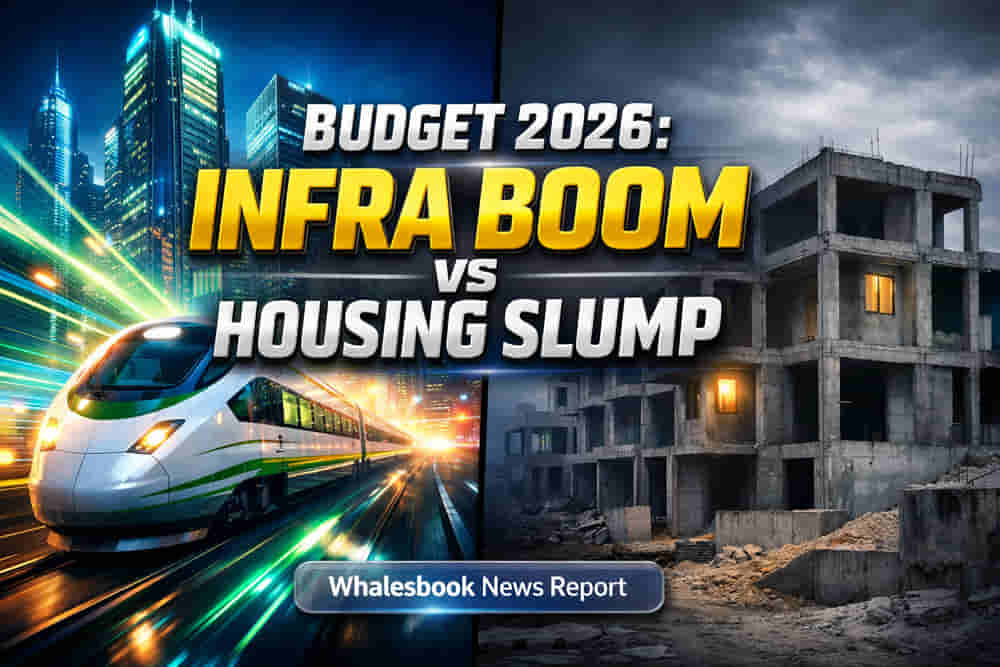
The Seamless Link
Building on the government's focus, the FY2026-27 Union Budget integrates real estate as a key beneficiary of enhanced infrastructure spending and strategic asset monetization. The substantial allocation towards public capital expenditure, coupled with measures designed to de-risk project financing and unlock government-owned properties, signals a clear direction for sector growth, primarily driven by indirect support mechanisms rather than direct fiscal intervention for demand stimulation.
The Infrastructure Engine
Public capital expenditure has seen a notable increase, earmarked at ₹12.2 lakh crore for FY2026-27, an ascent from ₹11.2 lakh crore in the prior fiscal year. This expanded outlay is strategically directed towards urban agglomerations with populations exceeding five lakh, aiming to fuel development and connectivity. The proposed Infrastructure Risk Guarantee Fund is set to lower financing hurdles for large-scale projects by offering partial credit guarantees to lenders, thereby improving project viability and encouraging investment in critical infrastructure. Furthermore, the government plans to establish dedicated Real Estate Investment Trusts (REITs) to monetize a portfolio of Central Public Sector Enterprise (CPSE) real estate assets. This initiative, encompassing railway land, port assets, and government properties, is poised to deepen institutional participation in commercial real estate and generate new avenues for income-generating assets. This move aligns with a broader strategy of asset recycling to enhance capital efficiency and generate recurring revenue streams for public enterprises.
Connectivity and Emerging Markets
The budget's commitment to enhancing connectivity is underscored by the approval of seven high-speed rail corridors. These include crucial routes such as Mumbai–Pune, Pune–Hyderabad, Hyderabad–Bengaluru, Hyderabad–Chennai, Chennai–Bengaluru, Delhi–Varanasi, and Varanasi–Siliguri. Such ambitious infrastructure projects are anticipated to profoundly influence residential and industrial development patterns along these transit arteries. This focus on inter-city mobility is expected to foster new economic clusters and drive property market expansion in Tier-2 and Tier-3 cities, mitigating reliance on saturated metropolitan cores. Studies on high-speed rail corridors indicate potential for increased human interaction, activation of local economies, and a boost to realty development around stations. The high multiplier effect of infrastructure spending, estimated at 2.5 to 3.5 times GDP over the medium term, further supports the government's strategy of leveraging these projects for broader economic growth.
Valuation and Demand Dynamics
Despite the significant infrastructure push, the sector's outlook is tempered by the absence of direct fiscal incentives for residential buyers or developers. This lack of targeted policy support has left concerns surrounding affordable housing unaddressed. Shishir Baijal, Chairman and Managing Director of Knight Frank India, characterized the budget as reinforcing macro continuity rather than providing an immediate demand shock, stating it keeps buyer sentiment pragmatic and supportive of medium-term demand in residential and logistics markets. However, he noted the disappointment regarding the lack of specific fiscal measures for affordable housing. Anuj Puri, Chairman of ANAROCK Group, echoed this sentiment, describing the budget as a growth catalyst rather than a rescue for the sector's most stressed segment. ANAROCK data illustrates a stark decline in affordable housing's market share, falling from over 38% in 2019 to approximately 18% by 2025, highlighting the critical need for direct intervention. Recent reports indicate that affordable housing's share of new residential launches has fallen to approximately 17% in early 2025, a significant drop from earlier years. While mid-income and premium housing segments show more consistent traction, with premium homes (over INR 1 crore) accounting for about 62% of sales in early 2025, the affordable segment continues to grapple with rising construction costs and limited buyer support. Industry leaders have expressed a desire for stability over stimulus and structural reforms over short-term incentives.