 Whalesbook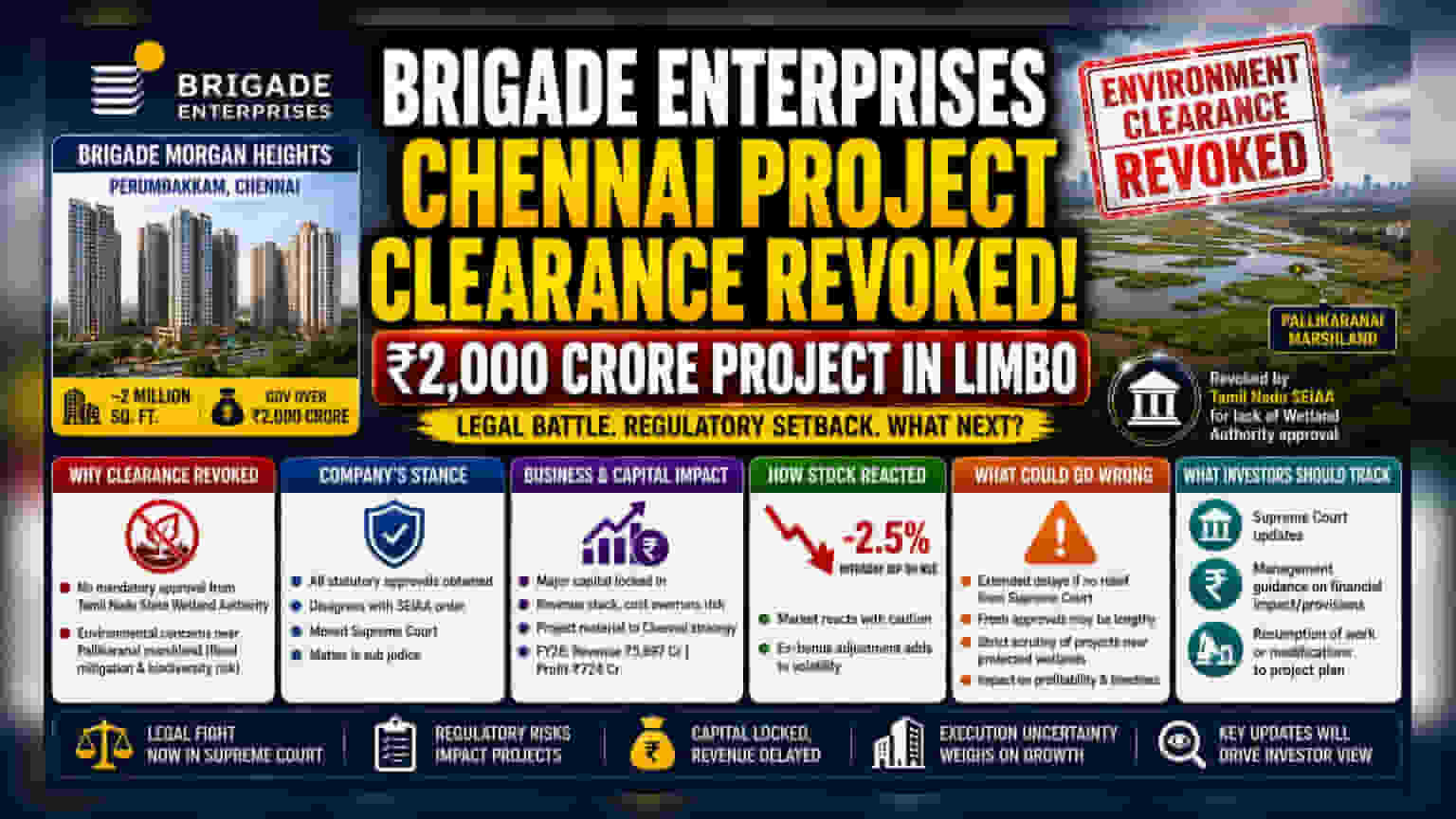
The Tamil Nadu environmental authority has revoked the clearance for Brigade Enterprises' major residential project in Perumbakkam, Chennai, citing non-compliance with wetland norms. The Rs 2,000-crore project faces an immediate halt, creating execution uncertainty. Brigade Enterprises is challenging the order in the Supreme Court. Investors are monitoring the potential impact on project timelines and capital deployment.
What Happened
Brigade Enterprises has faced a significant regulatory setback in Tamil Nadu, where the State Environment Impact Assessment Authority (SEIAA) has revoked the environmental clearance for its residential development in Perumbakkam, Chennai. The project, known as Brigade Morgan Heights, involves approximately 2 million square feet of space and has a gross development value estimated at over Rs 2,000 crore.
The regulator’s decision stems from an allegation that the company failed to secure mandatory permission from the Tamil Nadu State Wetland Authority before initiating construction. Environmental concerns regarding the project's proximity to the ecologically sensitive Pallikaranai marshland have been central to this dispute, with various stakeholders raising flags about potential impacts on flood mitigation and local biodiversity.
The Company's Stance
Brigade Enterprises has maintained that it followed the necessary protocols and obtained the statutory approvals required to launch the project. The company has stated that it disagrees with the SEIAA’s decision and considers the order legally unsustainable. In response to the revocation, the company, alongside its project partners, has approached the Supreme Court of India to challenge the order. As the matter is now sub judice, the legal outcome will be the primary factor determining the future of the construction work.
Business And Capital Impact
For a real estate developer, major projects like this involve significant upfront capital allocation, including land acquisition, approvals, and initial development costs. When a project is halted by regulatory action, capital becomes locked in an asset that cannot generate revenue or progress toward delivery. This increases the execution risk and can lead to cost overruns if the delay is prolonged.
While Brigade Enterprises reported a revenue of Rs 5,697 crore and a profit of Rs 724 crore for FY 2025-2026, a project of this scale (Rs 2,000 crore GDV) is material to the company’s regional growth strategy. Investors should note that while this is a project-specific issue rather than a company-wide crisis, the uncertainty surrounding project timelines is a key concern for the short to medium term.
How The Stock Reacted
The stock market has reacted with some caution to the news. On the day of the announcement, Brigade Enterprises' shares saw a dip, with an intraday decline of around 2.5% on the National Stock Exchange (NSE). Market participants are balancing this regulatory news against the company's broader business performance. It is worth noting that the stock had recently undergone an ex-bonus adjustment, which typically affects price movement, making it important to separate market volatility from the fundamental business impact of the regulatory halt.
What Could Go Wrong
The primary risk for investors is the potential for an extended project delay. If the Supreme Court does not grant immediate relief or if the company is required to go through a fresh, lengthy approval process with the Wetland Authority, the project timeline could shift significantly. Furthermore, this situation highlights the sensitive nature of real estate development near protected wetland zones, an area where regulatory oversight has become increasingly stringent. Such compliance risks are a common challenge in the real estate sector, but they can materially impact the profitability of individual projects.
What Investors Should Track
Moving forward, investors may monitor three key areas. First, any official updates from the Supreme Court regarding the appeal. Second, management commentary on the expected financial impact, including any provisions or adjustments needed for the project. Third, any updates on the resumption of work or modifications to the project plan that might be required to satisfy the Wetland Authority's conditions. These details will be crucial in assessing how much this development will impact the company’s delivery schedule and operational efficiency in the Chennai market.