

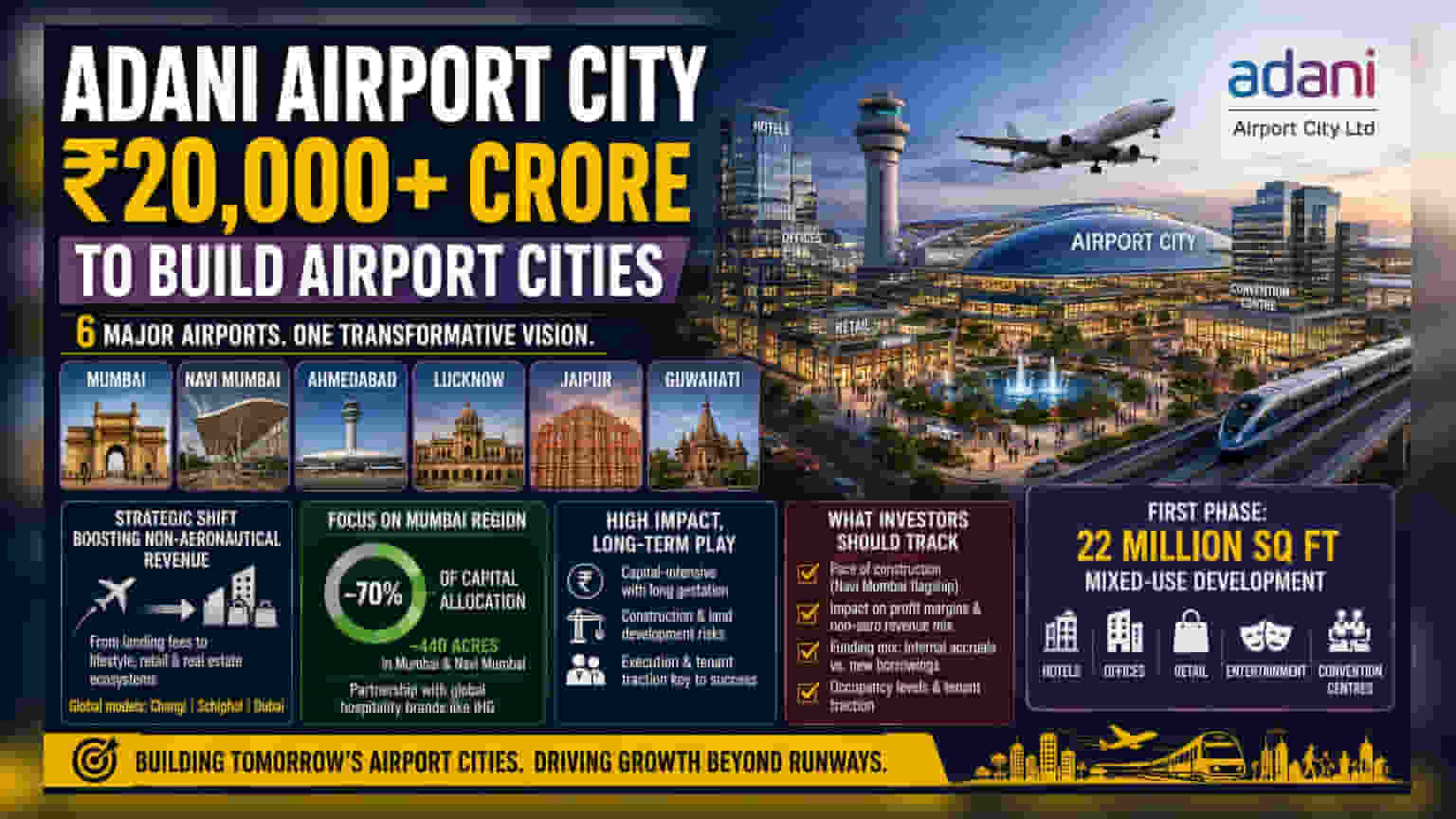
Adani Airport City Ltd (AACL) has announced a ₹20,000 crore investment to develop integrated commercial hubs spanning 22 million sq ft across six airports. The project aims to boost non-aeronautical revenue by building hotels, offices, and retail districts, with 70% of the planned capital earmarked for the Mumbai and Navi Mumbai region.
What Happened
Adani Airport City Ltd (AACL), a wholly owned subsidiary of Adani Airport Holdings Limited (AAHL), has unveiled plans to invest over ₹20,000 crore to develop integrated 'airport cities' across its network. The project targets six major airports: Mumbai, Navi Mumbai, Ahmedabad, Lucknow, Jaipur, and Guwahati. In the first phase, the company intends to develop approximately 22 million square feet of mixed-use infrastructure. These planned districts will house hotels, office spaces, retail outlets, entertainment venues, and convention centers, designed to be seamlessly integrated with existing transport and metro networks.
Why It Matters For The Business
This initiative marks a shift in the company's business model. Currently, airport revenue is often heavily dependent on aeronautical sources like airline landing fees and passenger charges. By building commercial districts, the group aims to increase its 'non-aeronautical' revenue, which includes income from hospitality, retail, and office leasing. This strategy mirrors successful international models like Singapore’s Changi Airport, Amsterdam Schiphol, and Dubai International, where the airport vicinity serves as a self-sustaining business and tourism ecosystem.
Focus On The Mumbai Region
A significant portion of this capital—nearly 70%—is focused on the Mumbai Metropolitan Region. The group controls approximately 440 acres of land in Mumbai and Navi Mumbai, which it considers strategically vital due to high passenger traffic and robust demand for premium commercial space. The company has already entered into agreements with global hospitality brands, including IHG Hotels & Resorts, to bring international hotel chains to these locations.
Financial And Execution Context
This project represents a large, capital-intensive undertaking with a long gestation period, meaning the returns on this investment will likely be realized over several years. For investors, the key financial aspect is how the company balances this heavy capital expenditure with its existing debt levels. Large infrastructure projects inherently carry risks related to construction timelines, land development complexities, and the ability to attract long-term commercial tenants. The success of this model will depend on the group's ability to execute these developments on time and maintain the planned occupancy levels in its commercial and hospitality spaces.
What Investors Should Track
Moving forward, the primary monitorables for this project will be the pace of construction and land utilization at the Navi Mumbai site, which serves as a flagship for the broader plan. Investors may also track management commentary on how these developments impact overall profit margins and the share of non-aeronautical income in the company's total revenue. Additionally, the funding mix for these projects—specifically the balance between internal accruals and new borrowings—will be relevant for understanding the long-term impact on the balance sheet.