

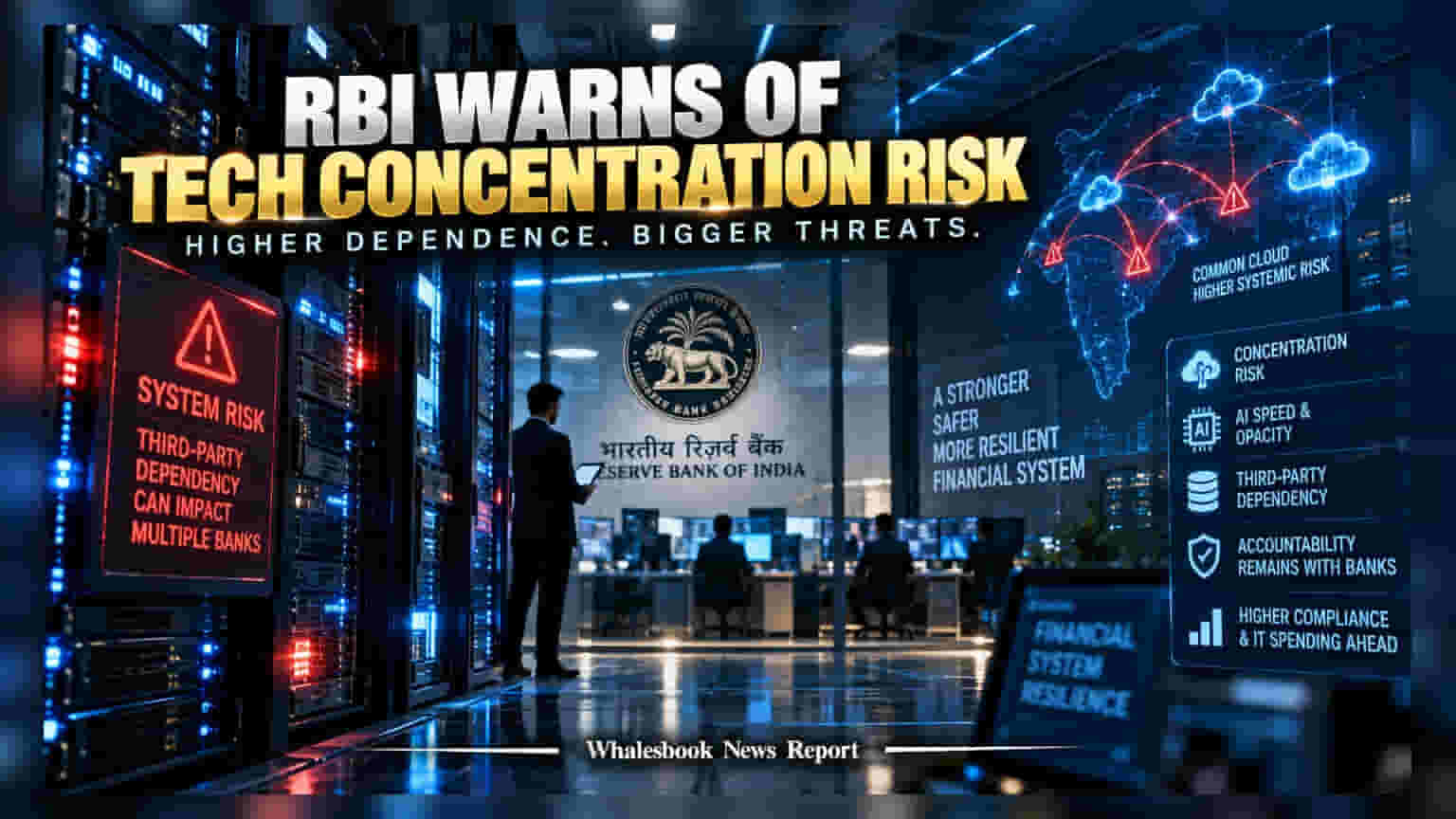
Reserve Bank of India Deputy Governor Rohit Jain has flagged the financial sector's heavy dependence on a small group of cloud and technology providers as a potential systemic threat. For investors, this warning signals that banks and financial institutions may face increased regulatory pressure to diversify their digital infrastructure, which could lead to higher IT spending and a renewed focus on operational resilience.
The Reserve Bank of India (RBI) has issued a stern caution regarding the financial sector's deepening reliance on a narrow set of technology and cloud service providers. Speaking at the Global Fintech Fest in Mumbai on Wednesday, September 9, 2026, Deputy Governor Rohit Jain highlighted that while digital adoption drives efficiency, it also creates significant systemic risks that could impact the broader financial system.
The central bank's primary concern centers on 'concentration risk.' Many financial institutions, including banks and non-banking financial companies, increasingly rely on the same few platforms for critical services like cloud storage, data processing, and artificial intelligence-driven analytics. The RBI warned that this common dependency creates a situation where a technical failure at a single provider is no longer contained within one company, but could instead trigger a cascade of disruptions across multiple institutions simultaneously.
The Challenge of Speed and Complexity
Beyond simple concentration, the RBI highlighted how modern tools like artificial intelligence and tokenisation introduce new layers of complexity. Deputy Governor Jain specifically pointed to the 'speed and opacity' of these systems. Because automated algorithms can execute transactions or make decisions faster than human supervisors can monitor, any malfunction could spiral out of control before intervention is possible. Furthermore, the 'opacity'—or the difficulty in fully understanding how complex AI models arrive at their conclusions—makes it harder for both institutions and regulators to identify and fix potential problems before they manifest as crises.
Accountability Remains with Banks
The RBI made it clear that while financial institutions are eager to adopt these new technologies to stay competitive, they cannot pass the buck to their tech partners. The central bank emphasized that delegating IT tasks to third-party vendors does not absolve a bank or financial firm of its operational responsibilities. Institutions remain fully accountable for any failure, regardless of whether the root cause lies within their own servers or those of their cloud service providers.
What Investors Should Monitor
For shareholders and analysts, this regulatory stance suggests a potential shift in how financial institutions will manage their digital infrastructure. To comply with the RBI's focus on resilience, banks may need to invest in multi-cloud strategies, build redundant systems, and enhance their internal audit capabilities for AI models. While these measures are essential for long-term stability, they could translate into higher operational and capital expenditure for banks in the coming quarters.
Investors may want to track upcoming circulars and guidelines from the RBI regarding third-party vendor management and cyber-resilience. Additionally, management commentary in future quarterly earnings calls regarding IT spending and risk-mitigation strategies will be important to understand how individual firms plan to address these concerns without significantly pressuring their profit margins.