 Whalesbook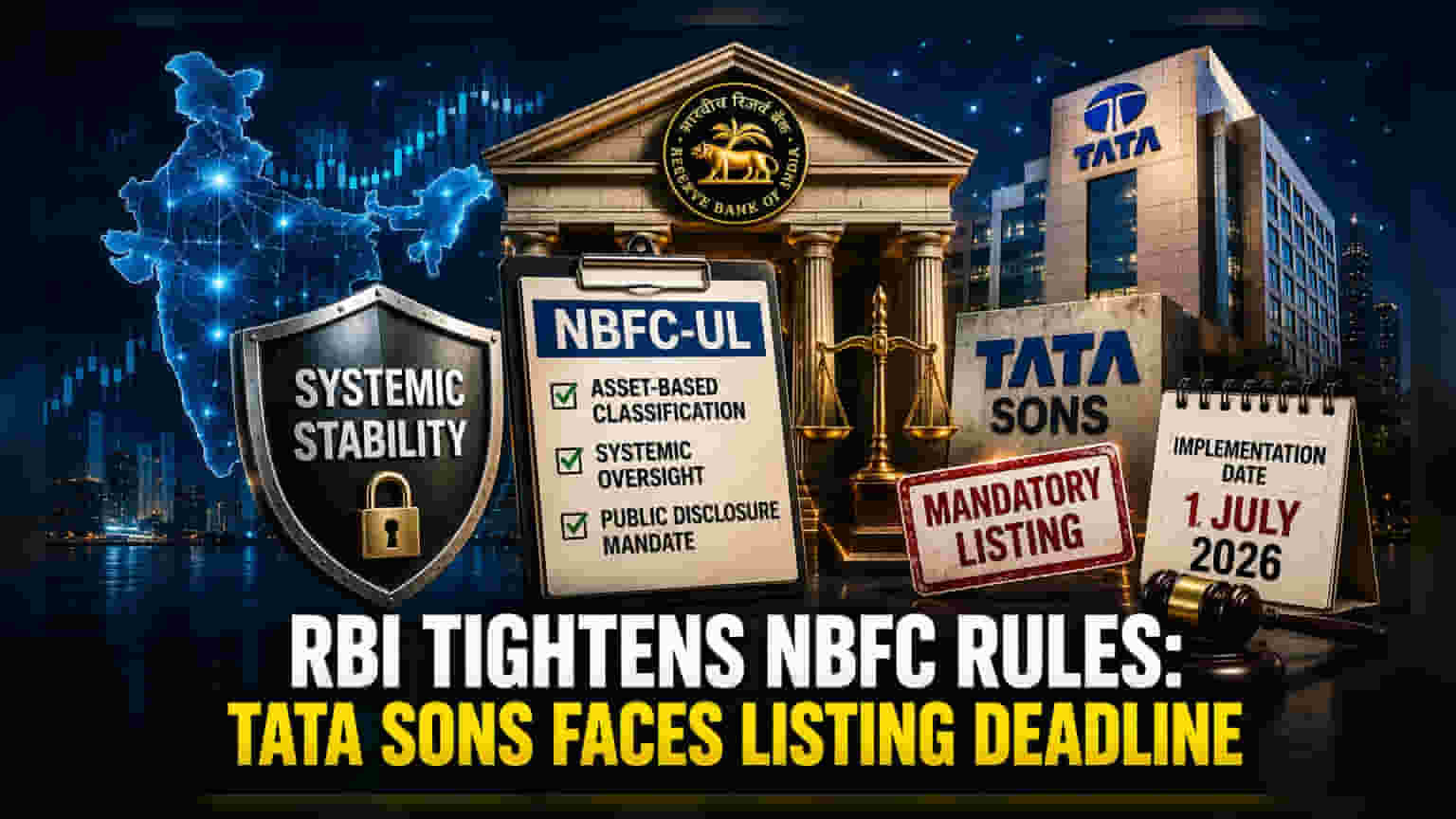


The Regulatory Impasse
The Reserve Bank of India (RBI) is preparing to finalize its updated classification for Upper-Layer Non-Banking Financial Companies (NBFC-UL), a move that underscores the central bank's commitment to maintaining systemic oversight. Governor Sanjay Malhotra confirmed the imminent release of the updated registry, which continues to serve as the benchmark for mandatory regulatory compliance. The classification is more than a mere administrative update; it dictates the operational and public-disclosure obligations for entities deemed systemically significant to India’s financial stability.
The Tata Sons Dilemma
For the Tata Group’s holding company, the upcoming list represents a continuing hurdle. Tata Sons has been seeking to surrender its NBFC status to avoid the mandatory listing deadline—originally set for September 2025. However, the regulatory environment has hardened significantly since its initial application. Recent amendments from the central bank have clarified that equity infusions from group companies with access to debt markets constitute indirect access to public funds. This interpretation renders previous arguments—centered on the company’s debt-free standalone balance sheet—largely ineffective under the current 2026 framework. Market observers and governance advisory firms have increasingly viewed the conglomerate's attempts to remain private as procedurally deficient given the shift toward an absolute, asset-based classification threshold of ₹1 lakh crore.
Structural Risks and Market Oversight
Beyond the immediate impact on Tata Sons, the shift to a simplified, asset-size-based identification methodology for the Upper-Layer signals a broader regulatory intolerance for regulatory arbitrage. By moving away from parametric scoring to a hard-cap asset threshold, the central bank has stripped away the flexibility that previously allowed large conglomerates to modulate their classification. The inclusion of government-owned NBFCs under this revised scope further levels the playing field, ensuring that systemic risk is managed consistently across both state and private sector giants. The focus remains on transparency, with the regulator signaling that systemic significance is a function of scale, not merely operational structure.
Future Outlook
As the July 1, 2026, implementation date for the latest framework approaches, the market is bracing for a definitive stance on the pending applications for de-registration. The consensus among financial analysts is that the central bank’s recent clarifications have effectively closed off remaining avenues for avoiding public-listing mandates. For shareholders and the broader market, this signifies a potential shift toward greater transparency in holding company capital allocation, though the timeline for any formal IPO process remains subject to the finalization of the RBI’s updated Upper-Layer list.