

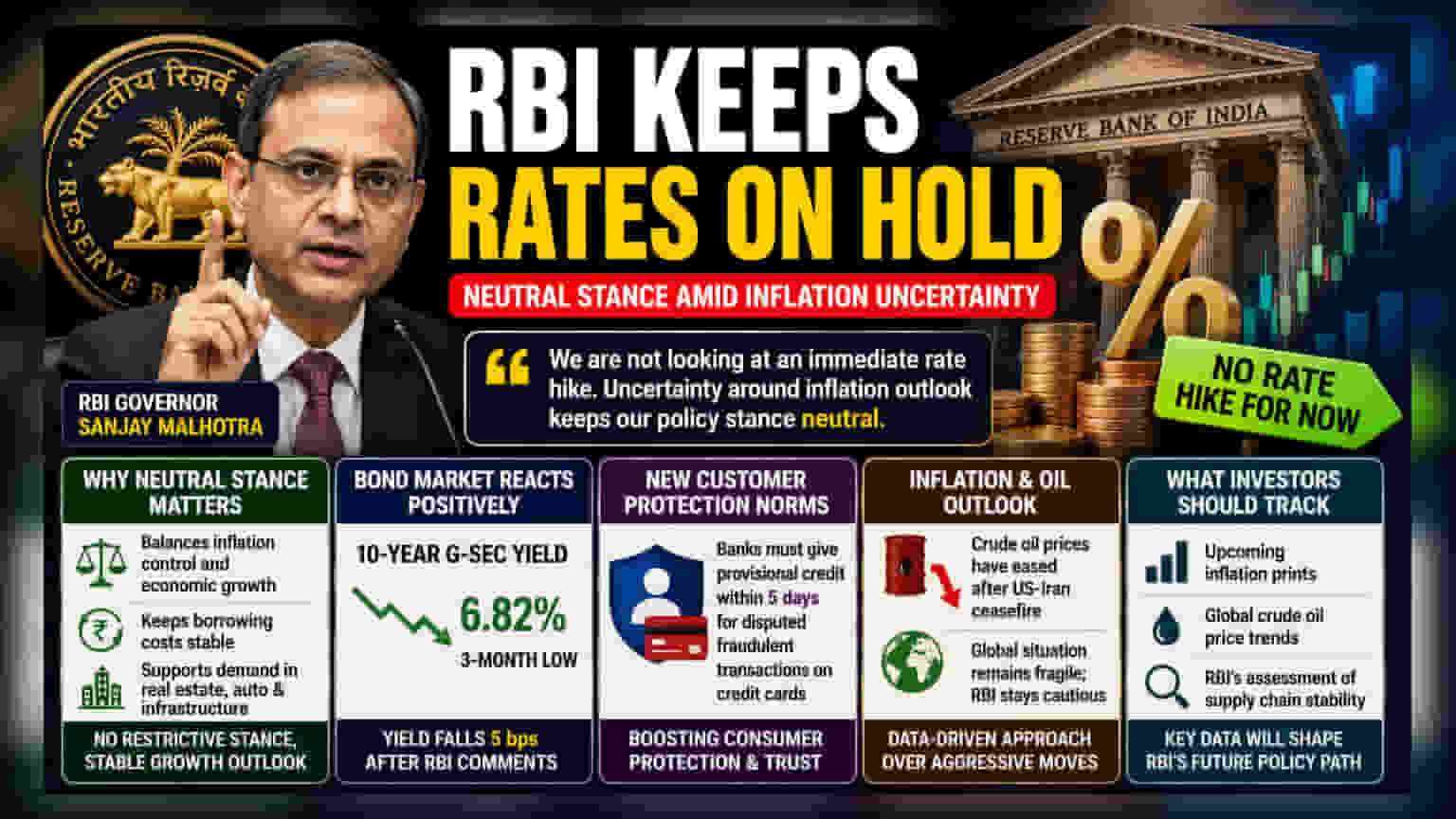
RBI Governor Sanjay Malhotra confirmed the central bank will not rush to raise interest rates, maintaining a neutral policy stance. This data-driven approach aims to manage persistent inflation uncertainty while balancing global geopolitical risks. The move has provided relief to the bond market, with yields reflecting reduced expectations of immediate tightening.
What Happened
Reserve Bank of India (RBI) Governor Sanjay Malhotra has signaled a cautious path forward for the country’s monetary policy. In recent comments, the Governor clarified that the central bank is not planning to raise interest rates immediately. The decision to keep the policy stance 'neutral' rather than shifting to 'restrictive' is largely due to ongoing uncertainty regarding the inflation outlook. While global crude oil prices have eased following the recent US-Iran ceasefire, the RBI remains watchful, prioritizing data-driven decisions over aggressive policy changes.
Why The Neutral Stance Matters
For investors and businesses, the RBI’s neutral stance is a significant signal. A neutral stance suggests that the central bank is balancing the need to control inflation without abruptly slowing down economic growth. When the RBI holds rates steady, borrowing costs for businesses and consumers generally remain stable. This is particularly important for sectors like real estate, auto, and infrastructure, where the cost of loans directly influences demand. If the RBI had shifted to a restrictive stance, it would have signaled higher interest rates, which typically pressure profit margins and slow consumer spending.
How The Bond Market Reacted
The bond market reacted positively to the RBI’s commitment to flexibility. Following the Governor's statement, the yield on India’s benchmark 10-year government bond fell five basis points, reaching a three-month low of 6.82%. In financial markets, when bond yields fall, it often reflects a belief that interest rates will remain stable or potentially lower in the future, which is generally viewed as a positive sign for fixed-income assets.
New Customer Protection Norms
Beyond interest rates, the RBI has also introduced a new directive focused on consumer protection. Banks are now required to provide provisional credit to customers within five days for disputed amounts linked to fraudulent electronic transactions on credit cards. This directive aims to reduce the financial burden on consumers during the investigation of suspicious transactions, enhancing trust in digital payment systems.
What Investors Should Track Next
The RBI’s future policy path depends heavily on incoming economic data. While the recent cooling in oil prices is a positive development, the central bank has warned that the global geopolitical situation remains fragile. Investors should monitor three key areas: upcoming inflation prints, global crude oil price trends, and the RBI's internal assessments of supply chain stability. These factors will determine whether the central bank stays neutral or is forced to change its stance in future meetings.