

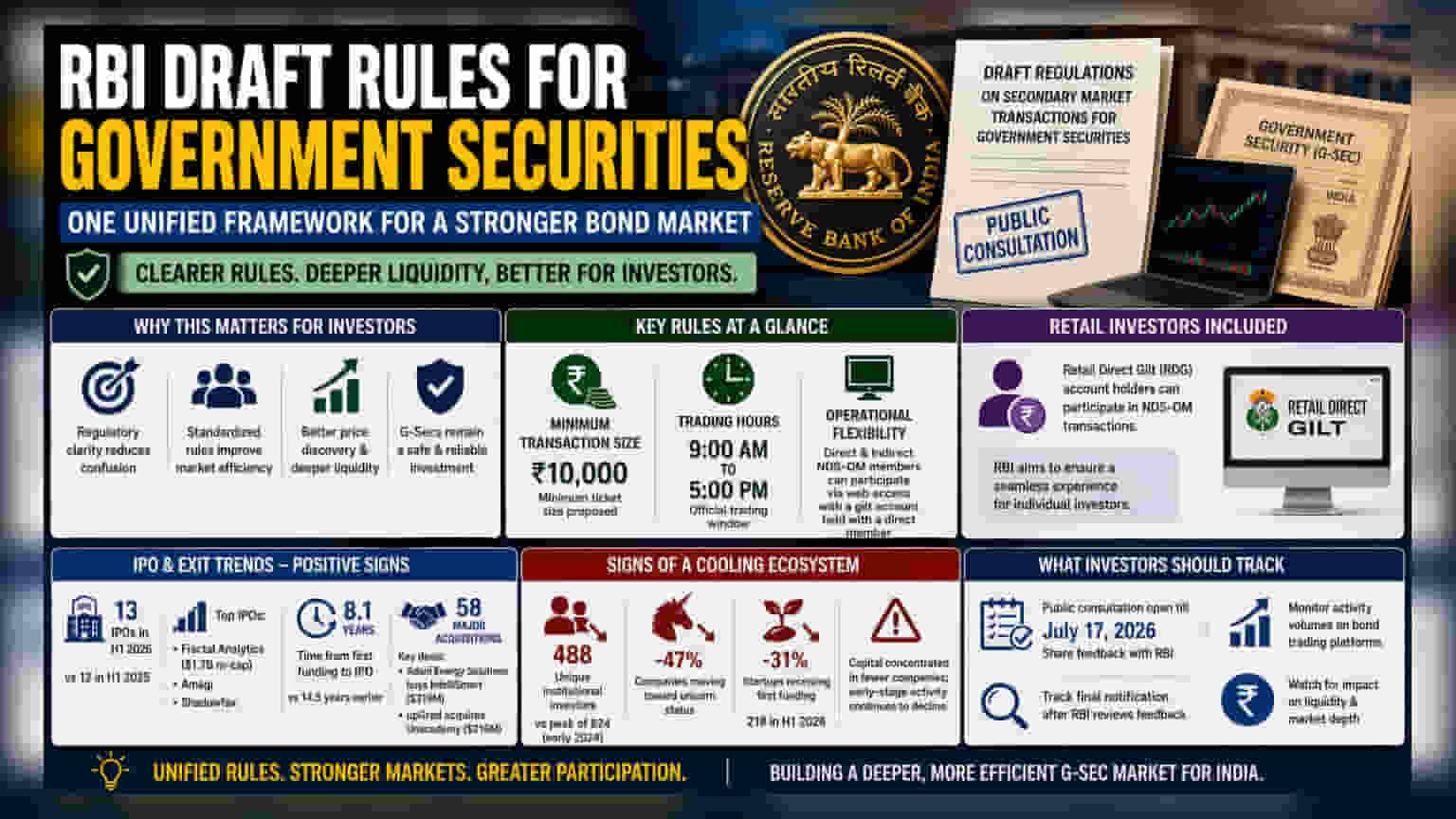
The Reserve Bank of India has issued draft guidelines to streamline secondary market trading for government securities. The proposal introduces a minimum transaction size of ₹10,000 and sets official trading hours from 9:00 AM to 5:00 PM. Market participants have until July 17, 2026, to provide their feedback.
What Happened
The Reserve Bank of India (RBI) has released a set of draft regulations focused on secondary market transactions for government securities (G-Secs). The primary goal of these new rules is to bring existing, scattered guidelines into one unified framework. By consolidating these rules, the central bank aims to provide clearer operational guidelines for all market participants, ranging from large institutions to individual investors.
Why This Matters for Investors
For investors, regulatory clarity reduces confusion and helps the market function more efficiently. When trading rules are standardized, it becomes easier for both professional traders and individual investors to understand how transactions are executed, settled, and reported. This is a step toward professionalizing the government bond market, which is often considered the safest asset class for fixed-income investors in India. A more efficient secondary market can lead to better price discovery and deeper liquidity.
Key Rules Explained
The draft introduces specific standards to maintain order in the bond market:
- Minimum Transaction Size: The RBI has proposed a minimum transaction size of ₹10,000. This standardizes the ticket size, ensuring consistency across the market.
- Trading Hours: The regulator has set the official window for these transactions from 9:00 AM to 5:00 PM.
- Operational Flexibility: The draft provides details on how direct and indirect members of the Negotiated Dealing System-Order Matching (NDS-OM) platform should function. It clarifies that indirect members can participate via web-based access, provided they hold a gilt account with a direct member.
The Retail Investor Angle
This move also has implications for retail participation. The RBI has clarified that investors holding a Retail Direct Gilt (RDG) account—the platform designed to let individuals buy government bonds directly—can participate in NDS-OM transactions. By explicitly including these account holders in the framework, the RBI is signaling that it wants to maintain a seamless experience for individuals who are increasingly using the Retail Direct scheme to invest in sovereign debt.
What Investors Should Track
The draft is currently open for public consultation, and market participants have been invited to submit their feedback by July 17, 2026. The key monitorable for investors will be the final notification issued after the RBI considers the feedback. Investors may also want to track if these standardized timings and ticket sizes lead to higher activity volumes on the bond trading platforms, which would indicate a healthier and more accessible market for all.