 Whalesbook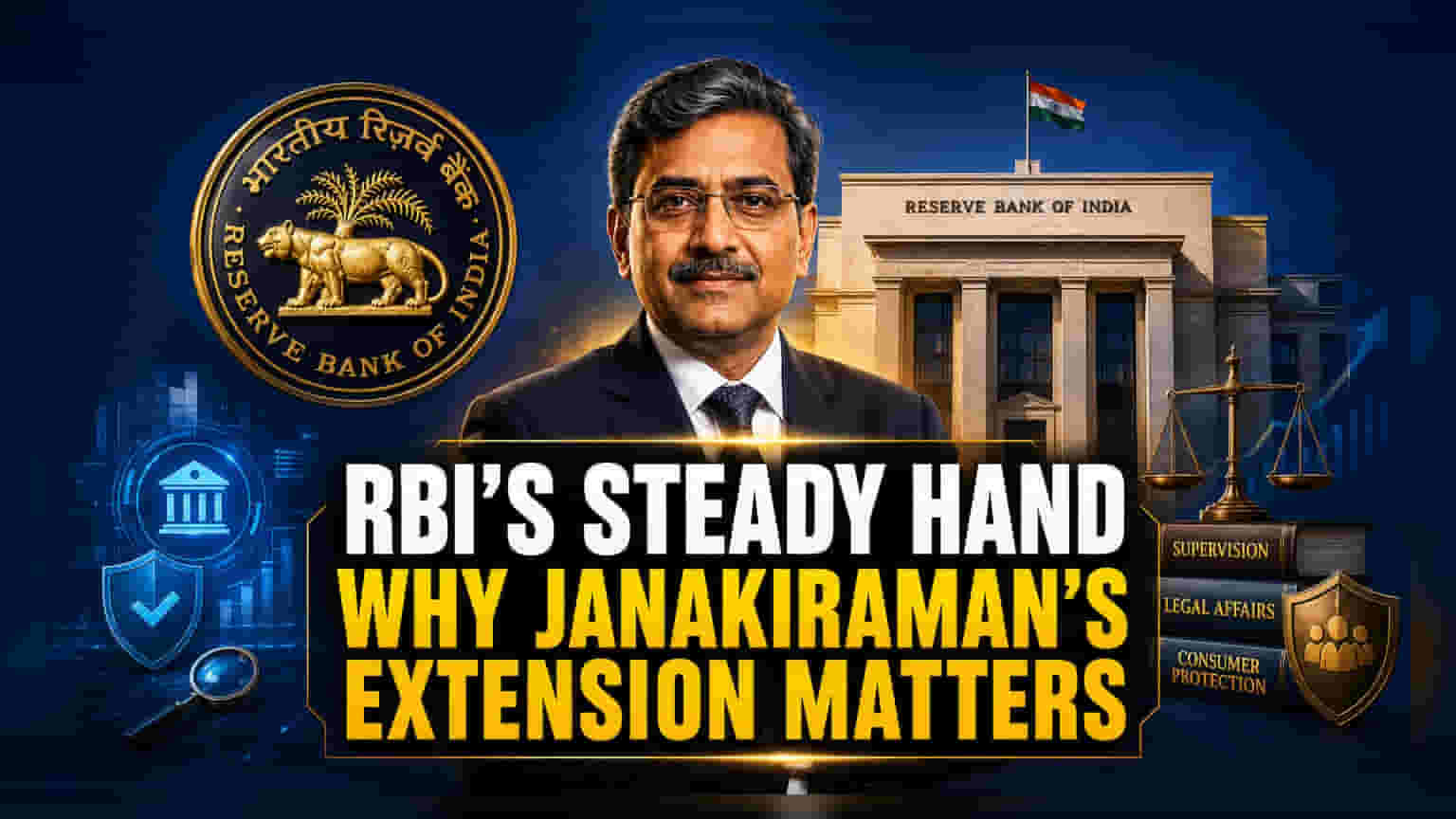


The Anchor of Regulatory Continuity
The decision to extend Swaminathan Janakiraman’s tenure serves as a clear signal of the government's priority for institutional stability. Following the recent departure of T. Rabi Sankar and the appointment of Rohit Jain, the RBI’s leadership composition underwent a significant reshuffle. By retaining Janakiraman, the central bank maintains a steady hand at the helm of its most critical oversight functions.
Portfolio Consolidation and Seniority
Janakiraman has emerged as the senior-most deputy governor, assuming a pivotal role in coordinating the complex activities of the central bank. His current mandate is expansive, encompassing supervision, inspection, legal affairs, and the Deposit Insurance and Credit Guarantee Corporation. Beyond these core regulatory tasks, he manages human resources, financial inclusion, and consumer protection. Most notably, he has recently taken charge of the secretary’s department—a function essential for operational cohesion across the Reserve Bank’s various divisions. This concentration of authority positions him as the primary link between the Governor’s office and the operational execution of regulatory policy.
The Strategic Banking Perspective
Bringing a career background from the State Bank of India (SBI), the country's largest commercial lender, Janakiraman’s reappointment underscores the value placed on practical banking experience within the central bank. While other deputy governors often focus on economic modeling or specific market operations, Janakiraman’s strength lies in his deep-rooted understanding of banking risks and practical supervision. This perspective is vital as the RBI navigates an increasingly digital and fintech-integrated landscape, where supervisory frameworks must be both agile and robust.
The Structural Risk Assessment
Despite the perceived stability, the concentration of so many diverse portfolios—ranging from legal and premises to supervision—under one individual creates potential bottlenecks. The RBI currently operates at its mandated capacity of four deputy governors. However, the recent redistribution of tasks after the exit of T. Rabi Sankar has significantly widened the scope of responsibilities for both Janakiraman and his colleagues. Critics of this lean administrative structure often point to the immense load placed on these officials, suggesting that the complexity of modern financial oversight may eventually require further decentralization of decision-making powers or an expansion of the deputy governor roles to prevent operational fatigue.