 Whalesbook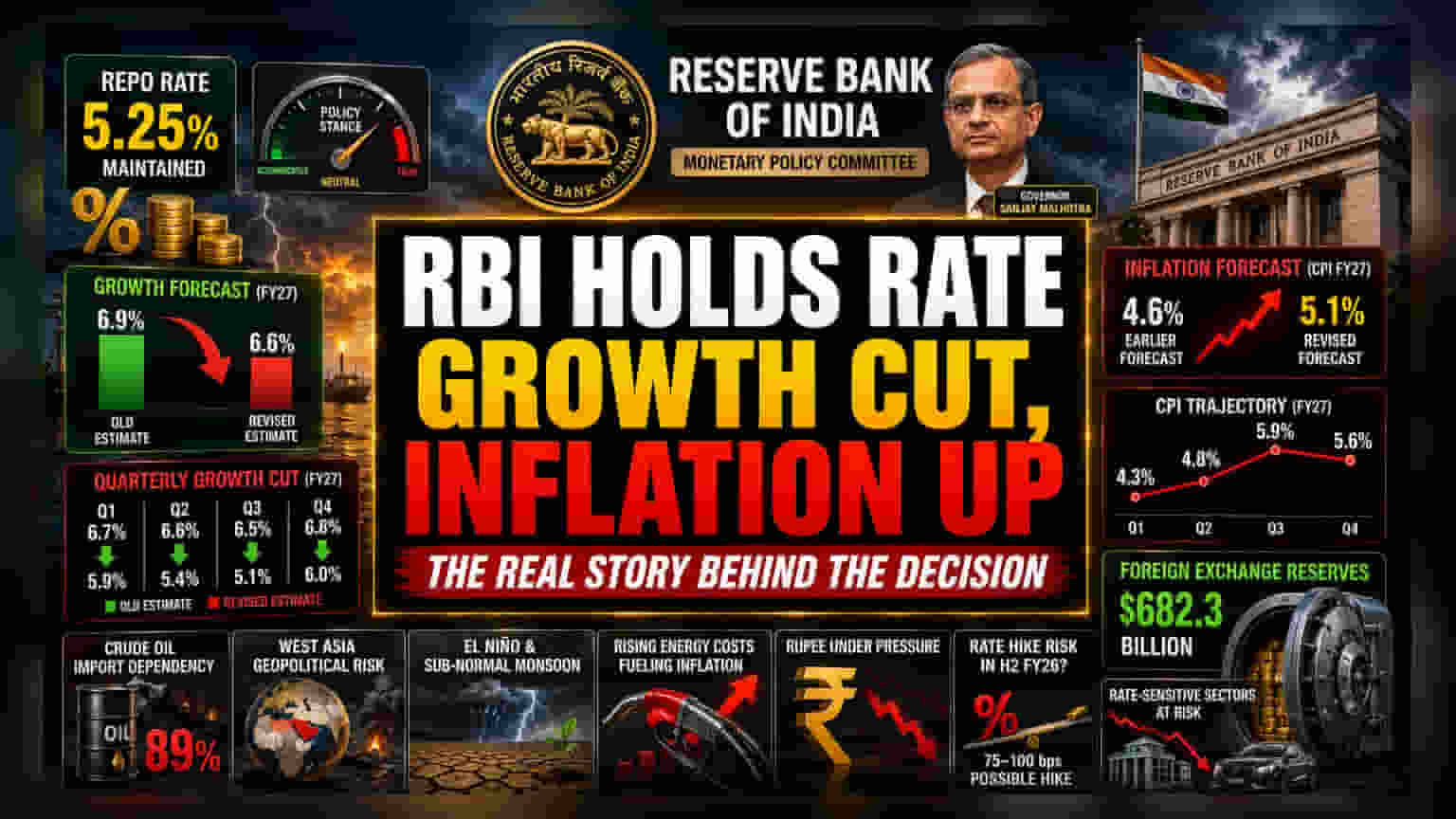


The Policy Impasse
The Reserve Bank of India’s Monetary Policy Committee, under the leadership of Governor Sanjay Malhotra, opted for stability in its June 2026 meeting, holding the benchmark repo rate at 5.25%. This decision reflects an institutional preference for liquidity management over aggressive rate adjustments, even as the macroeconomic environment deteriorates. The committee’s choice to maintain a neutral stance suggests that the central bank is prioritizing cautious observation, waiting for clarity on the intensity of the West Asia conflict and its subsequent impact on supply chains before committing to a directional shift.
Inflation and Growth Divergence
The decision was underpinned by a sobering revision of forward-looking data. The RBI adjusted its FY27 consumer price index inflation forecast upward to 5.1%, a 50-basis-point increase driven by the pass-through effect of elevated energy costs and the potential for a sub-par monsoon season. Simultaneously, the central bank downgraded its real GDP growth projection for FY27 to 6.6% from 6.9%. The quarterly growth estimates were notably slashed, particularly for the second and third quarters, underscoring the friction caused by external energy price shocks and weakening domestic consumer sentiment.
The Forensic Bear Case: Structural Risks
While the market initially cheered the rate pause, the structural narrative remains challenging. Unlike earlier periods of calm, the current environment is heavily constrained by an 89% reliance on crude oil imports, making the economy exceptionally sensitive to regional instability. Analysts note that with CPI inflation projected to accelerate in the latter half of the fiscal year—peaking at 5.9% in Q3—the current 5.25% repo rate may effectively act as a negative real interest rate if price pressures materialize as expected. Furthermore, management of the rupee has become increasingly complex. Should the RBI be forced to defend the currency against ongoing depreciation, the 'neutral' stance may be abandoned in favor of liquidity tightening, potentially triggering a sharp correction in interest-sensitive sectors like real estate and automotive finance.
Future Outlook and Analyst Consensus
Market participants are now recalibrating their expectations for the remainder of the fiscal year. The consensus among treasury heads indicates that while the RBI has successfully avoided an immediate rate hike, the path of least resistance has narrowed significantly. Brokerages are closely monitoring the Q3 inflation trajectory; if realized figures overshoot the 5% threshold, expectations for a 75-to-100 basis point rate increase in the latter half of 2026 will likely gain momentum. For now, the central bank remains in a wait-and-see mode, relying on its robust $682.3 billion in foreign exchange reserves to provide a buffer against short-term external shocks.