 Whalesbook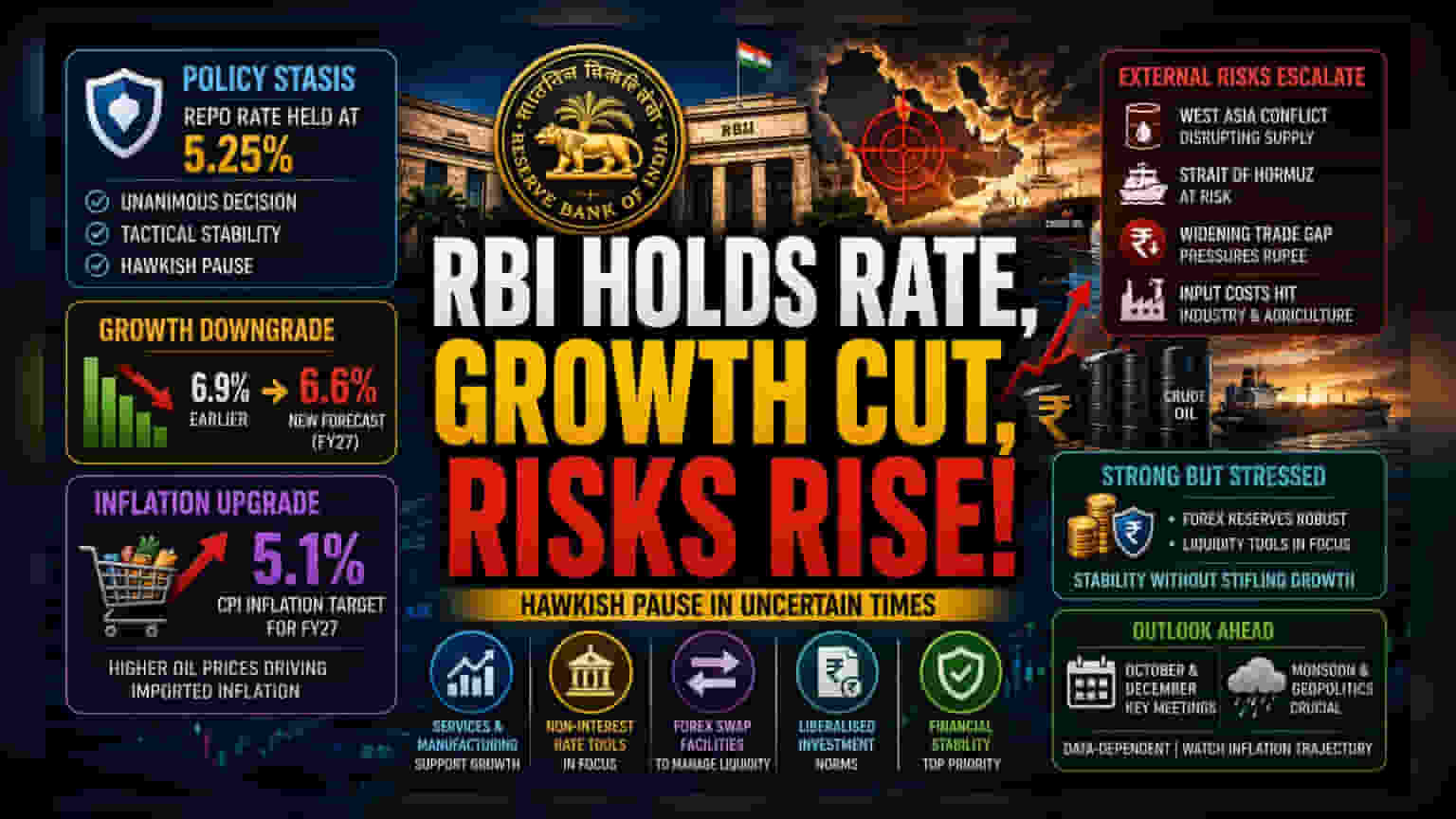


The Policy Stasis Amid Escalating Risks
The Monetary Policy Committee’s unanimous decision to hold the repo rate at 5.25% reflects a tactical preference for stability over aggressive policy intervention. By maintaining a neutral stance, the central bank is effectively buying time to gauge the full extent of the West Asia conflict’s impact on domestic macro-indicators. This “hawkish pause” underscores a pivot toward risk-aversion, as policymakers grapple with the dual challenges of cooling domestic demand and imported inflation triggered by the Strait of Hormuz disruption.
The Analytical Deep Dive: Growth vs. Inflation
The downward revision of the GDP growth forecast to 6.6% from 6.9% is a sobering acknowledgement of the structural headwinds now facing the Indian economy. Unlike previous quarters where momentum was driven by resilient private consumption and fixed investment, the current outlook is heavily overshadowed by the volatility in global commodity markets. With crude oil prices consistently trading at higher bands, the central bank has adjusted its CPI inflation target upward to 5.1% for FY27. This move signals a departure from the earlier belief that inflation would remain benign, highlighting a critical shift in the bank's tolerance for price instability. Comparing this to peer economies, the Indian framework remains relatively more resilient, yet the persistence of upstream cost pressures suggests that any easing cycle is likely off the table for the near term.
The Forensic Bear Case
The risks facing the economy are increasingly external and potentially systemic. A prolonged blockade of major maritime chokepoints is not merely an energy supply issue; it represents a fundamental threat to the domestic manufacturing and agricultural sectors, which rely on imported inputs like fertilizers and petrochemicals. Unlike periods of relative global calm, the current environment lacks a clear path to normalization, creating a risk of stagflation if energy costs continue to seep into the broader consumer basket. Furthermore, while India’s forex reserves remain robust, the underlying pressure on the rupee due to a widening trade gap could force the RBI to deploy more intensive liquidity-management measures, potentially limiting the space for future growth-supportive policies.
The Future Outlook
Looking ahead, the central bank has signaled it will remain data-dependent, with future policy moves contingent on the evolution of monsoon conditions and geopolitical stability. Analysts anticipate that the October and December meetings will be crucial, as these will provide greater clarity on whether cost-push inflation is becoming entrenched. For now, the focus is on utilizing non-interest rate tools—such as forex swap facilities and liberalized investment norms—to preserve financial stability without stifling the nascent recovery in services and manufacturing.