

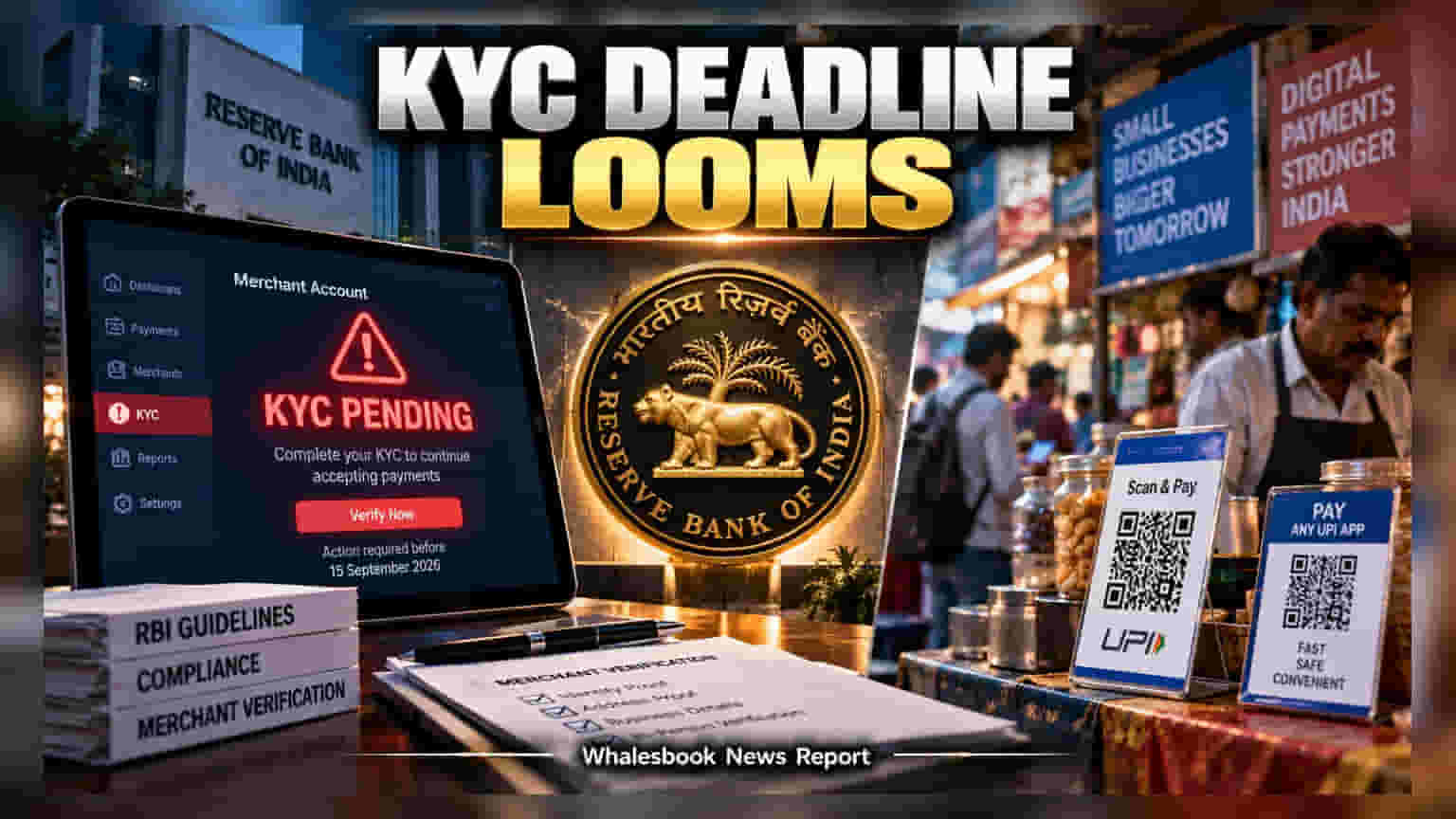
Payment aggregators are requesting the Reserve Bank of India to extend the September 15, 2026, deadline for mandatory merchant re-verification. Industry data indicates nearly one-third of small offline merchants face potential service suspension, which could impact transaction volumes and operational continuity for payment firms if the timeline is not relaxed.
Payment aggregators in India are actively lobbying the Reserve Bank of India for an extension to the September 15, 2026, deadline for mandatory merchant re-verification. Industry players are concerned that failing to meet this cutoff will force them to suspend payment services for a large number of merchants, specifically those who remain non-compliant with the updated KYC standards.
Why the Verification Hurdle Exists
The current operational challenge stems from the Reserve Bank of India’s updated Master Directions. These rules mandate that in-person KYC verification must be conducted directly by the employees of the payment aggregators. This requirement effectively prevents the use of third-party agents for these specific checks. While aggregators have been aggressively scaling their internal teams to handle the verification process, they report that reaching the "tail-end" of merchants—particularly small, informal businesses in remote areas—is logistically difficult and time-consuming.
Estimates suggest that 30 to 35 percent of small offline QR-based merchants and approximately one million online merchants currently remain unverified. Although most aggregators have successfully completed about 80 percent of their targets, the remaining gap creates a significant compliance risk as the September deadline approaches.
Potential Impact on Business
The situation poses a dual challenge for payment firms. On the operational front, the mandate to use in-house staff rather than third-party agencies increases the cost of compliance, requiring significant hiring and training. From a revenue perspective, widespread suspension of non-compliant merchants could lead to a temporary contraction in transaction volumes and processing fees, as these merchants would be unable to accept digital payments.
There is also a broader concern regarding financial inclusion. Many of these small businesses, including local kirana stores and street vendors, rely heavily on digital transaction tools. If these services are suspended, these merchants might be forced to shift back to cash-only transactions, which could affect the usage metrics of digital payment platforms in the short term.
Regulatory authorities face the difficult task of balancing stringent compliance to prevent misuse of financial systems with the goal of keeping small businesses integrated into the digital economy. Industry insiders remain cautiously optimistic, hoping for a deadline relaxation that would allow more time to bring the remaining merchants into compliance without disrupting their daily business activities.
Investors and stakeholders will now watch for any official notification or circular from the Reserve Bank of India regarding a potential extension or additional guidance. The speed at which aggregators can resolve these verification bottlenecks and the ultimate regulatory decision will be the key factors determining the stability of merchant networks in the coming weeks.