

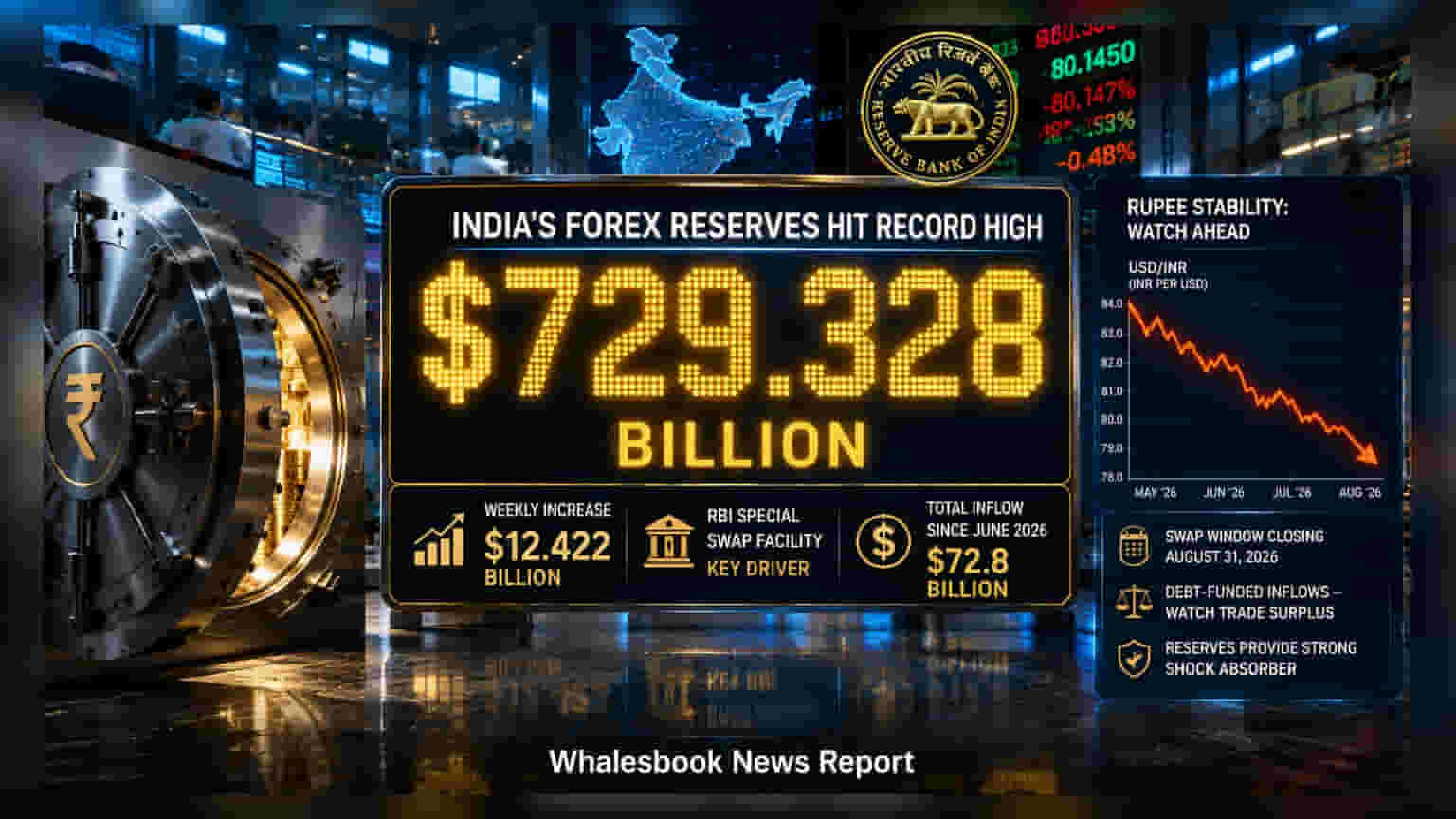
India’s foreign exchange reserves reached an all-time high of $729.3 billion for the week ending August 21, 2026. The surge was driven by the Reserve Bank of India’s temporary swap facility, which brought in significant foreign currency deposits. While this provides a cushion against currency volatility, investors are watching the August 31 deadline for the facility’s end, which may influence future rupee stability.
India's foreign exchange reserves reached a record high of $729.328 billion for the week ending August 21, 2026. This significant increase of $12.422 billion in just one week was primarily driven by the Reserve Bank of India’s (RBI) special swap facility. This facility, which was launched in June 2026, has been a key tool for the central bank to bring foreign currency into the country and stabilize the Indian rupee.
Role of the RBI Swap Facility
The central bank introduced this concessional swap facility to encourage banks to bring in foreign currency, particularly through Foreign Currency Non-Resident (FCNR) deposits. Since the launch of this program in early June 2026, it has successfully attracted about $72.8 billion in total inflows. A large portion of this, approximately $65.397 billion, has come through FCNR deposits. By offering a swap window, the RBI essentially provided banks an easier way to access foreign currency, which helped boost the total reserves quickly. In addition to these deposits, money also came in through external commercial borrowings and other overseas loans, which added another $7.451 billion to the profile.
Understanding the Risks and Future Outlook
While the record reserve level acts as a strong shock absorber against international market volatility and oil price shocks, some analysts point out that this growth relies on debt-funded incentives. These inflows are essentially liabilities that the country has taken on, rather than money earned through a surplus in trade. The RBI bears the costs of hedging these funds, which makes this an expensive way to build reserves compared to normal market operations.
The central bank has already moved to close this window, advancing the deadline to August 31, 2026, from the original September date. This indicates that the primary engine behind the recent surge is about to stop. As the facility closes, the market will be looking to see if the rupee faces renewed pressure. If the country does not see a rise in its actual trade surplus—meaning it is not earning more through exports than it spends on imports—the reliance on these temporary liquidity windows may leave the currency vulnerable once the incentives disappear. Investors will be tracking how the rupee performs once the swap window shuts and whether the current reserves are sufficient to handle potential future market stress.