

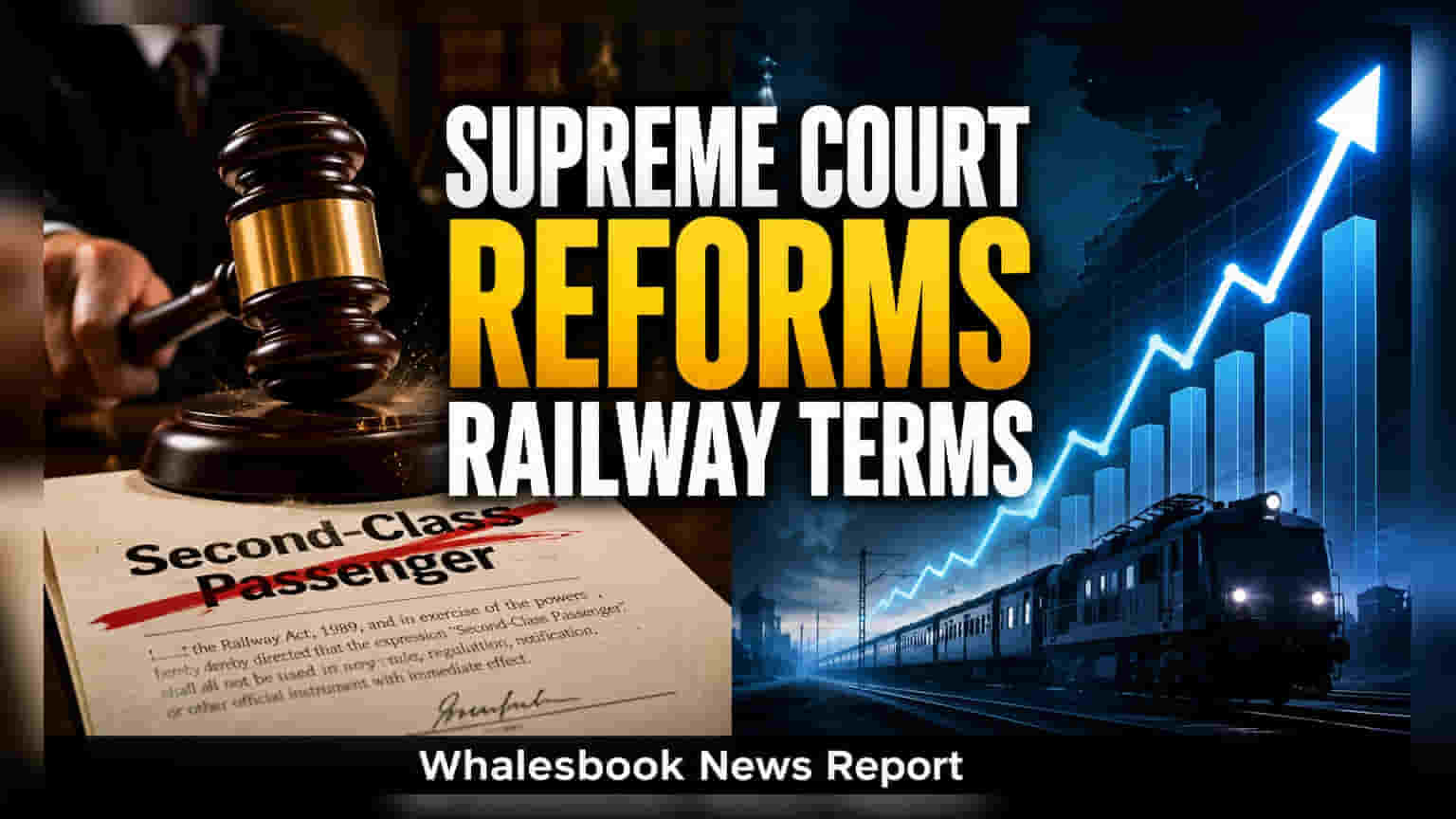
The Supreme Court has asked Indian Railways to stop labeling passengers as 'second-class,' stating the term violates constitutional equality. The court emphasized that class categories should apply only to train coaches, not to the people traveling in them. This directive was issued while awarding ₹8 lakh compensation in a case involving a passenger's death.
The Supreme Court has directed Indian Railways to stop using the term 'second-class passenger' in its operations and documentation. A bench comprising Justices Sanjay Karol and Nongmeikapam Kotiswar Singh noted that labeling citizens based on the fare they pay is offensive to the spirit of the Constitution of India. The court suggested that the term 'class' should remain strictly associated with the physical coach or compartment, rather than defining the status of the traveler.
This observation emerged while the court was hearing an appeal regarding a compensation claim for a passenger who died after falling from a train in 2015. In its judgment, the bench overturned lower court decisions that had denied compensation to the victim’s family due to technical issues, specifically the lack of a recovered ticket. The Supreme Court awarded ₹8 lakh in compensation, reinforcing that procedural technicalities should not prevent the railways from fulfilling its duty as a state instrumentality.
Welfare-Oriented Approach for Railways
Beyond the change in terminology, the court emphasized that Indian Railways must maintain a welfare-oriented approach. Under the Railways Act, 1989, the entity is expected to prioritize public service and citizen safety over narrow or strictly technical interpretations of the law. This ruling serves as a reminder to the organization to balance its administrative functions with its constitutional responsibility to protect the dignity of all citizens.
Indian Railways remains one of the largest public sector employers in the country, with a workforce of approximately 1.23 million people. As the backbone of Indian transportation, the network manages massive scale, having transported over 7.2 billion passengers in the 2024-25 period. Given this scale, legal rulings that impact operational policies often require significant administrative adjustments across the system. The court's focus on moving away from historical, hierarchical labels reflects a broader judicial push to modernize state-run services to align with contemporary standards of equality. Investors and stakeholders in the logistics and transport sector may monitor how these directives influence future railway policy, passenger service standards, and potential changes to ticketing terminology in upcoming official communications.