

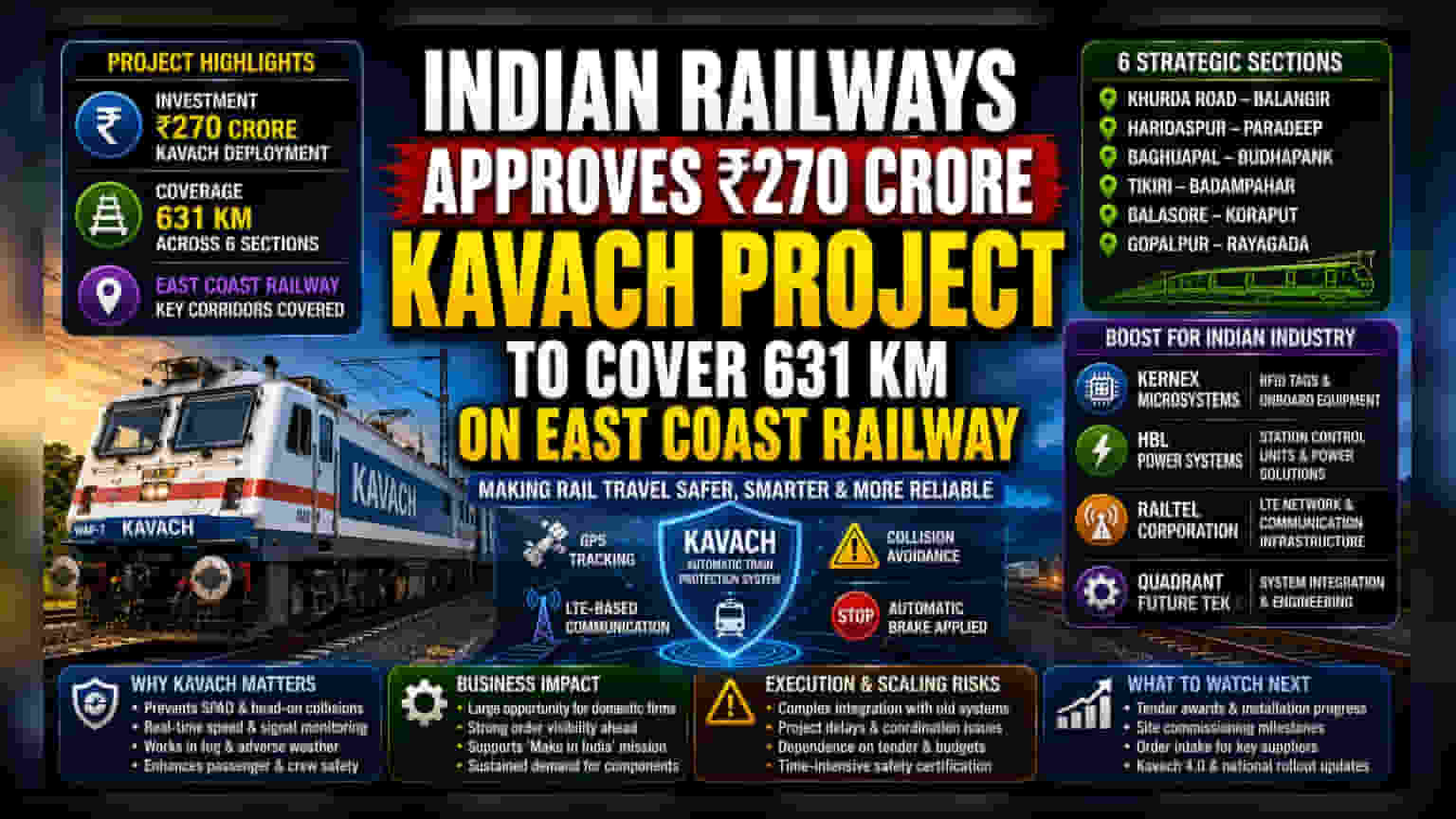
Indian Railways has sanctioned ₹270 crore to install the indigenous Kavach safety system across 631 route kilometers in the East Coast Railway zone. This rollout is part of a broader nationwide effort to improve train collision avoidance and signal safety. Investors are tracking how this acceleration impacts suppliers of railway signaling and safety electronics.
What Happened
Indian Railways has approved a project worth ₹270 crore to deploy its indigenous 'Kavach' safety technology across 631 route kilometers in the East Coast Railway (ECoR) zone. The initiative covers six strategic railway sections, including critical corridors like Khurda Road–Balangir, Haridaspur–Paradeep, and Baghuapal–Budhapank. The move aligns with the ministry’s ongoing mission to integrate LTE-based communication systems and collision avoidance technology across high-density and strategically important rail routes in India.
The Business Impact
The Kavach project involves significant manufacturing and integration requirements, creating potential opportunities for various domestic companies in the railway safety and signaling ecosystem. Key industry players that have been associated with Kavach implementation include firms like Kernex Microsystems, HBL Power Systems, RailTel Corporation, and Quadrant Future Tek. These companies are involved in providing essential components such as RFID tags, station-based control units, and onboard locomotive equipment. As the government continues to fast-track the nationwide rollout, companies with specialized capabilities in safety electronics and railway signaling may see sustained demand for their products and services.
Why Kavach Matters
Kavach is an Automatic Train Protection (ATP) system developed indigenously to enhance operational safety. It functions by continuously monitoring train speed and location, providing real-time signal information to the locomotive pilot. If a pilot fails to respond to a danger signal or exceeds safe speed limits, the system automatically activates the brakes. This is particularly important for preventing signal passing at danger (SPAD) and head-on collisions. Beyond core safety, the technology is designed to function effectively during adverse weather conditions like dense fog, which historically causes major service disruptions and reliability issues across the Indian rail network.
Execution And Scaling Risks
While the project expansion is positive, the rollout of such complex infrastructure across a vast, 68,000-kilometer rail network presents challenges. The process involves integrating new electronic systems with decades-old signaling infrastructure and requires precise coordination between trackside, station, and locomotive equipment. Previous implementation periods have highlighted that scaling the technology requires significant time, rigorous safety testing, and massive coordination across different railway zones. Any delay in procuring components, executing on-site installation, or achieving integration with older trains can affect project timelines. Additionally, because the sector is highly dependent on government tenders, the speed of execution is often tied to the consistency of budget allocation and policy support.
What To Watch Next
Investors tracking this sector may monitor the progress of tenders and actual installation milestones for these specific ECoR sections. The key monitorables include the pace of site commissioning, the order intake for key suppliers of Kavach components, and any management commentary regarding capacity utilization or margin trends in their signaling business units. Further, updates on the version upgrade, such as the transition to Kavach 4.0, and any broader government announcements regarding the pace of national-level rollout will remain important for gauging the long-term order visibility in this niche segment.