 Whalesbook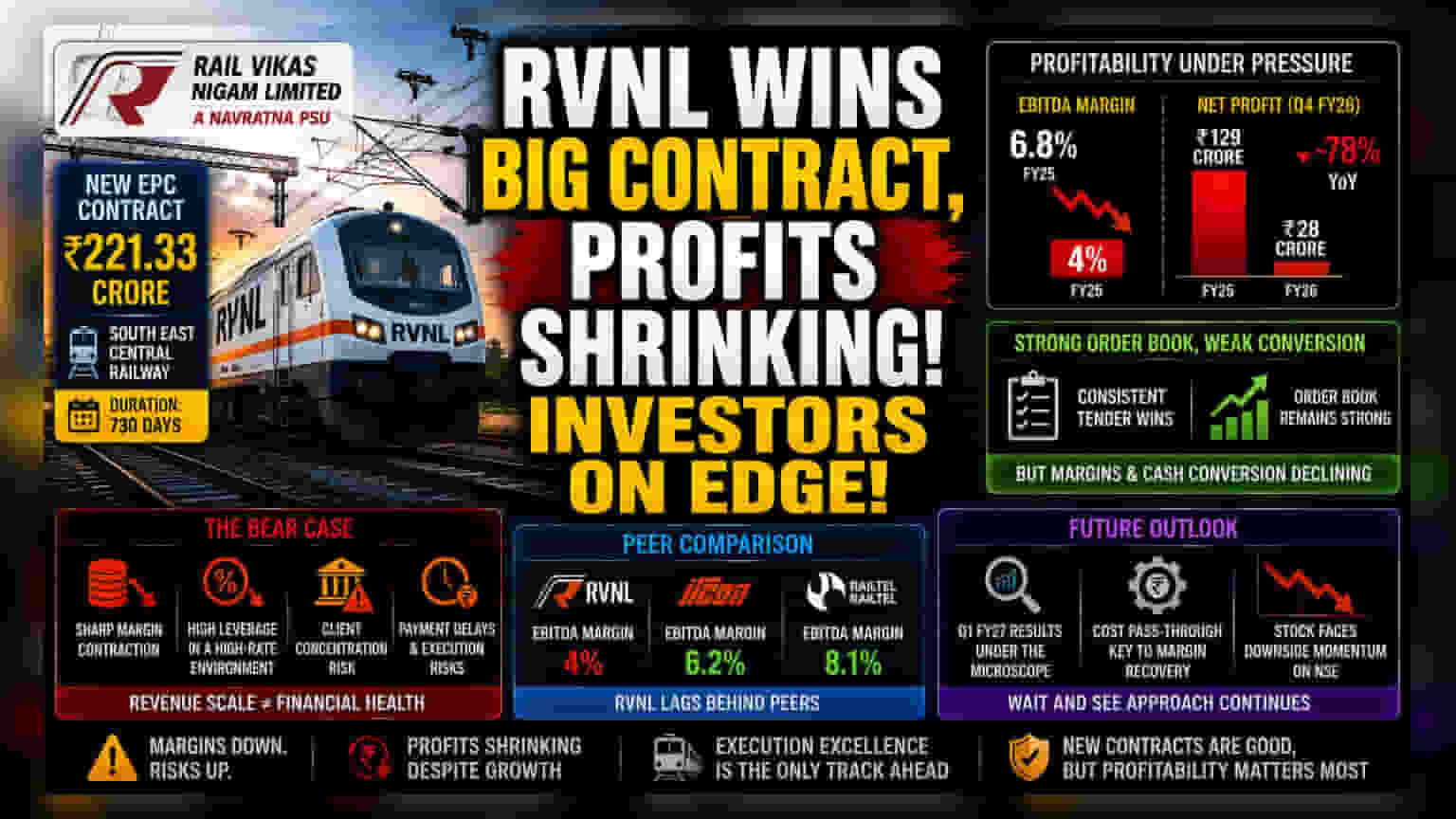


The Efficiency Paradox
While the ₹221.33 crore contract from South East Central Railway provides a necessary revenue tail, the deal structure highlights the mounting pressure on operational efficiency. Securing long-term EPC projects is standard for the Navratna entity, yet the recent 730-day mandate arrives at a moment where the firm is struggling to convert top-line growth into bottom-line gains. Despite revenue expansion, the company’s inability to defend its margin profile suggests that inflationary input costs and project execution overheads are outpacing the revenue generated by these new awards.
Order Book vs. Profitability
Comparing RVNL to its peers in the railway infrastructure sector, such as IRCON International or RailTel, reveals a industry-wide sensitivity to raw material price volatility. However, RVNL’s specific decline in EBITDA—shrinking from 6.8% to 4% year-on-year—stands out as a sharper contraction than some mid-cap engineering peers. The company has maintained a consistent flow of tender wins, including the recent Varanasi–Prayagraj traction project, yet the market is clearly prioritizing the deteriorating cash conversion cycle over the sheer volume of the order book. Investors are increasingly skeptical that these incremental wins can stabilize the profit trajectory in the current fiscal cycle.
The Forensic Bear Case
From a risk-averse institutional standpoint, the primary concern lies in the structural sustainability of RVNL’s execution model. The massive drop in net profit during the final quarter of FY26 serves as a warning that revenue scale is not equivalent to financial health. High leverage, often characteristic of heavy-capex PSU players, becomes a liability when interest rates remain sticky and project timelines encounter even minor regulatory or logistical delays. Furthermore, the reliance on state-led bidding processes introduces 'client concentration risk.' If the Indian Railways shifts its capital expenditure strategy or delays payment cycles for signaling upgrades, RVNL has limited levers to pull, given that a significant portion of its revenue is tied directly to government-funded infrastructure budgets.
Future Outlook
Market sentiment currently reflects a 'wait and see' approach as the stock faces downward momentum on the National Stock Exchange. Analysts are keeping a close watch on the first quarter results of FY27 to determine if the 4% margin level is a structural floor or a sign of deeper operational instability. Unless the company demonstrates an ability to pass through costs more effectively in its upcoming EPC bids, the stock may continue to struggle against the benchmark index, regardless of new contract announcements.