 Whalesbook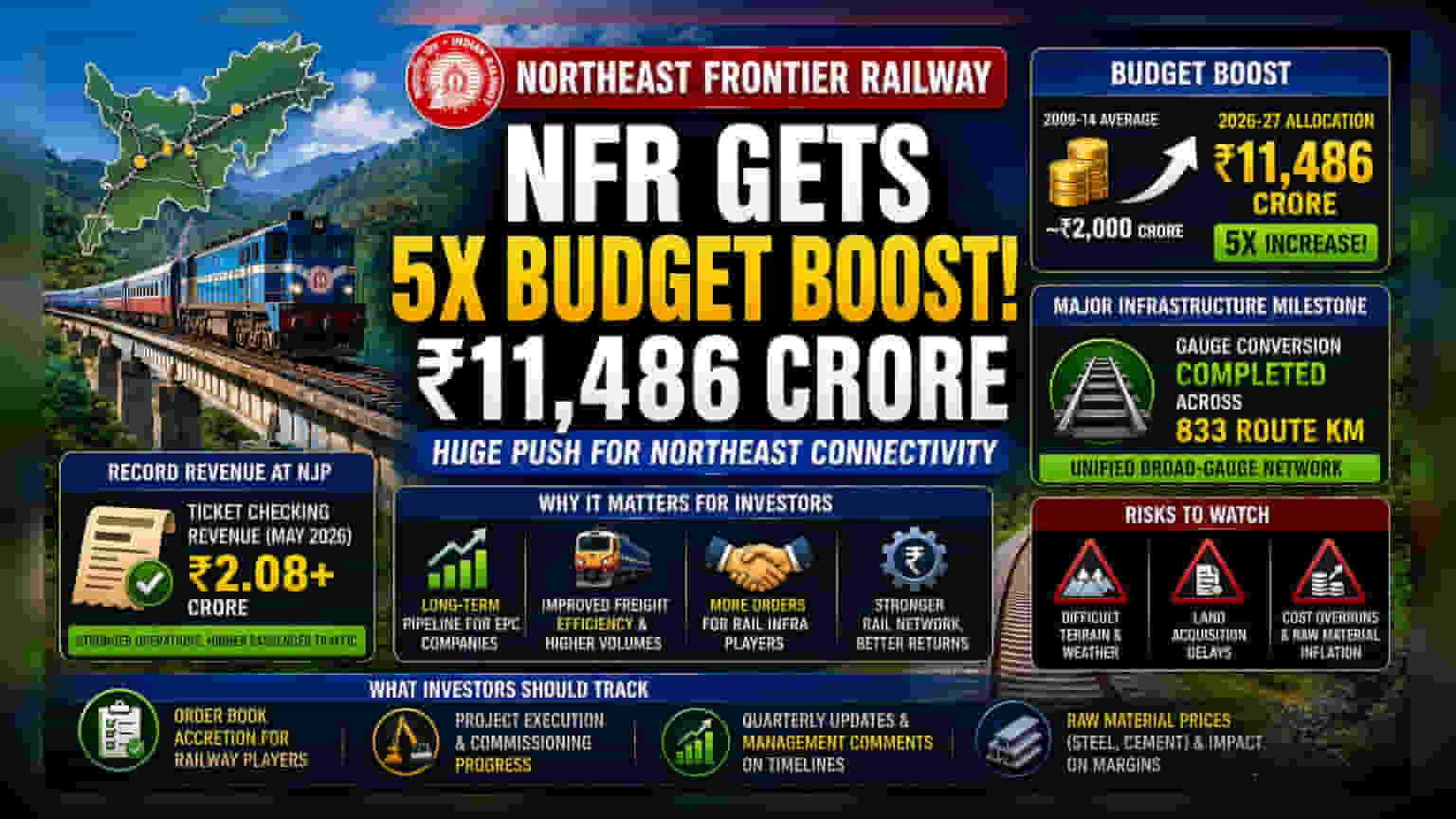


The Northeast Frontier Railway (NFR) budget for 2026-27 has surged fivefold to ₹11,486 crore, signaling a major government focus on connectivity. This funding supports crucial infrastructure, including the conversion of 833 route kilometers to broad gauge. For investors, this reflects a sustained order flow opportunity for railway engineering and construction firms (EPC). However, the focus remains on execution capabilities in challenging terrain, where project delays and high logistical costs have historically remained key monitorables.
What Happened
Northeast Frontier Railway (NFR) has announced a significant boost in its budgetary allocation for the 2026-27 financial year, reaching ₹11,486 crore. This is a fivefold increase compared to the average annual allocation of roughly ₹2,000 crore recorded between 2009 and 2014. The official update also highlights a major infrastructure milestone: the completion of gauge conversion across 833 route kilometers, creating a unified broad-gauge network across the region. Additionally, the ticket checking section at New Jalpaiguri (NJP) reported a record-breaking revenue of over ₹2.08 crore for May 2026, which indicates a rise in passenger movement and operational efficiency.
Why This Matters For Investors
For stock market investors, this substantial budget hike acts as a forward-looking indicator for the railway infrastructure sector. The government’s sustained commitment to the Northeast is not just a one-time event; it implies a long-term pipeline of work for Engineering, Procurement, and Construction (EPC) companies. Players involved in rail infrastructure, such as Rail Vikas Nigam Ltd (RVNL), IRCON International, and RITES, among others, often secure orders from such budget allocations. Increased spending on track laying, station modernization, and bridge construction typically translates into potential revenue visibility for these firms. Moreover, the shift to a broad-gauge system is operationally significant, as it improves freight efficiency and reduces transit times, which can lead to higher volume handling for the railways over time.
The Bigger Business Context
This funding surge is part of a larger structural push to integrate Northeast India into the national rail grid. Historically, connectivity in this region was hampered by fragmented networks and diverse gauges, which required passengers and freight to switch trains, leading to bottlenecks. The achievement of a unigauge system is a major efficiency improvement. For the business side, this means the region is better equipped to handle heavier freight and faster passenger trains, potentially increasing the revenue-earning capacity of the railway network in the long run.
What Could Go Wrong
While the funding is positive, executing railway projects in Northeast India carries inherent risks. The region is known for its difficult geographical terrain, including mountains and major river systems. Historically, infrastructure projects in such areas have been prone to cost overruns and timeline delays due to extreme weather conditions, such as heavy monsoons, and complex geological challenges. Another persistent risk in railway construction is land acquisition, which can often stall project progress despite allocated funds. Investors typically weigh these execution risks against the company’s ability to maintain profit margins while dealing with potential inflation in raw material costs.
What Investors Should Track
Moving forward, investors may want to monitor the pace of project commissioning rather than just the announcement of new funds. Key indicators to watch include the actual order book accretion for listed railway contractors, the progress of ongoing projects as reported in quarterly filings, and management commentary regarding execution timelines in difficult terrains. Additionally, any updates on raw material costs, such as steel and cement, will be important, as these directly impact the profit margins of construction companies involved in these large-scale railway projects.