

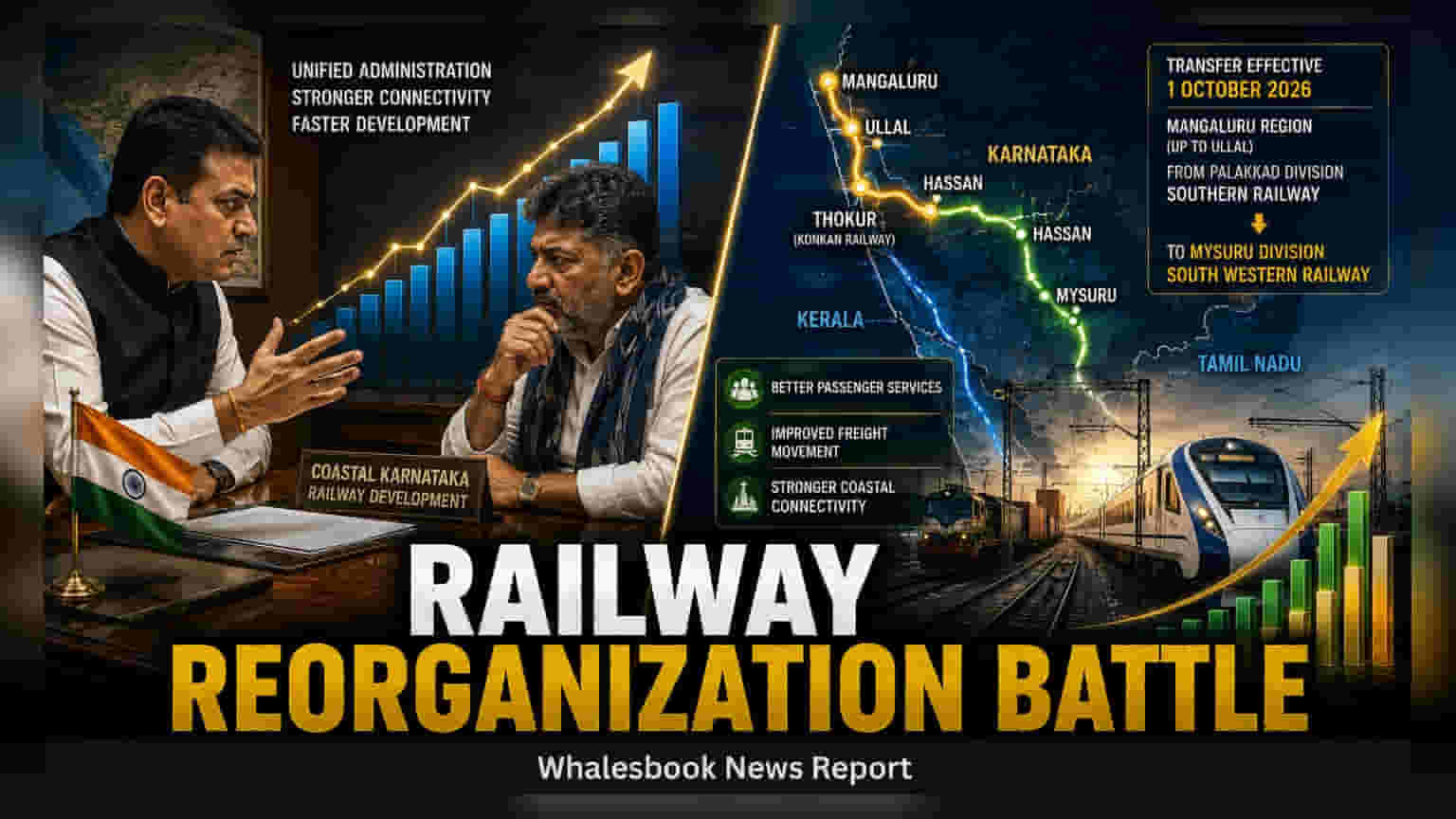
The Railway Board has officially decided to move the Mangaluru railway jurisdiction to the Mysuru Division, effective October 1, 2026. While officials claim this will improve administrative and operational efficiency for coastal Karnataka, the move has triggered opposition from Kerala over potential revenue losses.
The Railway Board has finalized the administrative transfer of the Mangaluru railway region, extending up to and including Ullal, from the Palakkad Division of Southern Railway to the Mysuru Division of South Western Railway. This significant change is scheduled to take effect on October 1, 2026.
Dakshina Kannada Member of Parliament Capt. Brijesh Chowta has actively sought support from the Karnataka government to ensure the transition proceeds smoothly. The MP has urged Karnataka Chief Minister DK Shivakumar to formalize the state's position in favor of the shift, emphasizing that unified administrative control is essential for the growth of coastal Karnataka’s rail infrastructure. Currently, the fragmentation of railway administration across different zones is often cited as a hurdle to cohesive planning and faster infrastructure development.
Benefits of Unified Oversight
The primary objective of this transfer is to align the railway network in coastal Karnataka with the Mysuru Division, which already oversees the vital Hassan-Mangaluru rail corridor. By bringing the coastal region under a single administrative umbrella, authorities aim to streamline passenger services, improve freight movement, and accelerate the development of rail facilities. This is expected to create a more efficient corridor connecting the state's interior directly to the coast and the New Mangalore Port, reducing coordination bottlenecks that have previously affected operations.
Inter-State Friction and Concerns
Despite the push for administrative rationalization, the decision has met with resistance from Kerala. The Chief Minister of Kerala and other representatives from the state have formally opposed the move, describing it as unilateral. Their concerns primarily revolve around the potential loss of revenue and development focus for the Palakkad Division, which currently manages these assets. Protesters from the neighboring state have expressed worry that the separation could negatively impact the financial health of the Southern Railway’s Palakkad wing.
In response to these concerns, railway officials have clarified that the restructuring is an administrative exercise designed for operational efficiency. They have stated that the move does not involve the transfer of any stations located within Kerala, aiming to keep the impact localized to the Karnataka sector. Under the new arrangement, the Thokur railway station will remain under the jurisdiction of the Konkan Railway Corporation, serving as a critical interchange point.
What Lies Ahead
For residents, traders, and logistics providers in the region, the next few months will be a transitional phase. Investors and local stakeholders will be watching how the Railway Board manages the transfer of staff and assets to ensure that daily train services and passenger quotas are not disrupted during the shift. The focus will remain on whether this administrative realignment leads to the promised improvements in infrastructure and freight capacity or if the inter-state disagreement creates hurdles for long-term railway development projects in the coastal region.