

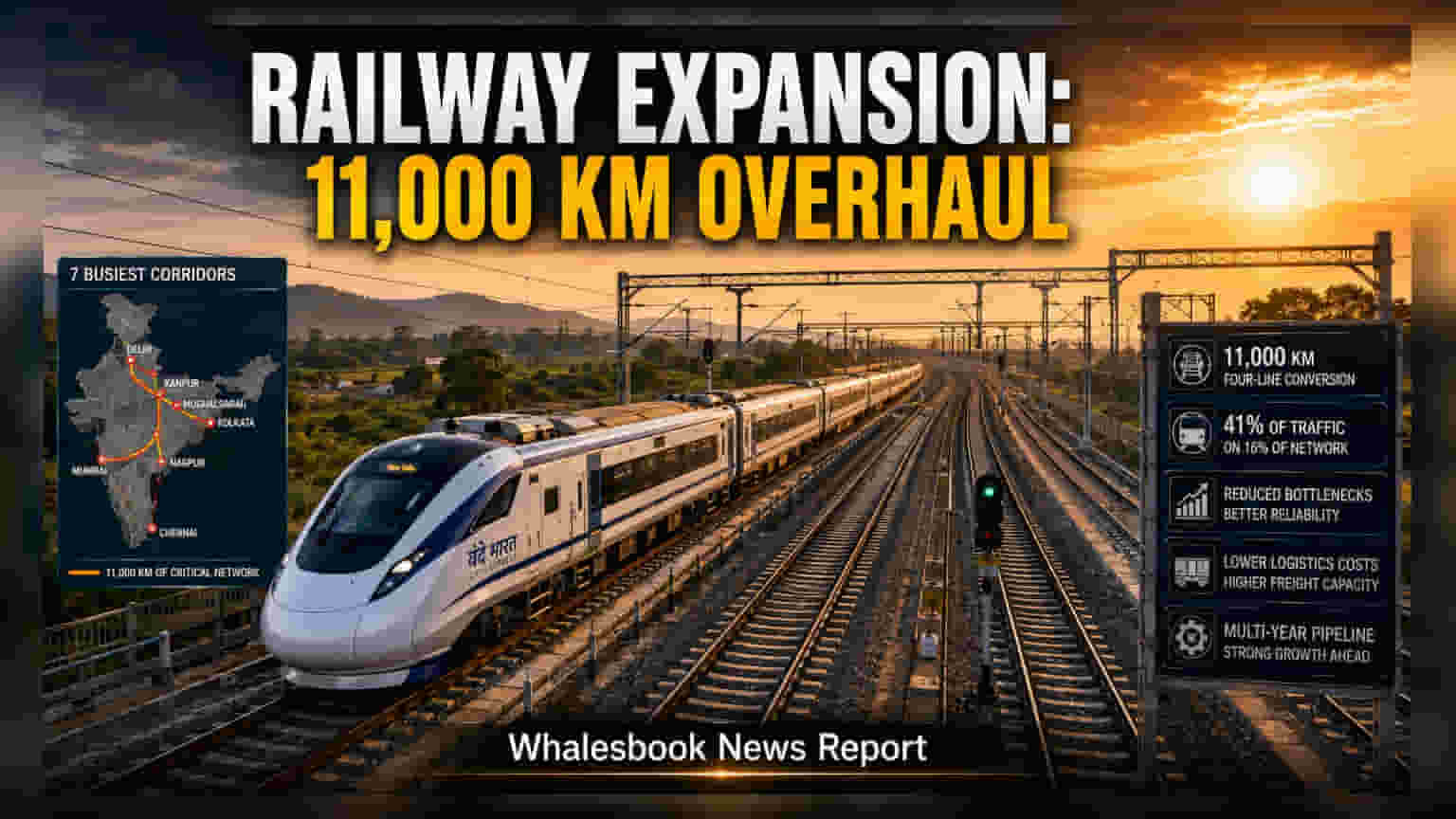
The government has announced plans to upgrade seven high-density railway corridors, spanning 11,000 kilometers, into four-line networks. This massive infrastructure effort aims to tackle severe congestion and lower logistics costs across the nation. For investors, the initiative highlights potential long-term growth for railway infrastructure, construction, and equipment suppliers, though execution risks related to land acquisition and ongoing operations remain significant factors.
The Ministry of Railways has announced an ambitious infrastructure expansion to convert seven of India’s busiest rail corridors into four-line networks. Spanning 11,000 kilometers, these routes are critical to the national economy, currently handling 41% of all rail traffic despite accounting for only 16% of the country’s total network. The initiative is a strategic move to separate passenger and freight traffic, which is expected to reduce bottlenecks and improve the reliability of train schedules.
From an economic perspective, the primary goal is to reduce national logistics costs, which have long been identified as a challenge for Indian manufacturing and trade. By expanding track density, the railways aim to move heavier, longer, and more frequent freight trains, which enhances the efficiency of rail as a transportation mode compared to road freight. For the broader market, this signals a massive, multi-year pipeline for the railway infrastructure sector.
Investors tracking the infrastructure and capital goods sectors may view this as a long-term growth signal. Companies involved in construction, engineering, procurement and construction (EPC) services, signalling systems, and rolling stock manufacturing are likely to be the primary beneficiaries as tenders for these projects are released. The sustained government spending on railway upgrades typically supports revenue visibility for players across the construction and railway supply chain, including steel and cement manufacturers.
However, large-scale infrastructure projects of this nature carry significant execution risks. A major challenge involves upgrading infrastructure on high-density, active lines without disrupting the daily flow of passenger and freight services. Past experience with such projects indicates that managing construction in already crowded corridors is operationally complex and can lead to time overruns. Furthermore, land acquisition remains a standard hurdle for large-scale rail expansion in India, which can delay project completion and increase total costs.
From a financial viewpoint, the scale of this project necessitates substantial capital spending. While this drives economic growth and improved logistics, it also places focus on the government's fiscal management. For investors, the next critical updates to monitor will be the release of specific tender timelines, the total budgetary allocation for these corridors, and the pace of land acquisition. Market participants will also track how quickly these projects move from planning to actual commissioning, as the transition to four-line corridors is essential for long-term freight and passenger capacity growth.