

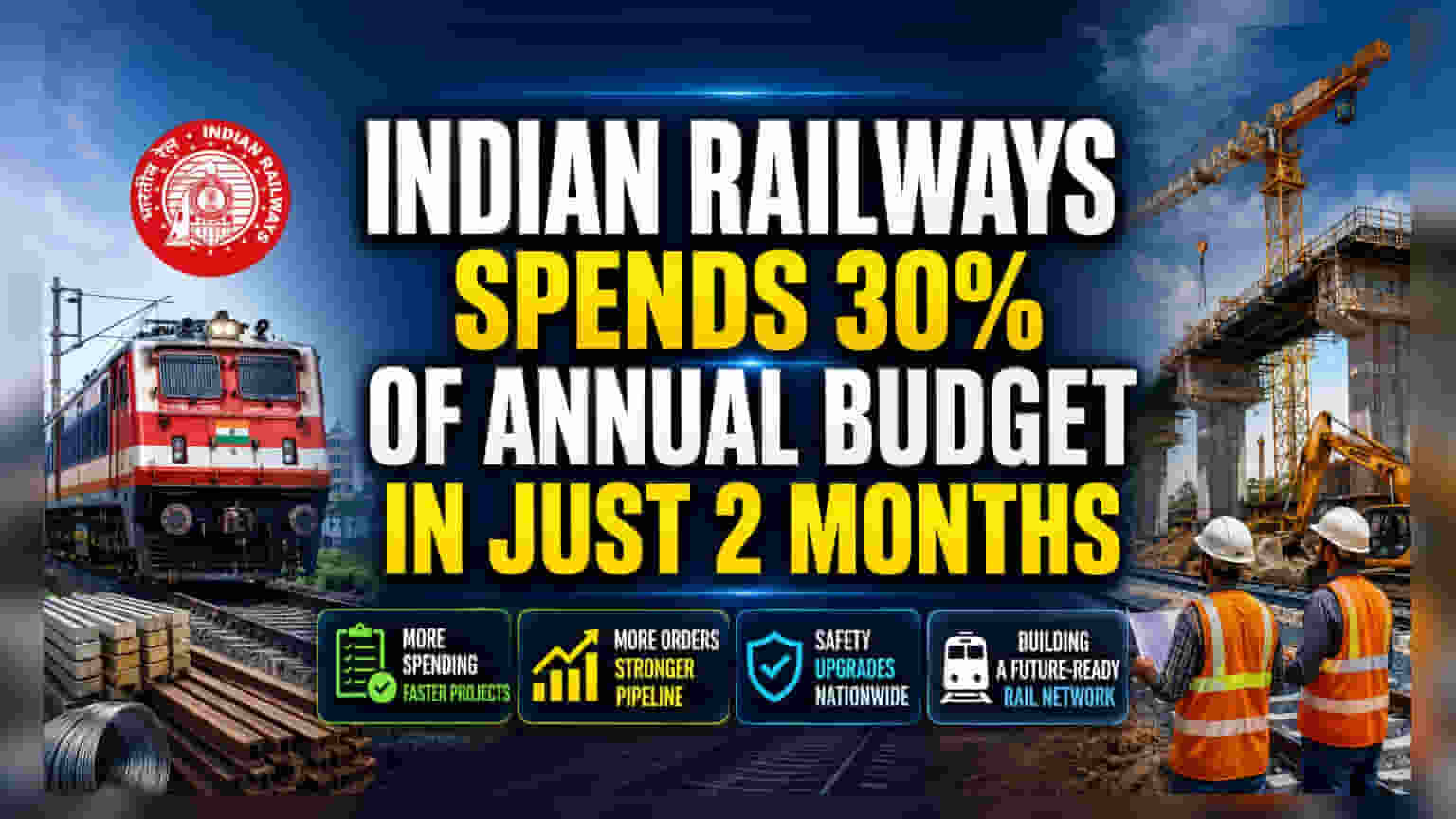
Indian Railways has deployed ₹84,000 crore of its annual budget within April and May 2026, marking a fast start to its ₹2.81 lakh crore capital spending plan. This aggressive pace aims to boost infrastructure and safety, which directly impacts the order flow and project execution timeline for listed railway construction and rolling stock companies.
What Happened
Indian Railways has accelerated its spending in the first two months of the 2026-27 financial year, utilizing nearly 30% of its total annual capital expenditure (capex) budget. Official data shows that approximately ₹84,000 crore has already been deployed by May 2026. The government has set a gross budgetary support target of ₹2,81,030 crore for the full year, with total planned expenditure reaching ₹2,93,030 crore when including extra-budgetary resources. This front-loading of funds is aimed at prioritizing critical safety upgrades, new line construction, and track modernization across the country.
Why This Matters for Investors
For investors, the speed at which the Railways deploys its budget is a key indicator of activity levels in the sector. When the government accelerates spending, it typically translates into faster project execution and quicker order awarding for private sector players. Companies involved in railway construction, signalling, and the supply of rolling stock—such as wagons, coaches, and locomotives—are direct beneficiaries of this capital outlay.
Potential Impact on Rail Companies
The railway infrastructure sector comprises several listed companies that rely on government orders. Construction and engineering firms, such as Rail Vikas Nigam Ltd (RVNL) and IRCON International, generally benefit from the focus on new track construction and gauge conversion. Similarly, manufacturers of rolling stock and components, such as Titagarh Rail Systems and Texmaco Rail & Engineering, often see demand cycles aligned with these railway spending trends. When the Railways spends its budget early in the year, it creates a pipeline of work that can support the revenue visibility for these companies over the coming quarters.
Risks and Execution Challenges
While the accelerated spending is a positive sign, investors should be aware of the inherent risks in this sector. The most significant challenge remains the 'execution risk.' Even if the government has the budget, delays in land acquisition, environmental clearances, or site handover can stall projects.
Additionally, companies in this space are highly sensitive to raw material price fluctuations. Since railway projects are often long-term, sharp increases in the prices of steel, cement, copper, or aluminium can compress profit margins if the contracts do not have adequate price-escalation clauses. Investors should also watch for 'working capital' risks, as payment delays from government entities can sometimes stretch the balance sheets of smaller suppliers and contractors.
What Investors Should Track
Moving forward, the primary monitorable is whether this early-year spending momentum is sustained. Investors should track:
- Order Book Conversions: Watch if the announced spending is actually turning into completed orders for listed companies.
- Margin Stability: Observe the quarterly results of rail-related companies to see if they are effectively managing raw material costs amidst the rapid project execution.
- Receivables Days: Monitor the 'days sales outstanding' or trade receivables in company balance sheets to check if payments from the Railways are being received on time.
- Project Commissioning: Follow updates on actual project timelines versus the promised dates, as cost overruns due to delays are common in large infrastructure projects.