

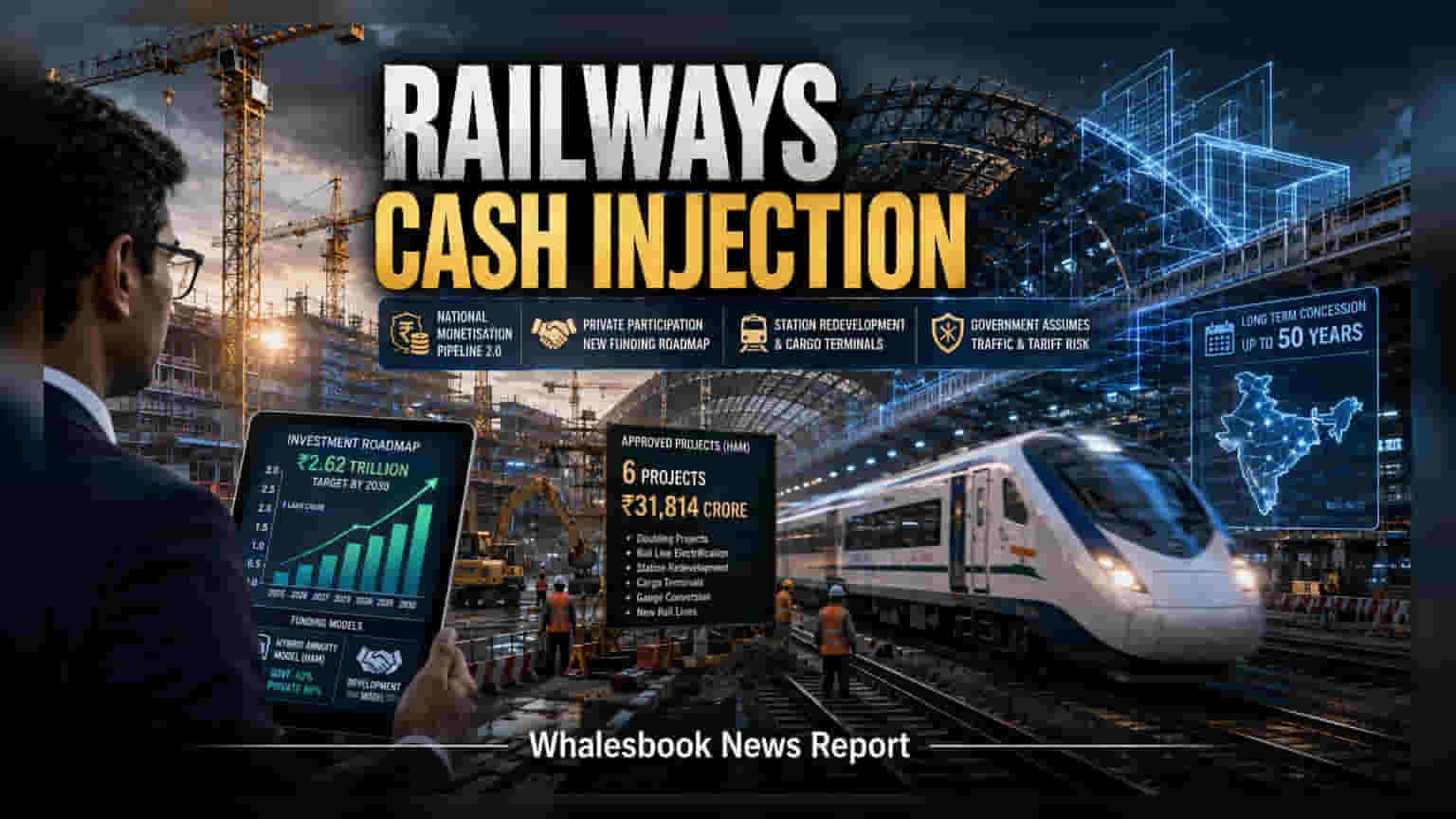
Indian Railways is adopting Hybrid Annuity and Development Partner models to attract private funding for a ₹2.62 trillion project pipeline. This policy shift aims to lower risk for private developers and accelerate infrastructure projects, opening new bidding opportunities for major construction and engineering firms.
Indian Railways has officially launched a new funding roadmap under the National Monetisation Pipeline 2.0, targeting ₹2.62 trillion in investment by leveraging private participation. The strategy shifts away from traditional EPC (Engineering, Procurement, and Construction) contracts to the Hybrid Annuity Model (HAM) and the Development Partner Model, aiming to attract private capital into projects that were previously difficult to fund.
Under the Hybrid Annuity Model, which has proven successful in the national highway sector, the government assumes the traffic and tariff risks. The government will cover 40% of the construction cost upfront, while the private partner funds the remaining 60%. This structure is designed to insulate private developers from the uncertainty of passenger or freight volumes, making these railway projects more attractive for bank financing. The Public Private Partnership Appraisal Committee has already approved this framework for six rail projects with an estimated cost of ₹31,814 crore.
This shift is significant for listed infrastructure, construction, and railway-focused companies. Unlike the past, where project risks were largely borne by contractors, the new models provide a structured payment framework. Companies such as Larsen & Toubro, KEC International, Rail Vikas Nigam Limited, and IRCON International may find new opportunities as these tenders are released. Additionally, firms focused on station redevelopment and cargo terminal construction are expected to be key participants in the bidding process.
While the policy aims to unlock capital, there are structural risks that investors should monitor. Unlike road projects, railway infrastructure involves high-stakes operational safety, signaling, and network synchronization. Balancing private involvement with the government's need to maintain absolute control over core operations like safety and scheduling remains a complex challenge. Furthermore, the success of these projects depends heavily on the government's ability to complete land acquisition and obtain necessary clearances on time, as historical delays in these areas have frequently led to cost overruns in the past.
The financial health of these projects will also depend on the government’s ability to maintain a consistent annuity payment schedule without putting long-term pressure on its budget. As the national transporter moves toward this commercialized architecture, the key monitorable for the market will be the timeline for the first set of project tenders and the interest levels shown by large private developers. Investors may also watch for further updates on the concession terms, which are expected to extend up to 50 years to improve project viability.