

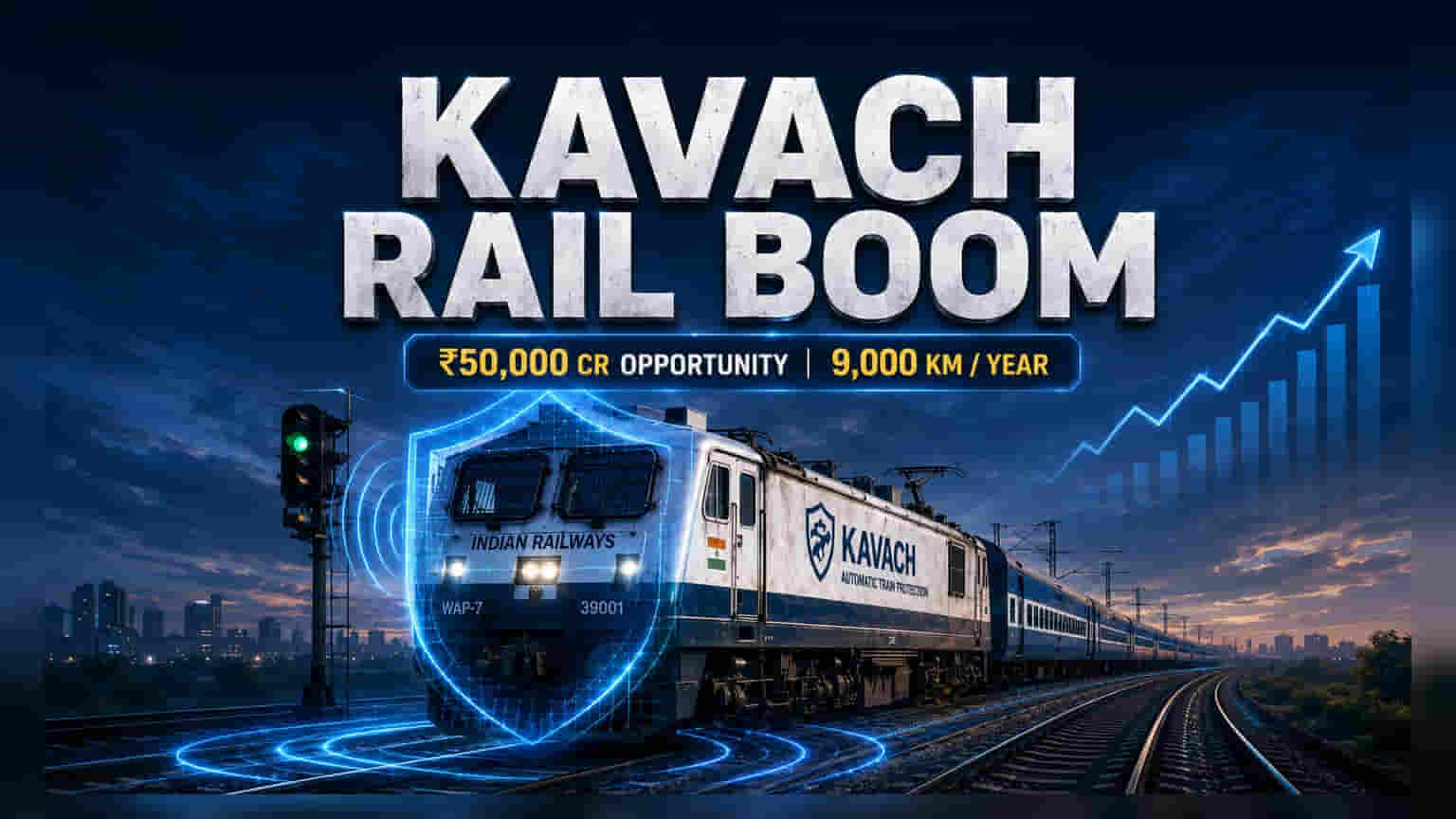
Indian Railways is accelerating its ₹50,000 crore Kavach safety system implementation, creating a pipeline of orders for firms like Kernex Microsystems, Concord Control Systems, and HBL Engineering. While the scale of these projects is significant, investors should focus on how these companies manage working capital needs and execute on long-term orders rather than just the order book size.
What Happened
Indian Railways is scaling up the installation of the indigenously developed Kavach Automatic Train Protection system. This technology, designed to prevent train collisions by automatically applying brakes, is now a top priority. As of March 2026, the network has 3,103 route kilometers covered by the system, with active implementation underway across another 24,427 kilometers. The government aims to add 9,000 route kilometers annually over the next two years, fueling a market opportunity estimated at ₹50,000 crore. This long-term investment cycle has brought significant attention to railway-focused technology and engineering firms.
The Players and Their Order Books
Several companies are key to this rollout, but each brings a different financial profile to the table. Kernex Microsystems has established a position in Kavach production with a reported order book of ₹4,150 crore as of May 29, 2026, which the company suggests provides about a decade of revenue visibility. It recently secured a ₹475.2 crore order from Chittaranjan Locomotive Works. However, investors may note that while its revenue grew significantly by 126.7% in FY26, there are signs of working capital pressure, with rising inventory levels and trade receivables.
Concord Control Systems is positioning itself as a high-margin technology provider. With a total order book of ₹697 crore as of March 31, 2026—including a new set of orders worth ₹279.9 crore secured in May 2026—the company expects EBITDA margins between 25% and 30%. Its business model includes 15-year maintenance contracts, which generally help provide a more predictable, recurring revenue stream compared to pure equipment sales.
HBL Engineering has been a pioneer in this space since 2005. It successfully demonstrated the Kavach 4.0 system in 2024 and received certification in 2025. Its remaining order book stood at ₹5,748 crore as of June 22, 2026. The company estimates that Kavach-related sales could contribute between ₹1,300 crore and ₹1,500 crore annually between FY26 and FY28.
Risks and Financial Realities
It is important for investors to understand that winning large orders is only the first step. The railway technology sector is capital intensive. As seen with Kernex Microsystems, rapid revenue growth does not always equate to immediate cash flow. High trade receivables and large inventory requirements can strain liquidity, meaning companies might need to spend more on working capital before they see the profit in their bank accounts.
Furthermore, the execution of these projects is subject to stringent railway safety certifications and site-readiness. Delays in site availability or technical hurdles with system integration can push revenue recognition further into the future. Investors should be wary of assuming that order book size will translate into linear earnings growth, as project timelines can shift.
What Investors Should Track
Moving forward, the primary monitorable is the speed of physical execution. Simply having an order is not enough; the market will look for the conversion of these orders into actual revenue and free cash flow. Key factors to observe include the pace of route kilometer commissioning, the ability of these companies to maintain their profit margins amidst competitive bidding, and how effectively they manage their working capital cycles to ensure that rapid growth does not lead to a liquidity crunch.