

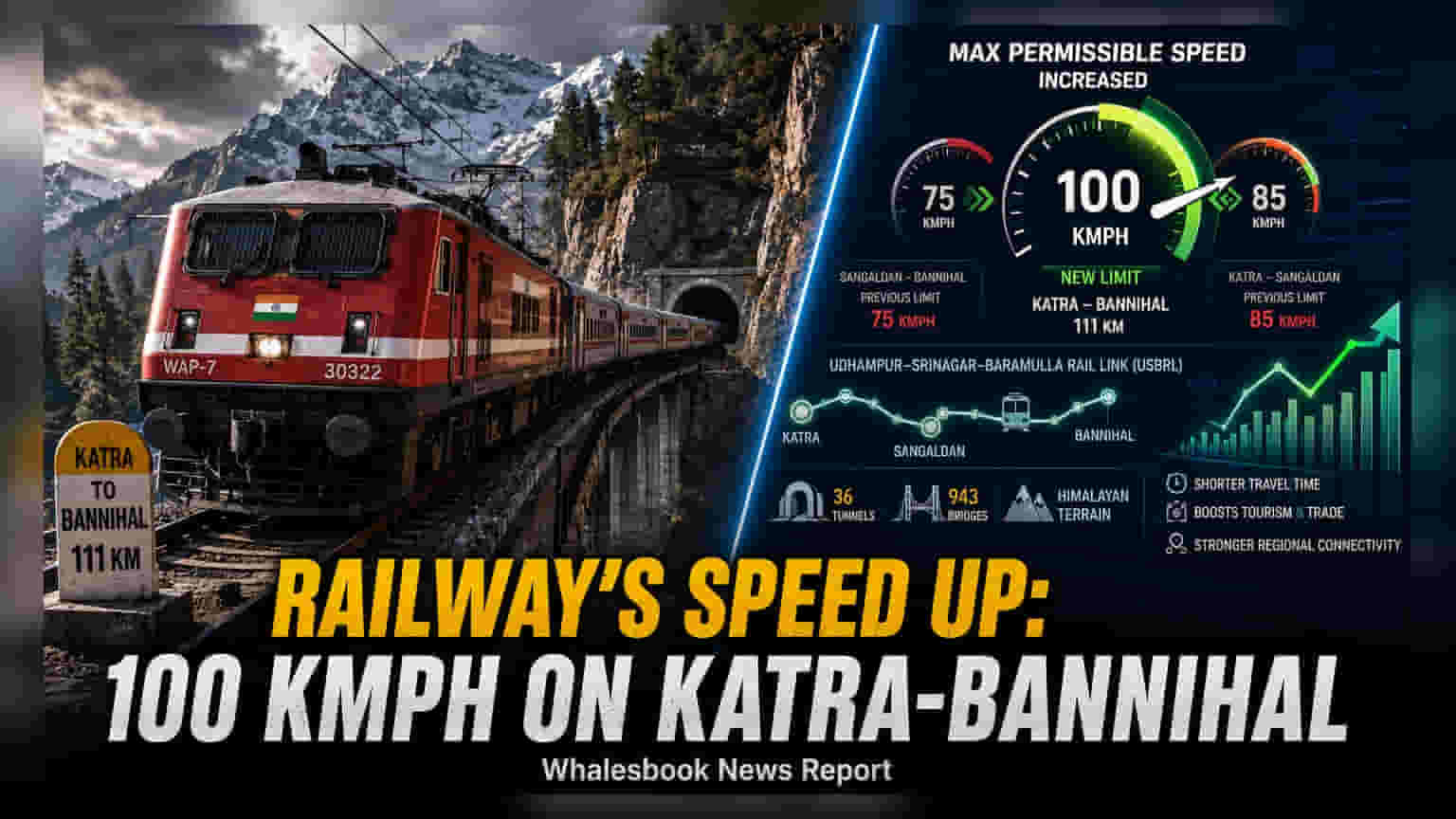
The Ministry of Railways has approved a speed increase to 100 kmph on the 111-km Katra-Banihal rail section in Jammu and Kashmir. This upgrade aims to improve travel efficiency and connectivity in the region, which is a key part of the larger Udhampur-Srinagar-Baramulla rail project. While this boosts operational capacity, the route continues to face geological and maintenance challenges typical of Himalayan infrastructure.
The Ministry of Railways has officially sanctioned an increase in the maximum permissible train speed to 100 kmph on the 111-kilometer rail stretch connecting Katra and Banihal. This decision comes after a thorough assessment of safety standards and technical readiness along the route. For passengers, this change is expected to result in shorter travel times and more reliable connectivity through the difficult Himalayan terrain of Jammu and Kashmir.
Previously, speed limits on this section were capped at 85 kmph for the Katra-Sangaldan segment and 75 kmph for the Sangaldan-Banihal stretch. By allowing higher speeds, Northern Railway aims to optimize the utilization of this infrastructure, which is a critical segment of the Udhampur-Srinagar-Baramulla Railway Link (USBRL) project. This project is widely recognized as one of the most challenging engineering feats in the country, involving numerous tunnels and bridges, including the iconic Chenab Bridge.
From an economic perspective, the enhancement is aimed at fostering tourism, trade, and economic activity in the region. Faster and more efficient rail travel often serves as a catalyst for local businesses, as it improves the movement of goods and people to and from previously difficult-to-reach areas. The government has prioritized this connectivity as part of its broader infrastructure development goals for the Union Territory.
However, operating rail lines in this region presents unique long-term risks. The geological nature of the Himalayas—prone to landslides and unstable slopes—requires continuous investment in infrastructure maintenance and safety monitoring. Ensuring the integrity of the tracks and tunnels is a perpetual task for engineers.
Financially, the Indian Railways operates under high pressure, with operating ratios often hovering around the 98% mark. This means that for every 100 rupees earned, nearly 98 are spent on operations, leaving little internal surplus. Consequently, projects of this scale rely heavily on government budgetary support and long-term borrowing to fund capital expenditure. Investors and policymakers tracking the sector often look at how efficiently such new, high-cost assets are maintained and utilized to justify the massive initial spending. The next phase of development for the region will likely depend on maintaining these safety and speed benchmarks while managing the high maintenance costs associated with this complex rail network.