 Whalesbook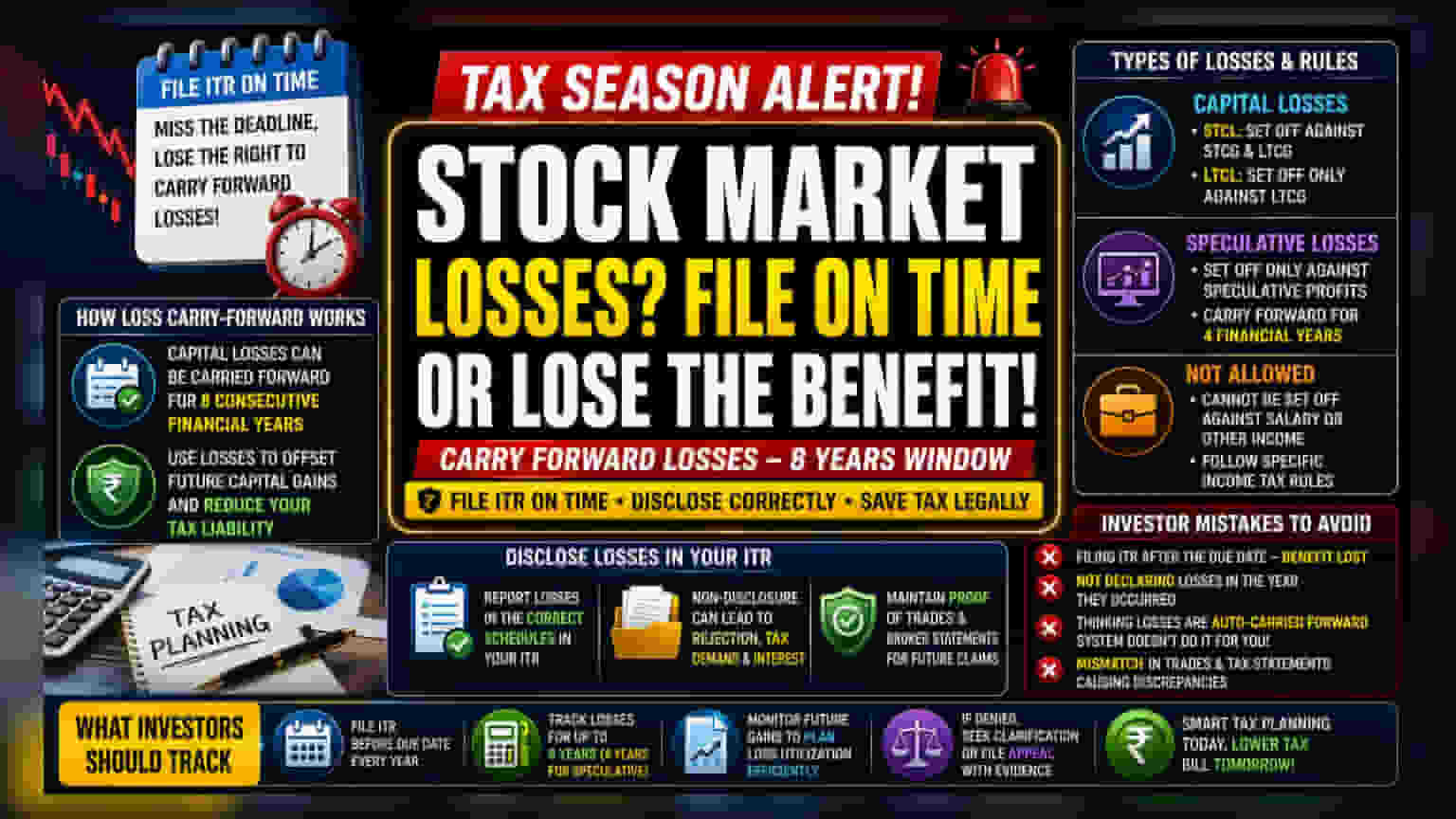
If you had losses in the stock market, filing your Income Tax Return (ITR) before the due date is mandatory to carry them forward. Missing this deadline prevents you from using those losses to lower your tax bill on future profits for up to eight years.
What Happened
For many stock market participants, tax season is often focused on reporting profits. However, reporting losses is equally important for tax planning. To carry forward losses from the stock market to future financial years, taxpayers must file their Income Tax Return (ITR) by the official due date. If the return is filed after the deadline, the income tax rules generally restrict the ability to carry forward these losses, effectively ending the opportunity to use them to offset future tax liabilities.
How Loss Carry-Forward Works
The Income Tax Department allows investors to carry forward losses to offset future gains, acting as a tax shield. For capital losses, this facility is available for eight consecutive financial years. This means if you incurred a loss in the current year, you can use it to reduce your taxable capital gains for the next eight years. For instance, if you have a net capital loss in the current financial year, it can be carried forward and adjusted against eligible capital gains in subsequent years until the loss is exhausted or the eight-year period expires.
Capital Gains Versus Speculative Losses
Investors must understand the distinction between different types of losses as the rules for adjustment vary. Short-term capital losses can be set off against both short-term and long-term capital gains. However, long-term capital losses are more restricted and can only be set off against long-term capital gains.
Speculative losses, which often arise from intraday trading, follow stricter rules. These losses can only be set off against speculative profits. Furthermore, the carry-forward period for speculative losses is limited to four financial years, which is shorter than the eight-year period allowed for standard capital losses. These losses cannot be set off against income from other sources like salary or house property.
Why Disclosure is Critical
Simply knowing you have a loss is not enough. You must properly disclose these losses in your ITR. The Income Tax Department requires specific reporting of these figures in the tax schedules provided in the ITR forms. If an investor fails to declare these losses in the return filed for the year they occurred, the department may disallow the claim when the investor tries to set them off against profits in future years. This often results in the tax department issuing notices to demand tax and interest on the adjusted amounts.
Investor Mistakes to Avoid
One common error is assuming that the tax system automatically tracks losses. The Income Tax portal does not automatically carry forward losses from previous years unless the taxpayer has declared them in the returns for those years. Another frequent mistake is filing a belated return. If you file your ITR after the due date, you generally lose the benefit of carrying forward business or capital losses. Investors should ensure they reconcile their trades with the tax statements provided by their brokers before filing to avoid discrepancies in reported figures.
What Investors Should Track
Investors should keep their annual tax statements and trading reports handy while preparing their ITR. The key monitorable for taxpayers is to ensure that the ITR is filed well within the deadline. If there are disputes or if the tax department denies the carry-forward due to technical reasons, taxpayers have the option to seek clarification or file an appeal, provided they have proof of timely filing and proper disclosure. Regularly maintaining a record of losses for the last eight years helps in tracking how much can still be used to offset future tax bills.

