

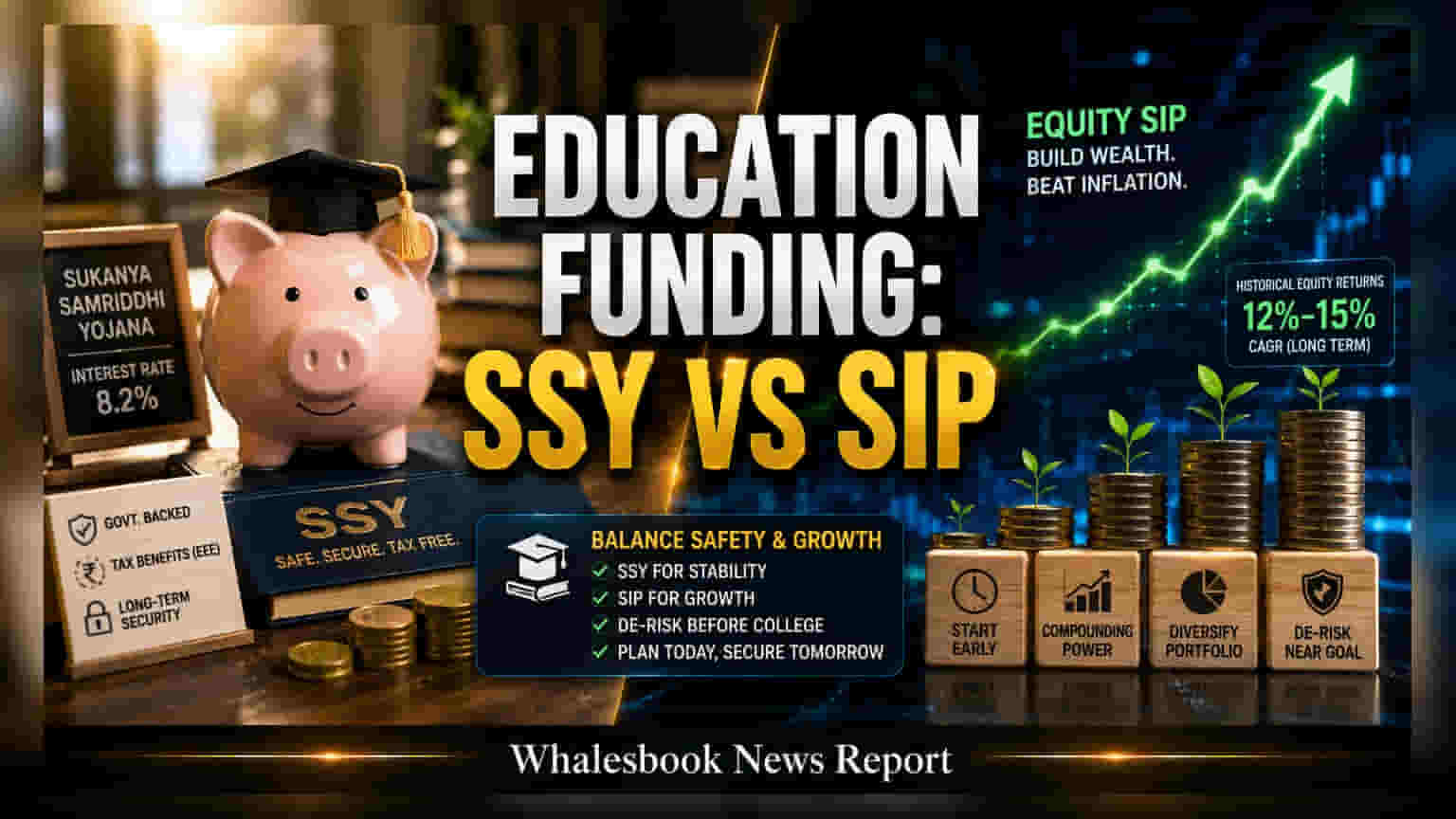
Rising education costs make simple savings insufficient, requiring a mix of stable government schemes and market-linked growth. Financial planners often suggest using the Sukanya Samriddhi Yojana for stability, paired with equity SIPs to fight inflation. A gradual shift from growth assets to safe options as the target date approaches helps protect the final fund.
The rising cost of higher education is forcing many parents to rethink how they save for their children's future. With education inflation in India consistently running between 8% and 12% annually, a course that costs ₹30 lakh today could easily exceed ₹80 lakh in 15 years. To bridge this gap, financial experts often suggest a dual strategy that balances the guaranteed safety of government schemes with the wealth-creation potential of the stock market.
The Role of SSY as a Stable Anchor
The Sukanya Samriddhi Yojana (SSY) serves as a common cornerstone for long-term education planning, particularly for girl children. As of the second quarter of the 2026-27 financial year, the scheme offers an interest rate of 8.2%. Beyond the interest, it provides tax benefits under the EEE (Exempt-Exempt-Exempt) status, meaning deposits, interest earned, and maturity proceeds are tax-free. However, SSY has strict limitations. It allows a maximum annual deposit of ₹1.5 lakh and features a long lock-in period. Because withdrawals for education are permitted only after the beneficiary turns 18 and are capped at 50% of the balance, it cannot be the only source of funds for immediate tuition payments.
Why Equity SIPs Are Essential
While debt instruments like SSY provide security, they often struggle to outperform inflation over long periods. To combat the 8-12% education inflation, many financial planners advocate for Systematic Investment Plans (SIPs) in equity mutual funds. Equity markets have historically provided higher returns than debt over long horizons, making them the primary engine for capital appreciation. By starting SIPs early, parents can benefit from the power of compounding, which allows the corpus to grow significantly more than simple interest-bearing accounts.
Managing Risk Near the Goal
A common mistake in education planning is keeping too much money in volatile equity markets right before the fees are due. If the market dips just as the college admission season begins, it can lead to a shortfall. This is known as the sequence-of-return risk, where poor market performance near the end of an investment term hits the final corpus hard. To mitigate this, experts suggest a de-risking process. About three to five years before the child enters college, it is common practice to shift funds from equity SIPs into safer instruments, such as liquid funds, debt funds, or bank deposits. This secures the money needed for the upcoming years and reduces exposure to market volatility.
Considerations for International Education
For families planning for education abroad, the strategy requires an extra layer of protection against currency fluctuations. Since the Indian Rupee can depreciate against foreign currencies like the Dollar or Pound, the cost of an overseas degree might rise faster than domestic education costs. Relying solely on local assets may leave a shortfall if the currency weakens. Including global mutual funds or gold in the portfolio is one way some investors try to hedge against this currency risk. The most important next step for parents is to define their specific education goals, calculate the inflated future cost, and adjust their monthly allocations to ensure both stability and growth are covered.