

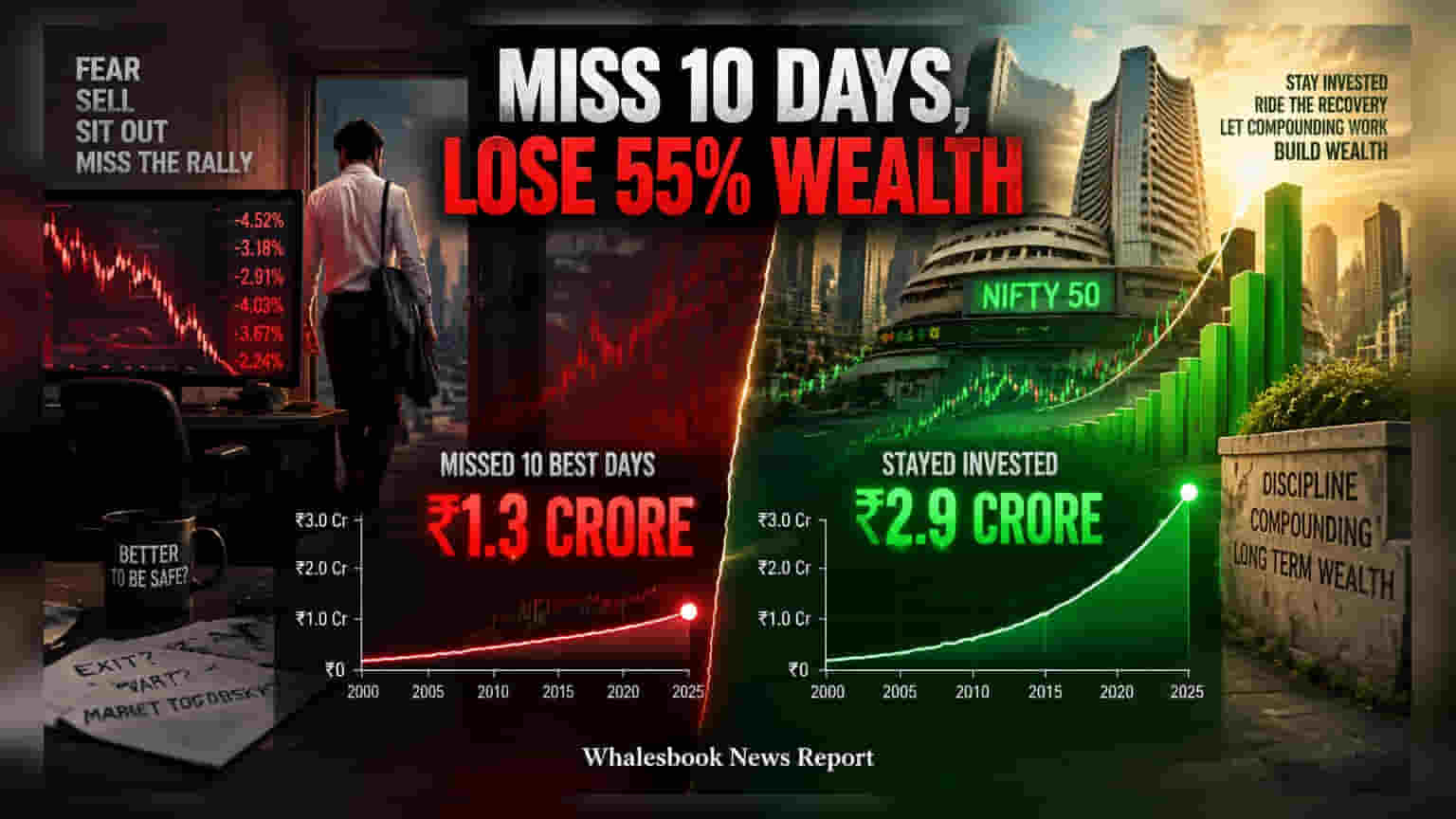
A study of the Nifty 50 Total Return Index from 1999 shows that staying invested is key to long-term wealth. Missing just the 10 most profitable trading days would have cut a ₹10 lakh investment from ₹2.9 crore down to ₹1.3 crore. These high-growth days often occur right after market crashes, making it nearly impossible for retail investors to successfully time their exit and re-entry.
Attempting to time the stock market is a strategy that often backfires for long-term investors. A recent analysis by FundsIndia Research covering over 27 years of the Nifty 50 Total Return Index—which tracks stock performance including dividends—highlights a stark reality: market returns are not spread evenly across time. Instead, a large portion of long-term gains often comes from just a handful of exceptionally strong trading sessions.
The High Cost of Market Timing
Data from June 30, 1999, to the present shows that a disciplined investor who stayed invested with a ₹10 lakh portfolio would have seen their wealth grow to approximately ₹2.9 crore. However, the outcome changes drastically if an investor chooses to sit on the sidelines during volatile periods. If that same investor missed just the 10 best trading days over those two-plus decades, the final corpus would have plummeted to about ₹1.3 crore. This represents a reduction of roughly 55% in total wealth.
This loss is not just about the missed profit of those specific days. Because wealth creation in the stock market relies heavily on compounding, every gain that does not happen on time prevents that money from growing in subsequent years. The ripple effect of missing a few high-performance sessions effectively halts the compounding engine for the rest of the holding period.
Why Timing the Market Is Difficult
One of the biggest risks in market timing is that the strongest trading days frequently happen immediately after periods of extreme market stress. For example, during the global financial crisis of 2008 and 2009, equities faced a steep decline. Many of the strongest recovery days occurred just as the market began to turn around. Investors who sold their holdings out of fear during the downturn often missed these quick, sharp rebounds.
Market experts from firms like Equitrust Solutions and Auxano Capital note that these rapid recoveries are often triggered by sudden policy shifts, valuation adjustments, or positive news flow that follows a period of heavy selling. By the time an investor feels safe enough to re-enter the market, a significant portion of the recovery has already occurred.
Psychological Hurdles for Investors
Human behavior plays a significant role in this failure. During market crashes, the urge to protect one’s capital by moving to cash is often overwhelming. While selling can provide temporary psychological relief, it creates a structural trap. Successfully timing the market requires two perfect decisions: knowing exactly when to exit to avoid a fall and knowing exactly when to re-enter to capture the bounce. History shows that achieving this consistently is extremely difficult, even for experienced professionals.
For most individual investors, the data suggests that staying the course is often more effective than trying to guess the next major turn. Focusing on long-term asset allocation and staying invested during volatility is a common approach to avoid missing the market's best days.