 Whalesbook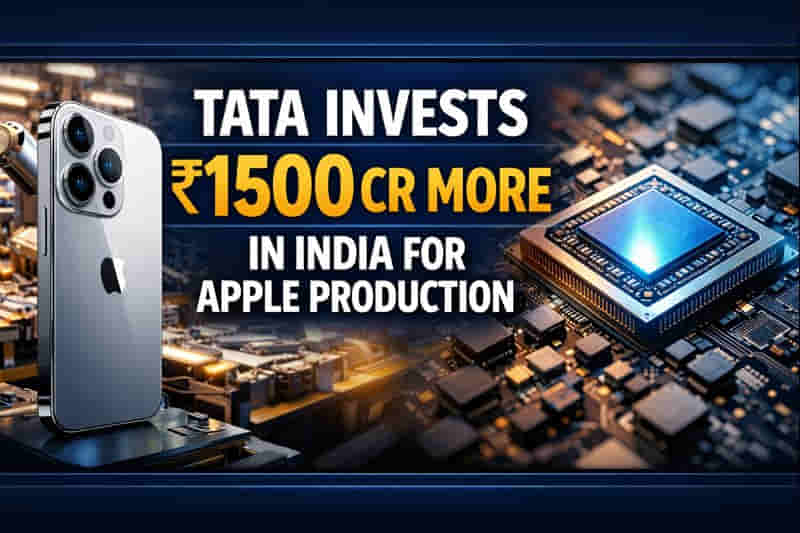
Tata Sons Fuels India's iPhone Manufacturing Ambitions with ₹1,500 Crore Investment
Tata Sons has significantly bolstered its commitment to India's burgeoning electronics manufacturing sector by injecting an additional ₹1,500 crore into its subsidiary, Tata Electronics. This latest capital infusion, detailed in updated filings with the Registrar of Companies, brings the total investment by the group's holding company into Tata Electronics to a substantial ₹4,500 crore over the past year.
Strategic Capacity Expansion
This move highlights the parent company's unwavering support for expanding Tata Electronics' manufacturing capabilities. The subsidiary has rapidly emerged as a key player, becoming one of Apple's major iPhone manufacturers in India. A significant portion of its output is destined for export markets, primarily the United States and Europe, reinforcing India's role in global tech supply chains.
Doubled Share Capital Signals Future Growth
Further indicating a strategy for sustained growth and future funding needs, Tata Electronics has also doubled its authorized share capital base to ₹20,000 crore. While the company did not explicitly state the reason for the capital infusion in its filing, it noted the requirement for "additional long-term finance by issue of securities/equity shares" to support its business operations.
Financial Performance and Investment Rationale
Mohit Yadav, founder of business intelligence firm AltInfo, noted that Tata Electronics secured this recent funding at ₹62 per share. He explained that the capital will primarily fund capital expenditure for electronics manufacturing and semiconductor expansion. However, he cautioned that a clear timeline for profitability remains uncertain due to these heavy growth investments.
Tata Electronics posted consolidated operating income of ₹66,206 crore for the fiscal year 2024-25, a significant leap from ₹3,752 crore in 2023-24. Despite this revenue surge, the company is still operating at a loss, although its net loss narrowed to ₹69 crore in FY25 from ₹825 crore in the previous fiscal year. Yadav pointed out that despite substantial assets valued at around ₹48,000 crore and high revenues, the net loss indicates that ongoing capacity expansions and integration costs are presently impacting profitability.
India's Growing Role in Global Tech Production
India's significance in the global smartphone manufacturing landscape is rapidly increasing. According to Counterpoint Research, over 70% of iPhones sold in the United States are now produced in India, with Foxconn being the largest producer. Apple's chief executive, Tim Cook, recently emphasized this shift, stating that a "vast majority" of US-sold iPhones originate from India.
Diversification into Semiconductors
Beyond smartphone production for Apple and high-tech components, Tata Electronics is making significant strides into the semiconductor industry. The company is investing approximately $14 billion to establish a semiconductor fabrication facility in Gujarat and a chip assembly and testing unit in Assam. This strategic move positions Tata Electronics at the forefront of India's semiconductor ambitions.
Adding further momentum, Tata Group and chip giant Intel recently signed a memorandum of understanding. This agreement aims to explore the manufacturing and packaging of Intel products for local markets at Tata Electronics' upcoming facilities and foster collaboration on advanced packaging technologies in India. The partnership also intends to explore opportunities for rapidly scaling tailored AI PC solutions for both consumer and enterprise markets within India.
Impact
This substantial investment by Tata Sons into Tata Electronics is a strong indicator of confidence in India's manufacturing capabilities and the potential of its electronics and semiconductor sectors. It strengthens Apple's supply chain diversification away from China and solidifies India's position as a global manufacturing hub. The move is expected to create significant employment opportunities, foster technological advancement, and contribute to India's economic growth. The expansion into semiconductors is particularly critical for the nation's strategic autonomy in advanced technology.
Impact Rating: 9/10
Difficult Terms Explained
- Registrar of Companies (RoC): A government office responsible for registering companies and maintaining their statutory records and filings.
- Equity Investment: Funding provided in exchange for ownership stakes (shares) in a company.
- Capital Infusion: The act of injecting money or capital into a company, typically to fund operations or expansion.
- Authorised Share Capital: The maximum amount of share capital that a company is permitted to issue to shareholders, as stated in its constitution.
- Consolidated Operating Income: The total revenue generated from the primary business operations of a company and its subsidiaries, after accounting for inter-company transactions.
- Net Loss: The amount by which a company's expenses exceed its revenue over a specific period.
- Capex (Capital Expenditure): Funds used by a company to acquire, upgrade, and maintain physical assets like property, buildings, or equipment.
- Semiconductor Fabrication Facility (Fab): A specialized factory where integrated circuits (semiconductor chips) are manufactured.
- Chip Assembly and Testing Unit: A facility that packages semiconductor chips and tests them to ensure they function correctly.
- Memorandum of Understanding (MoU): A formal agreement between two or more parties outlining their shared intentions and commitments before a legally binding contract is finalized.
- Advanced Packaging: A sophisticated process in semiconductor manufacturing that involves integrating multiple chips or components into a single package.