

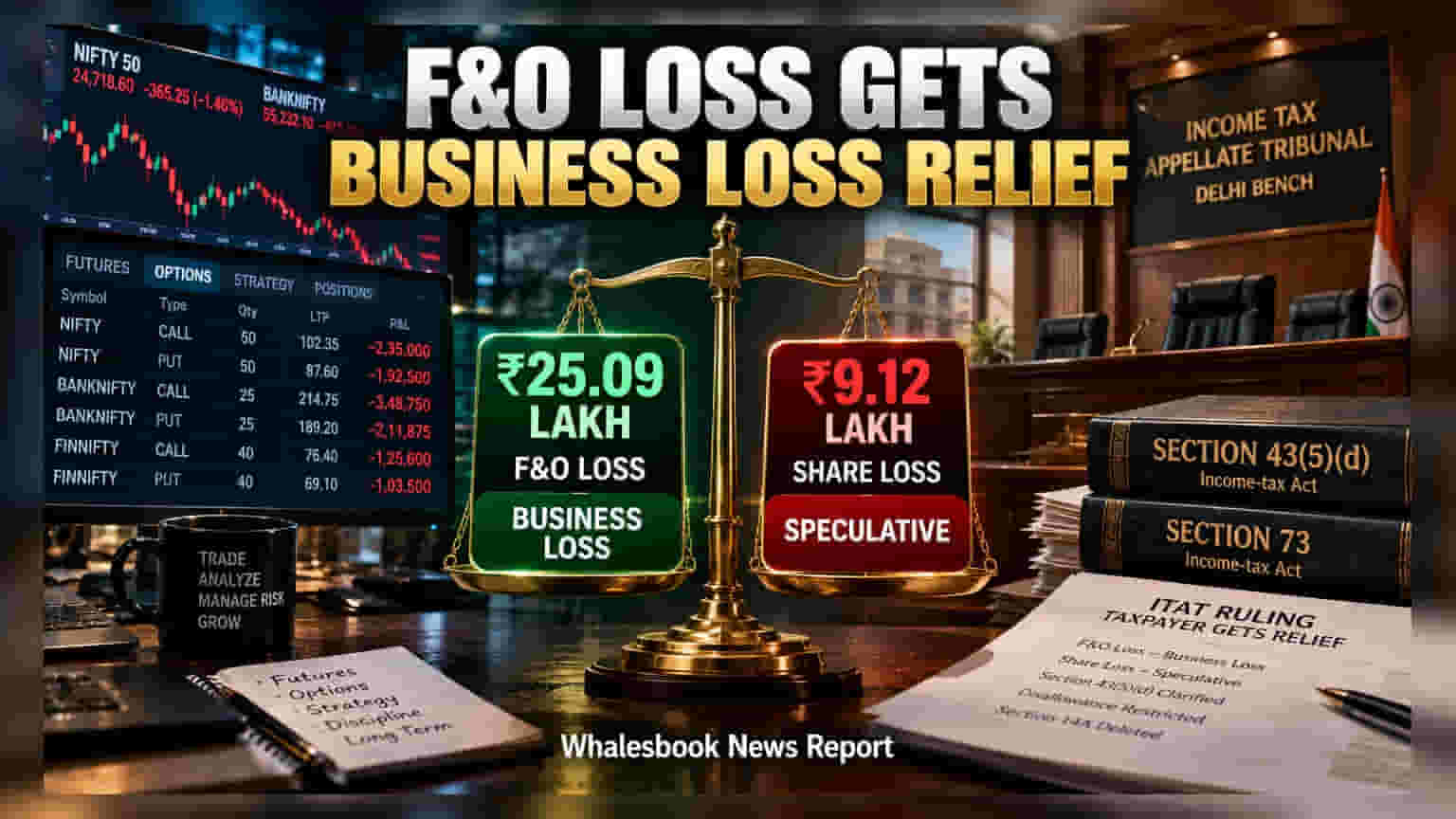
The Delhi bench of the Income Tax Appellate Tribunal (ITAT) has ruled that losses from exchange-traded derivatives (F&O) should be treated as ordinary business losses, rather than speculative ones. This distinction allows taxpayers to set off such losses against other business income. The tribunal clarified that Section 43(5)(d) protects these trades, distinguishing them from traditional share-trading losses which may still be classified as speculative.
The Income Tax Appellate Tribunal (ITAT) Delhi bench has provided clarity on the tax treatment of derivative losses, ruling in favor of a taxpayer who sought to classify exchange-traded derivatives (F&O) losses as ordinary business losses. The case involved a Mathura-based businessman who reported a total trading loss of ₹34.21 lakh. The tribunal allowed ₹25.09 lakh of this loss to be treated as business loss, rejecting the tax department's attempt to classify the entire amount as speculative.
This decision centers on the legal distinction between standard share trading and exchange-traded derivatives. While the tax department had applied the provisions of Section 73 to treat the derivatives loss as speculative, the tribunal clarified that this section is primarily designed to address share trading by companies. It does not automatically extend to derivatives traded on recognized stock exchanges.
The tribunal relied on Section 43(5)(d) of the Income-tax Act, which specifically excludes eligible exchange-traded derivatives from the definition of speculative transactions. This creates a favorable environment for taxpayers who engage in both activities, as it prevents the rigid classification of all market-related losses as speculative.
The ruling effectively split the taxpayer's total loss of ₹34.21 lakh into two categories. While the ₹25.09 lakh derivatives loss was accepted as business loss, a separate ₹9.12 lakh loss, which resulted from the actual purchase and sale of shares, was upheld as speculative. This emphasizes that even within a single portfolio, the nature of the transaction determines the tax character.
Beyond the loss classification, the ITAT provided further relief regarding business expenses. The Assessing Officer had initially disallowed ₹10 lakh of business expenditure, claiming it was linked to share trading, without providing sufficient evidence or a clear calculation. The tribunal found this estimate unreasonable and restricted the disallowance to ₹1 lakh. Furthermore, the tribunal deleted a ₹9,910 disallowance under Section 14A, reaffirming that such disallowances do not apply when the taxpayer has not earned any exempt dividend income.
For investors and traders, this ruling highlights the importance of documentation and the correct classification of trading activities. While the decision offers significant relief, the tax treatment remains fact-specific. Investors should ensure they maintain clear records of their trading activity to justify whether their derivative operations constitute a genuine business activity. The key monitorable for taxpayers remains how they document these activities in their returns and their ability to prove that derivative transactions are legitimate business-related efforts rather than simple speculative bets.