

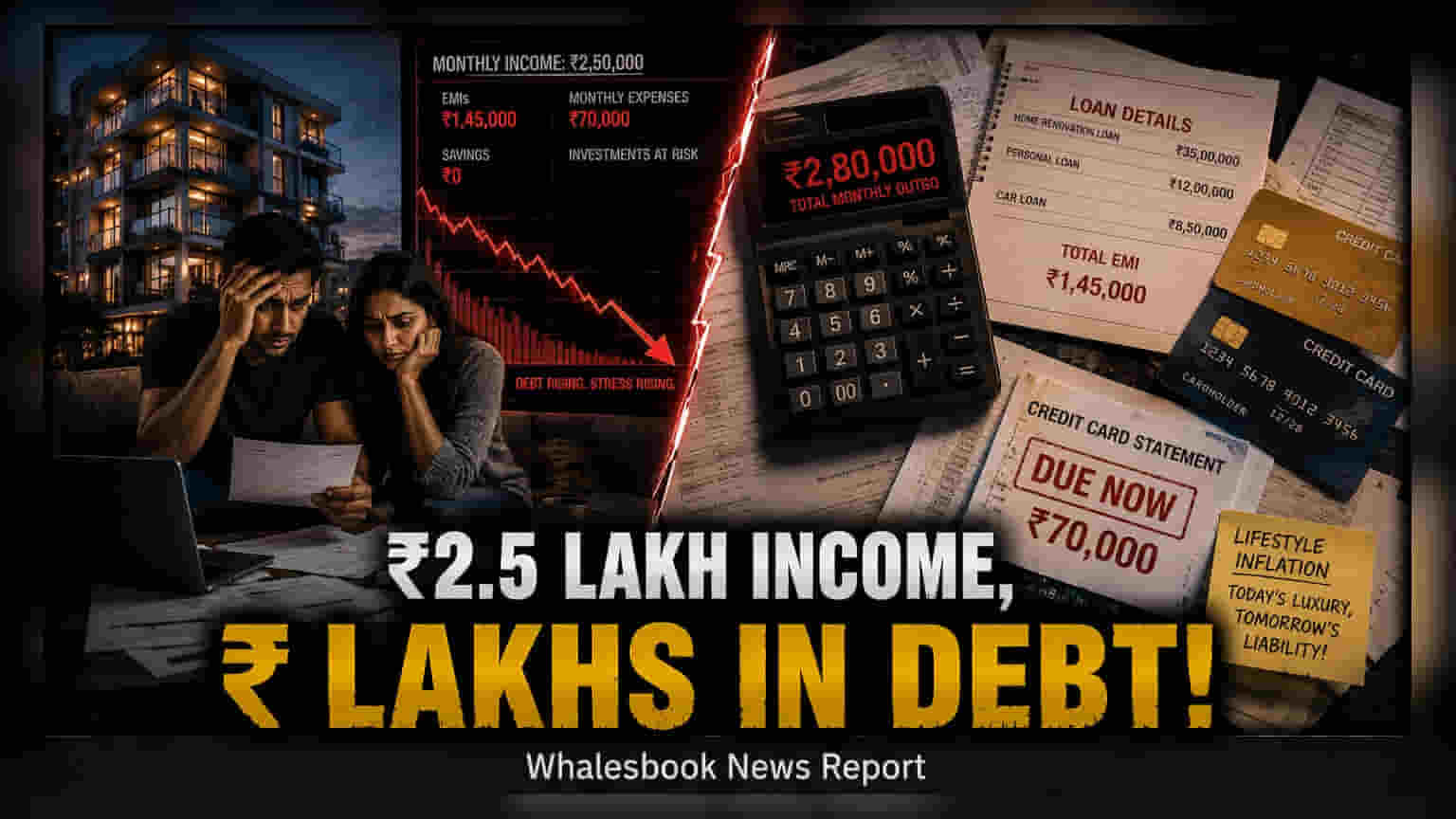
A Bengaluru couple earning ₹2.5 lakh monthly is struggling with debt due to high-cost life events and heavy credit usage. Their situation highlights a common financial trap where rising income is offset by unchecked spending and high-interest liabilities.
A widely discussed case involving a Bengaluru couple earning a combined ₹2.5 lakh monthly has brought the risks of 'lifestyle inflation' and debt-funded spending into the spotlight. Despite a high household income, the couple faces severe financial strain, serving as a reminder that financial security is determined not by how much one earns, but by how one manages expenses and debt.
The Anatomy of a Debt Trap
The financial pressure on this household stems from major life decisions financed primarily through borrowing. The couple undertook a wedding costing over ₹30 lakh, followed by a ₹35 lakh home renovation. These large outlays were not met with accumulated savings but were instead funded by personal loans and the liquidation of previous investments.
When major life events are financed through debt rather than long-term savings, it creates a structural problem. The couple now faces recurring monthly EMI (Equated Monthly Installment) obligations that consume a significant portion of their income. A car loan and ongoing household expenses add further pressure, leaving little room for error or financial growth.
The Danger of Revolving Credit
A critical, often overlooked issue in this case is the reliance on credit cards for routine monthly expenses, including the needs of dependent parents. The couple reportedly spends ₹70,000 monthly on credit cards. When credit cards are used as a primary cash-flow tool rather than for convenience, it poses a significant risk.
If the full balance is not cleared every month, high interest rates can cause debt to snowball, making it nearly impossible to save. Using credit to fund daily living expenses suggests that the household's fixed costs are already pushing the limits of their monthly income, reducing their ability to build a buffer for emergencies.
Lessons on Investing While in Debt
The couple continues to invest ₹15,000 monthly in SIPs despite the heavy debt burden. From a mathematical standpoint, financial experts often suggest that if high-interest debt—such as credit card dues or personal loans—exceeds the potential returns from mutual fund investments, it may make more sense to pay off the debt first.
Investing while carrying high-cost debt effectively acts as a negative return because the interest paid on the loans usually exceeds the interest earned on investments. The priority in such situations is typically to build an emergency fund and eliminate high-interest liabilities, which restores liquidity and reduces long-term interest payments.
What Individuals Should Monitor
For those managing their own finances, this situation highlights the importance of tracking the debt-to-income ratio. A healthy financial structure requires that fixed monthly obligations do not consume the majority of net take-home pay.
Moving forward, the primary focus for individuals in similar situations is to stop the cycle of debt accumulation. This involves auditing fixed expenses, pausing non-essential spending, and prioritizing the repayment of high-interest credit card debt. Relying on future salary growth to pay off past debts is a high-risk strategy, as it leaves households vulnerable to job losses or unexpected economic shifts.