

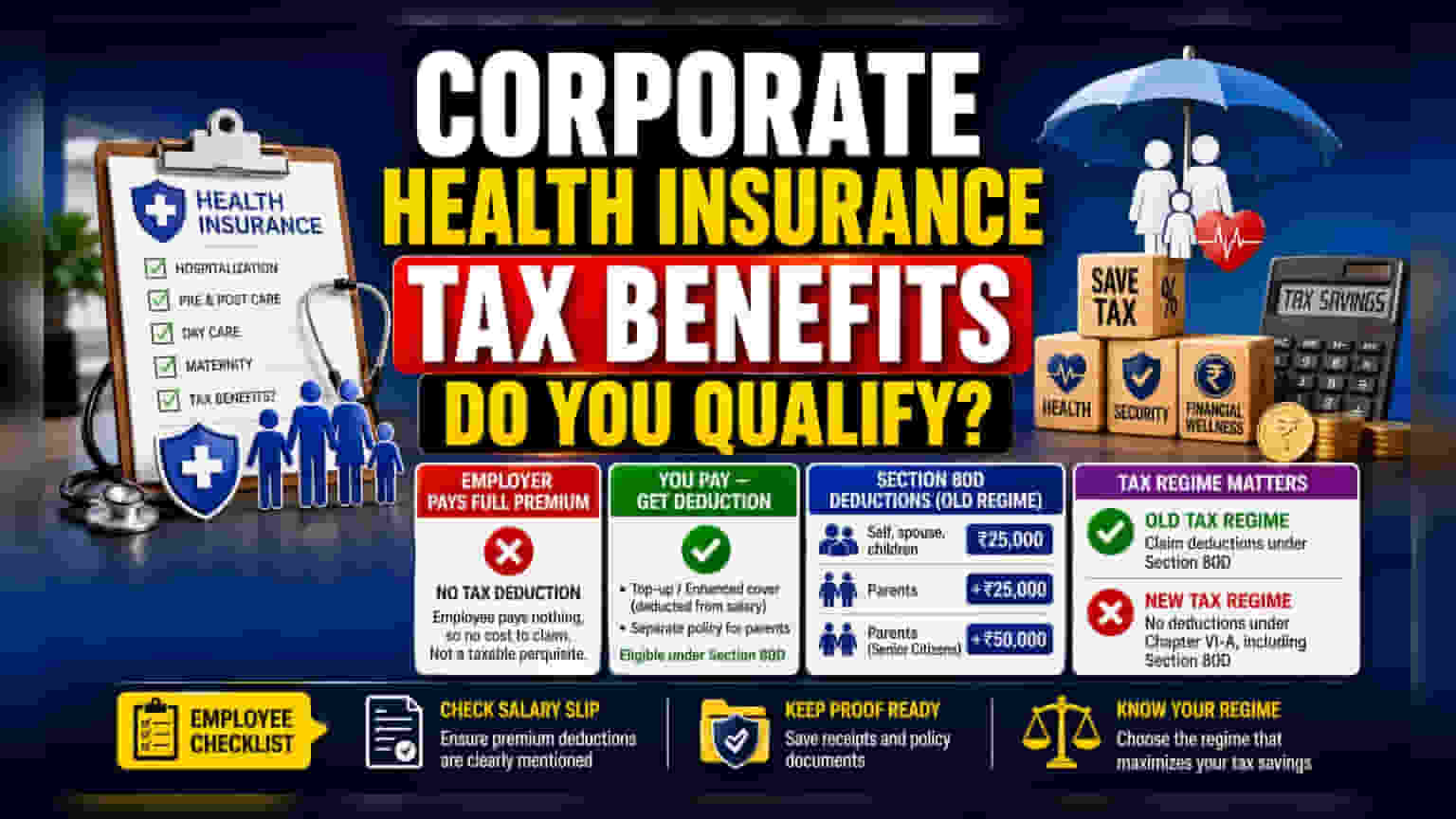
Many employees believe corporate health insurance offers automatic tax benefits, but rules vary based on who pays. If your company covers the full premium, no tax deduction applies. However, if you contribute toward top-up coverage or separate policies for parents, you may claim deductions under Section 80D, but only if you opt for the old tax regime.
What Happened
Corporate health insurance is a standard benefit for many employees in India, yet the tax rules surrounding these policies often lead to confusion. Many salaried individuals wonder if they can claim income tax deductions for the premiums paid by their employers. Understanding these rules is important, as the ability to claim a tax benefit depends entirely on whether the employee actually pays for the coverage or if the company bears the full cost.
When Employer-Paid Premiums Offer No Deduction
If your employer provides health insurance as a perk and pays the full premium, you cannot claim a tax deduction for it. From a tax perspective, since the employee has not spent any money on this premium, there is no cost to deduct from taxable income. This employer-funded insurance is viewed as a welfare benefit and is generally not treated as a taxable perquisite (an additional benefit) for the employee. If the company deducts nothing from your salary for this coverage, there is no tax benefit to claim.
Opportunities For Deduction
Tax benefits become possible when the employee contributes to the premium. This happens in specific scenarios, such as when an employee pays for 'top-up' or 'enhanced' coverage beyond the standard plan provided by the office. If the premium for this extra coverage is deducted from your salary, it is considered an expense borne by the employee.
Similarly, if an employee purchases a separate policy for their parents, these payments may also be eligible for deductions under Section 80D of the Income Tax Act. To claim these benefits, the payments must be clearly documented in your salary records or payment receipts.
The Tax Regime Factor
The choice of your tax regime plays the most critical role in whether you can actually use these deductions. Section 80D allows for deductions of up to ₹25,000 for premiums covering yourself, your spouse, and your children. If you are also paying for parents, an additional deduction of ₹25,000 is available, which increases to ₹50,000 if the parents are senior citizens.
However, these benefits are only available under the old tax regime. If you choose the new tax regime, which many taxpayers now prefer for its lower tax slabs, you generally cannot claim deductions under Chapter VI-A, which includes Section 80D. Therefore, even if you are eligible for the deduction based on your payments, it will yield no tax savings if you are filing under the new regime.
What Employees Should Track
Before finalizing your tax planning, review your salary slip and insurance policy documents. Check whether any insurance premiums are being deducted from your salary and ensure you have the necessary proof for these contributions. It is also important to confirm which tax regime you have opted for, as this will determine whether you can actually claim the benefit for any out-of-pocket health insurance expenses.