 Whalesbook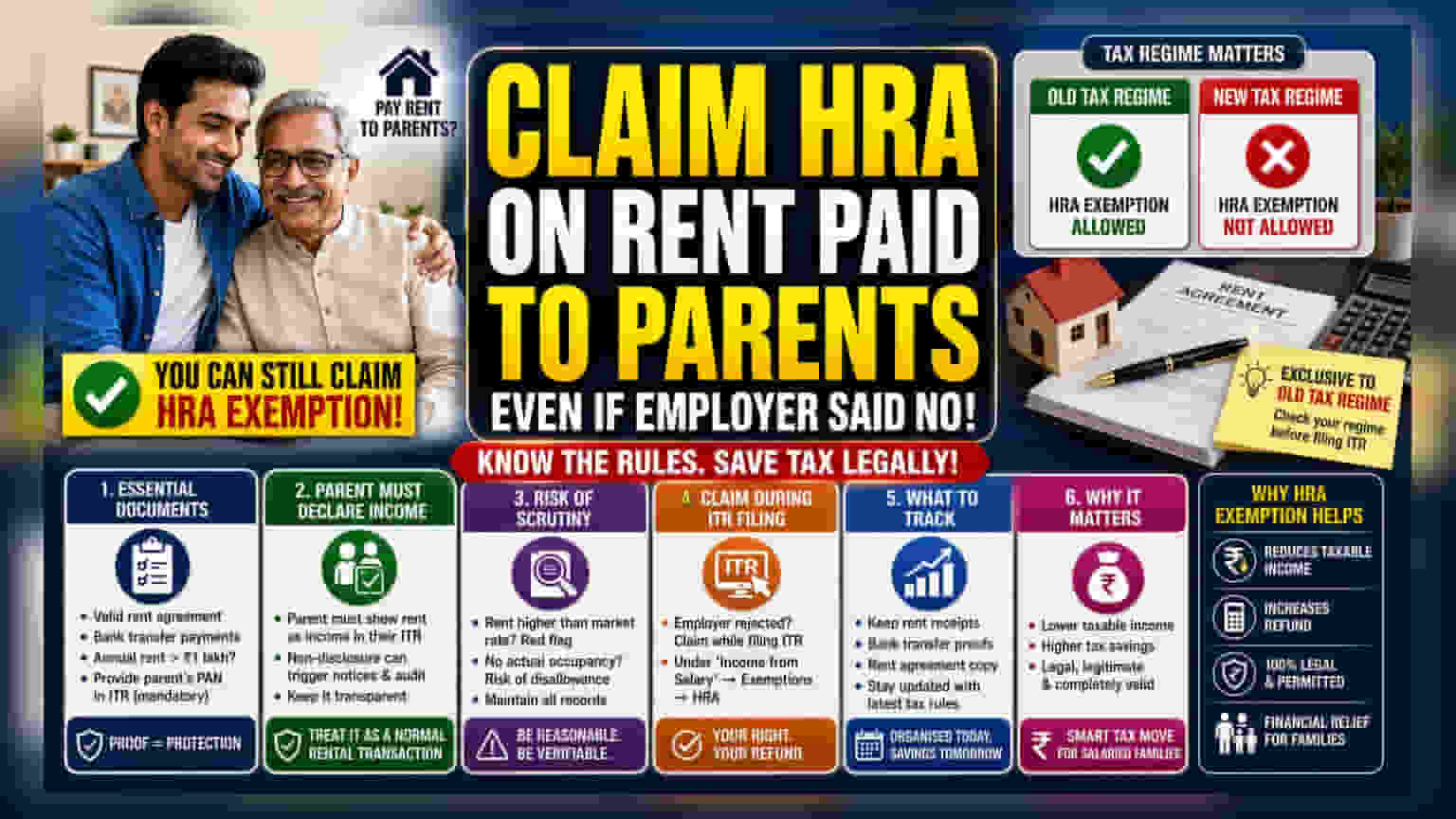


Many employees face rejection from their HR departments when claiming House Rent Allowance (HRA) for rent paid to parents. Tax laws allow this deduction, provided specific conditions are met. Crucially, this benefit is unavailable under the new tax regime. You must ensure the rent payment is a genuine, documented transaction, and the parent discloses this income in their tax return to avoid scrutiny from tax authorities.
What Happened
Taxpayers who pay rent to their parents can claim the House Rent Allowance (HRA) exemption even if their employer rejected the claim during the salary processing phase. While many corporate HR policies restrict such claims to avoid administrative complexity or potential abuse, the Income Tax Act, under Section 10(13A), does not explicitly bar paying rent to close family members. If you were unable to claim this benefit through your company, you can still adjust your tax liability when filing your Income Tax Return (ITR).
The Critical Tax Regime Distinction
The most important factor for taxpayers to understand is the difference between tax regimes. This HRA exemption is exclusively available under the old tax regime. If you have opted for the new tax regime, which was made the default in recent years, you cannot claim the HRA exemption regardless of who you pay the rent to. Before proceeding with any tax adjustment, employees must verify which tax regime they have selected for the financial year, as switching between them can significantly alter tax liability.
Essential Documentation Requirements
To successfully claim this exemption, the transaction must be more than just a paper entry. The tax department requires proof that the transaction is legitimate and follows market standards. First, you must have a valid rent agreement between you and your parent. Second, payments should ideally be made through bank transfers rather than cash to create a clear audit trail. Third, if the annual rent payment exceeds Rs 1 lakh, it is mandatory to provide the Permanent Account Number (PAN) of the landlord—in this case, your parent—in your ITR filing. Failing to provide this can lead to the rejection of the exemption.
Why the Parent's Cooperation Matters
For the claim to hold up under scrutiny, the arrangement must be transparent. The parent receiving the rent must declare it as rental income in their own income tax return. If you claim the deduction but the parent fails to disclose the income, it acts as a red flag for the tax department, potentially triggering an audit or a notice seeking clarification. Essentially, the tax authorities view this as an 'arm's length' transaction, meaning it should resemble a normal commercial rental agreement between a tenant and a landlord.
Risks and Potential Scrutiny
The primary risk for taxpayers is the possibility of the Income Tax department viewing the arrangement as a tax-saving device rather than a genuine rental situation. If the rent amount is significantly higher than the prevailing market rate for the area, or if there is no physical occupancy by the child, the tax officer may disallow the deduction. Transparency is the best defense; maintaining copies of receipts, the rent agreement, and bank statements ensures that if a notice is received, the taxpayer can provide verifiable proof of the arrangement.
What Investors Should Track
Taxpayers should maintain a structured file containing all rent receipts, proof of bank transfers, and a copy of the rent agreement. It is also advisable to ensure the parent is aware of the income disclosure requirements. Since tax laws are subject to updates, taxpayers should cross-check their eligibility against the latest guidelines provided by the Income Tax Department during the filing season to avoid future notices.