

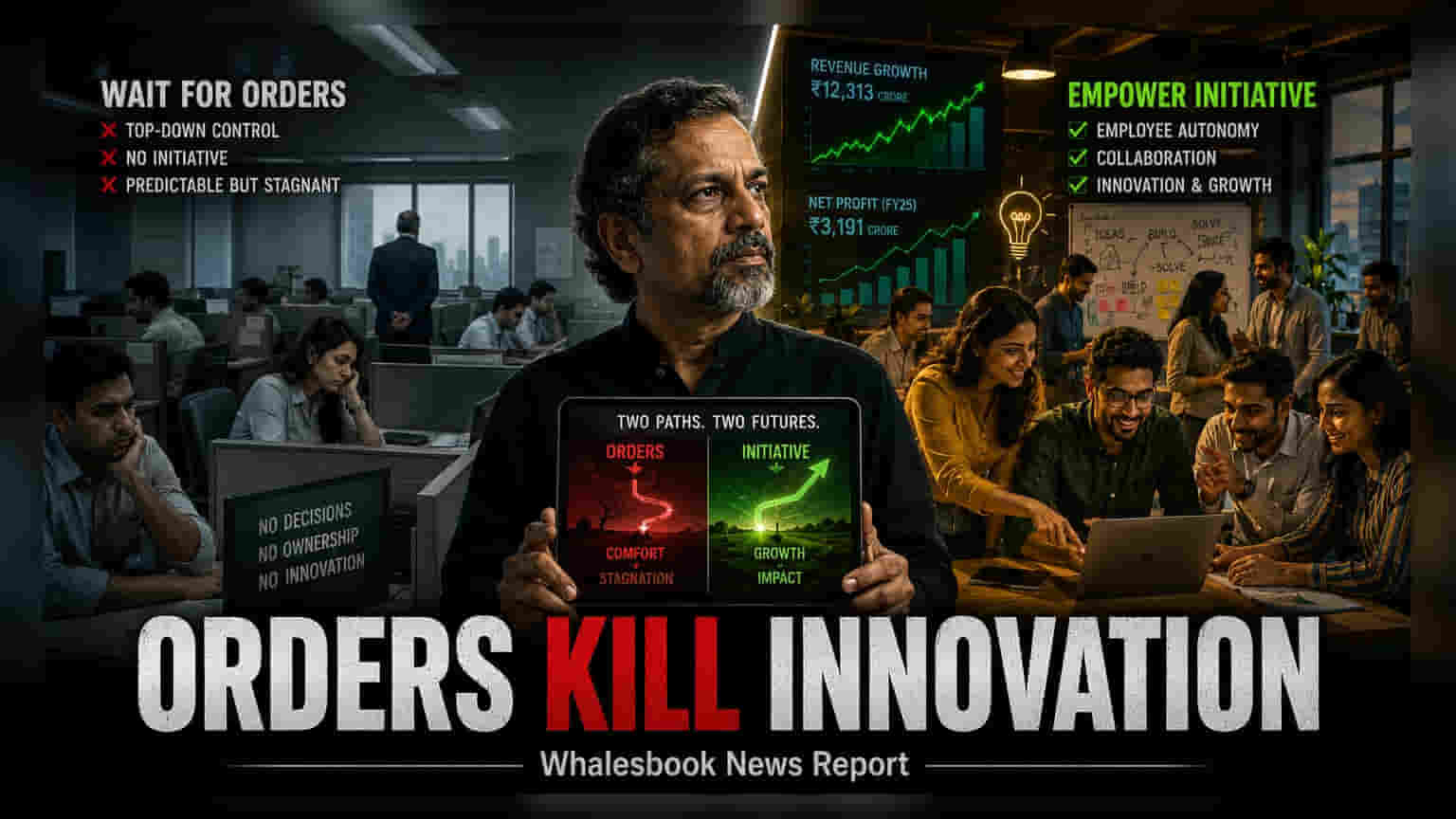
Zoho founder Sridhar Vembu argues that organizations relying on top-down instructions face stagnation, while fostering employee initiative drives innovation. As the leader of one of India's largest bootstrapped software firms, his perspective highlights the balance between operational discipline and creative freedom, especially as the company navigates rising tech costs and a return to in-office work.
Zoho founder Sridhar Vembu recently shared his perspective on workplace culture, arguing that organizations that rely heavily on metrics and top-down instructions risk long-term stagnation. In his view, a culture where employees wait for orders before acting might offer predictability, but it often suppresses the energy and independent thought needed for true innovation. For the software giant, the choice is between the comfort of certainty and the potential chaos that accompanies independent, proactive work.
For many observers of the Indian startup landscape, these comments offer a window into the management philosophy behind Zoho Corporation. Unlike many of its peers that depend on external venture capital, Zoho has maintained a bootstrapped, debt-free model. This approach often requires a workforce that is empowered to make decisions rather than constantly seeking leadership guidance. In the fiscal year 2025, the company reported a revenue of ₹12,313 crore and a net profit of ₹3,191 crore, figures that underscore the success of its internal business model.
However, balancing this culture with rapid scaling creates its own set of pressures. The company currently faces the same challenges as the broader technology sector, particularly regarding rising input costs. These include the increasing prices of memory and the high cost of computing tokens required for artificial intelligence development. Effectively managing these costs while maintaining profitability is a critical factor for the company.
Furthermore, the company has had to address operational risks related to productivity. Zoho has notably shifted its strategy away from remote-work arrangements, favoring a return to in-person collaboration. Management has expressed concerns that purely remote work environments can slow down issue resolution and impact the quality of collaboration, which they believe is vital for the company's innovation-led model.
While the company avoids the volatility of the public stock markets by remaining private, it is not immune to the challenges facing the global tech industry. Zoho is often viewed as a bellwether for the Indian software-as-a-service sector. The company's ability to maintain high profit margins while investing in new technology amidst a potential global economic slowdown remains a key area for industry observers. Whether its push for in-person collaboration and employee autonomy can effectively counter the rising costs of AI and tech development will be important to track.