

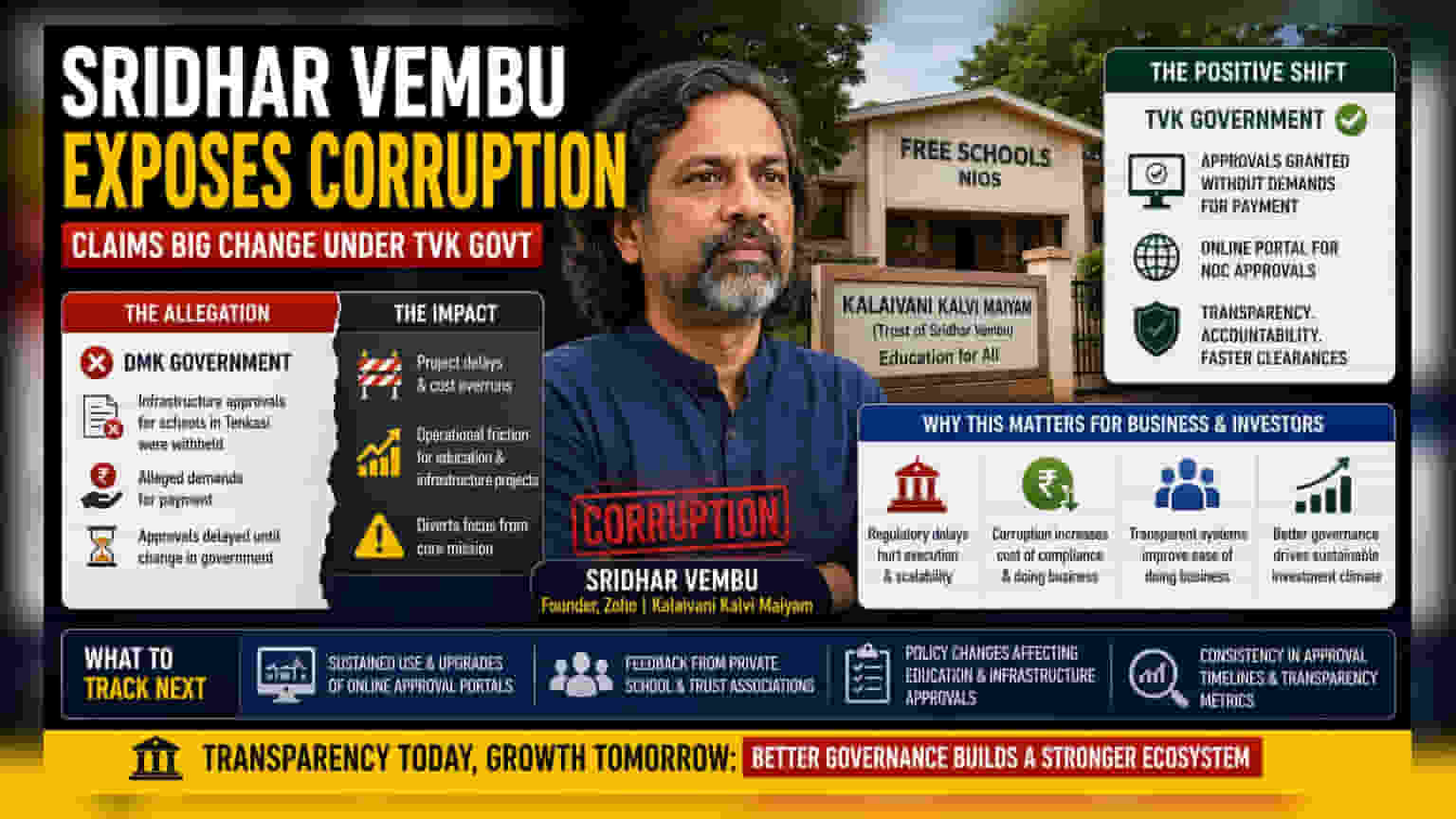
Zoho founder Sridhar Vembu has alleged that his trust faced corruption demands while seeking infrastructure approvals under the previous Tamil Nadu administration. He contrasted this with the current government's processes, noting smoother approvals for his free school initiatives. This highlights the business impact of bureaucratic transparency in the state's educational sector.
What Happened
Zoho founder Sridhar Vembu has publicly detailed allegations of corruption during the previous DMK government’s tenure in Tamil Nadu. His trust, Kalaivani Kalvi Maiyam, which manages free schools under the National Institute of Open Schooling (NIOS), reportedly faced significant obstacles while seeking infrastructure approvals. Vembu alleged that approvals for new school buildings in Tenkasi were deliberately withheld until there was a change in government. He stated that the current TVK administration granted these approvals without any demands for payment, which he credited as a significant improvement in the business environment.
The Business Environment Angle
For businesses and organizations operating in sectors that require frequent government clearances, such as education and real estate, these allegations highlight the operational friction caused by administrative delays. Vembu’s experience points to how regulatory approvals, or the lack thereof, can impact the execution of projects. In infrastructure-heavy sectors, the ability to secure permissions efficiently is a critical factor for organizations. Investors and stakeholders in the region often track whether policy shifts toward digital, automated approval systems effectively reduce the reliance on individual discretion, which is frequently cited as a source of corruption risk.
Transparency and Regulatory Shifts
The current Tamil Nadu government has emphasized the streamlining of NOC approvals for educational institutions, largely through the implementation of online portals. Such initiatives aim to remove human intervention, which is intended to curb graft and speed up the approval cycle. For private educational trusts and corporate social responsibility (CSR) initiatives, a transparent approval process is essential for planning expansion and allocating resources effectively. The shift toward digitization is watched closely by industry observers to see if it lowers the cost of compliance and reduces the likelihood of project delays.
Operational Governance and Risk
Allegations of this nature underscore the importance of governance for organizations operating in highly regulated spaces. Prolonged administrative hurdles can lead to cost overruns and uncertainty in project timelines. For any organization, the predictability of regulatory processes is as important as the rules themselves. When businesses face recurring demands for payments, it creates operational risks that can stall expansion and divert management attention from core activities. The public nature of Vembu's comments has brought renewed focus to the role of accountability in state administration and the practical benefits of technology-driven governance.
What Investors and Stakeholders Should Track
The primary monitorable is the sustained implementation of transparent, online processing for educational and infrastructure approvals in the state. Stakeholders will be watching to see if private school associations and other organizations report continued ease of operations under the new portal systems. Furthermore, any subsequent policy adjustments that further simplify or complicate the approval chain for institutions will be a key indicator of the stability and efficiency of the regulatory environment.