

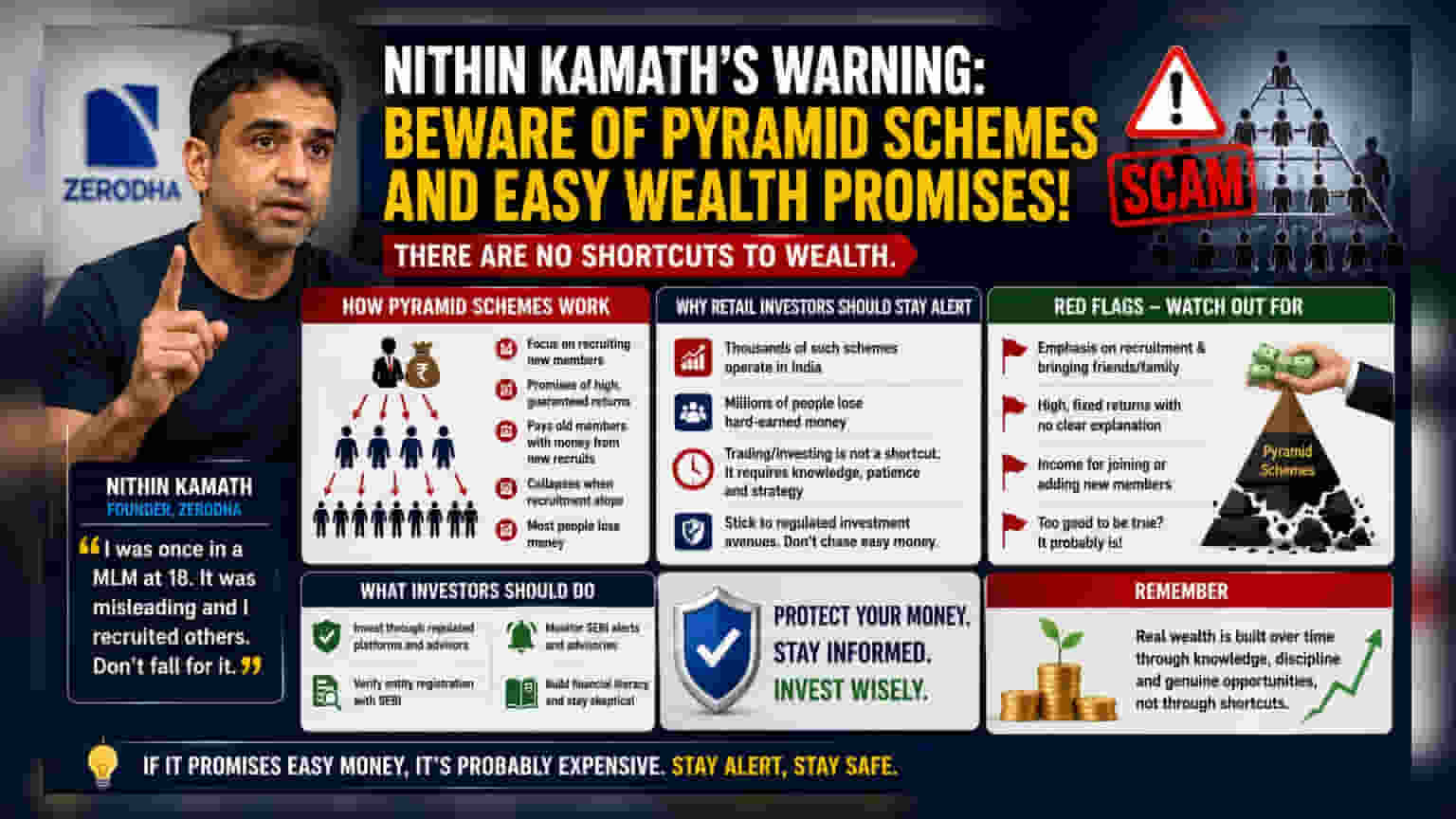
Zerodha founder Nithin Kamath has cautioned retail investors against pyramid schemes, sharing his personal experience with multi-level marketing scams in his youth. He highlighted that promises of quick, high returns often hide significant risks and urged investors to avoid 'get-rich-quick' traps, especially as retail market participation continues to grow.
What Happened
Zerodha founder Nithin Kamath recently issued a public warning advising individuals to be wary of pyramid schemes and promises of easy wealth. Reflecting on his own experience, Kamath revealed that he was once involved in a multi-level marketing business at age 18. He recounted that the experience was misleading and caused him to inadvertently recruit others, a common mechanism in such schemes. His comments come as a reminder for the growing base of retail investors in India to distinguish between genuine investment opportunities and fraudulent ventures.
The Mechanics of These Schemes
Kamath pointed out a fundamental flaw in pyramid schemes: they prioritize the recruitment of new members over the sale of actual products or services. These organizations typically promise high, guaranteed returns to attract participants. However, the business model relies on the money brought in by new recruits to pay off the older ones, rather than generating value through legitimate commerce. When the supply of new members dries up, the system collapses, leaving the majority of participants with losses. Kamath emphasized that any opportunity claiming to offer returns significantly higher than traditional, safe assets like bank fixed deposits should be viewed with extreme suspicion.
Why Retail Investors Should Stay Alert
With more retail investors entering the stock market, Kamath cautioned against the misconception that trading or investing is a shortcut to quick money. He warned that having unrealistic expectations about wealth creation can lead to disastrous financial decisions. In the stock market, returns are typically tied to risk, and professional trading requires knowledge, patience, and strategy, not recruitment or shortcuts.
He cited data suggesting that thousands of such schemes operate in India, impacting millions of people who lose significant capital. In an era where online platforms make it easier for fraudulent schemes to spread, he stressed that the safest path involves sticking to regulated investment avenues rather than falling for schemes that rely on bringing in new members to generate profit.
Red Flags for Investors
Investors can protect themselves by identifying common warning signs. If an investment opportunity emphasizes recruitment or bringing in friends and family as a primary way to earn money, it is likely a red flag. Legitimate businesses or investments earn money by selling products, services, or through market performance, not by charging a fee to new entrants. Furthermore, any promise of a fixed, high return without a clear explanation of where that money is coming from is a major cause for concern. If a scheme appears too simple or too good to be true, it is essential to exercise caution and avoid it entirely.
What Investors Should Watch
Investors should prioritize regulated investment platforms and registered financial advisors. Before investing, it is crucial to verify if the entity is registered with regulators like the Securities and Exchange Board of India (SEBI). Monitoring for any official alerts or advisories issued by regulatory bodies regarding specific investment schemes can also help in avoiding scams. Ultimately, the best defense against financial fraud is financial literacy and a healthy skepticism toward any system that guarantees easy money.