 Whalesbook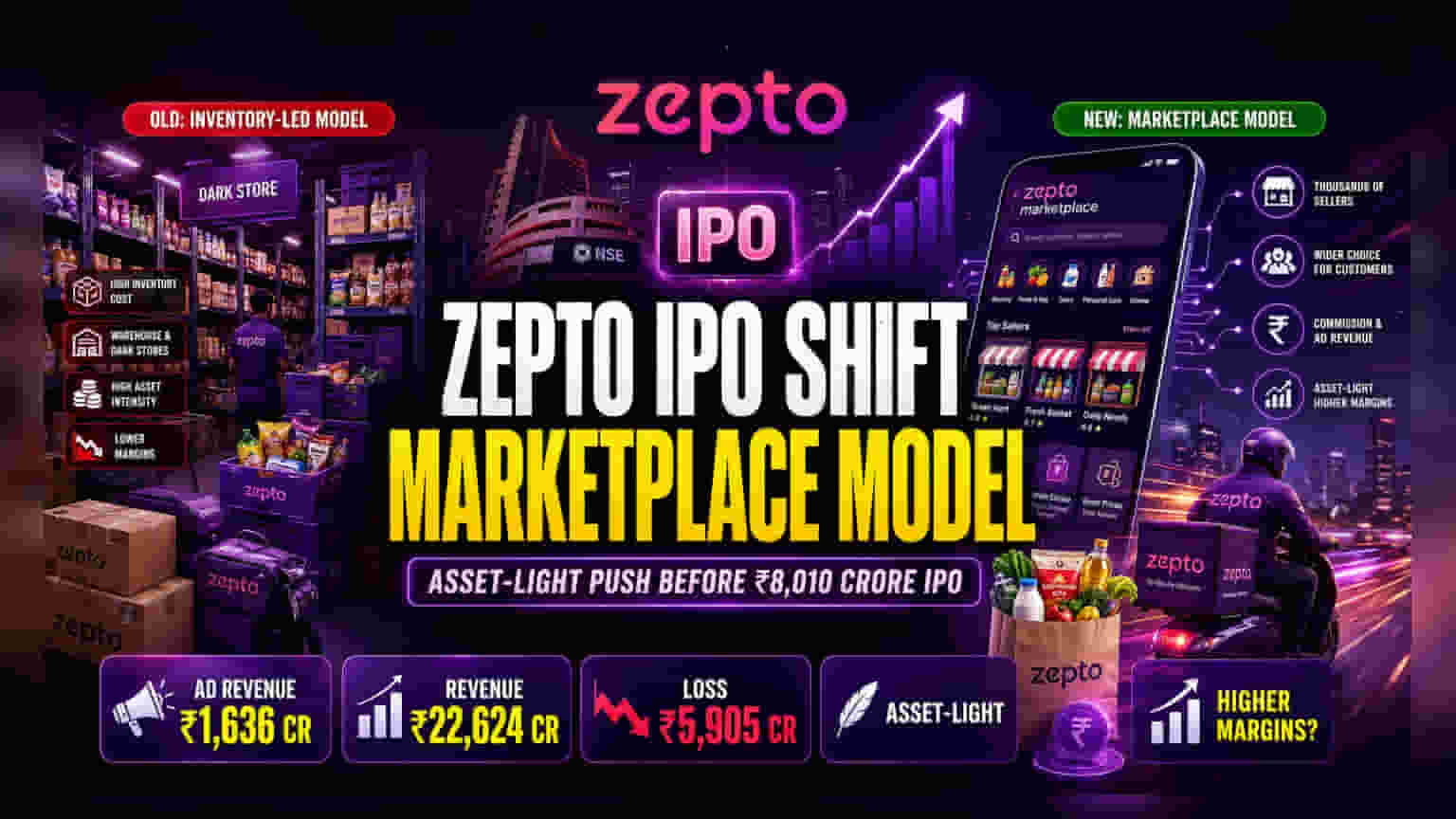


Quick commerce major Zepto is shifting to a marketplace business model ahead of its planned ₹8,010 crore IPO. The move aims to cut capital costs and improve margins by focusing on commissions and advertising fees instead of direct inventory sales. While advertising revenue has surged, investors are watching the company’s widening losses of ₹5,905 crore and its ability to turn profitable in a competitive market.
What Happened
Quick commerce company Zepto has officially signaled a major shift in its business strategy as it prepares for an Initial Public Offering (IPO) of approximately ₹8,010 crore. The company is transitioning from a traditional inventory-led model to a marketplace model. In an inventory-led setup, a company buys goods from suppliers and sells them directly to customers, which requires holding stock and managing warehouses. In a marketplace model, the company acts as a platform, connecting sellers with buyers and earning money through commissions and advertising fees.
Why The Shift Matters For Investors
This change is significant for anyone looking at Zepto's financial health. An inventory-led model is capital-intensive, meaning the company must spend heavily on buying and storing products, which increases financial risk. By moving to a marketplace model, Zepto aims to become more asset-light. This means the company may need to spend less cash on stock and instead focus on its platform, logistics, and delivery speed. For investors, this structure is typically seen as more efficient because it creates new, higher-margin revenue streams like platform commissions and brand advertising fees.
Advertising Growth as a Profit Lever
The company’s focus on advertising is already showing results. In FY26, advertising revenue jumped by 151% to ₹1,636 crore, compared to ₹651 crore in the previous year. As quick commerce platforms become essential for consumer brands to reach customers instantly, these platforms are evolving into major marketing channels. This high-margin revenue is crucial for companies like Zepto to offset the high costs of delivery logistics.
The Financial Performance Test
Despite the growth in revenue, which more than doubled to ₹22,624 crore in FY26 from ₹11,110 crore the year before, the company's losses have widened to ₹5,905 crore. This highlights the high cost of rapid expansion. The widening loss is largely due to the heavy spending required to build a network of dark stores and manage logistics. Investors will likely scrutinize whether the shift to a marketplace model can effectively reduce these losses or if the cost of customer acquisition remains too high to support a path to profitability.
Regulatory and Competitive Context
Regulatory alignment is a key driver for this change. India has specific foreign direct investment rules for e-commerce, and marketplace models are generally better suited to comply with these regulations than inventory-led ones, which face tighter restrictions on foreign funding and ownership. Furthermore, Zepto operates in a high-intensity sector against well-funded competitors like Zomato-owned Blinkit and Swiggy Instamart. As these platforms battle for market share, their ability to control costs while maintaining delivery speed will be a defining factor in their long-term viability.
What Investors Should Track Next
As Zepto approaches its IPO, potential investors may want to monitor several key factors. First, watch the 'take rate' or commission margins, which will indicate how profitable the marketplace model actually is. Second, track the company's burn rate—how much cash it is spending versus how much it is generating. Third, observe the competitive response, as rivals may adjust their strategies in reaction to Zepto's new model. Finally, the ability to control logistical costs, which have historically been the biggest expense in this sector, will remain a primary monitorable for long-term sustainability.