 Whalesbook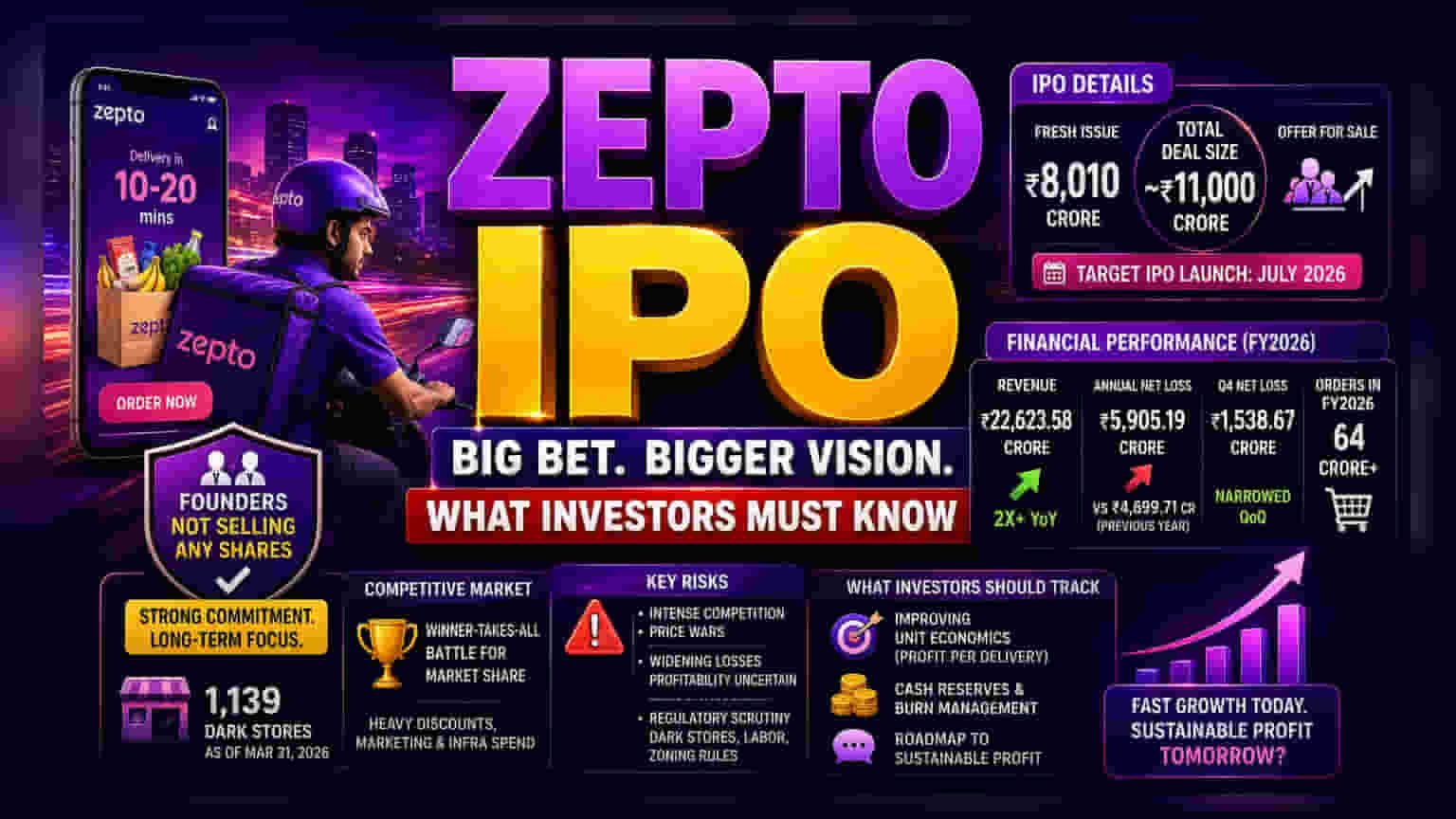


What Happened
Quick commerce company Zepto has submitted its updated draft red herring prospectus to the Securities and Exchange Board of India. The company intends to raise Rs 8,010 crore through a fresh issue of shares. When combined with the offer for sale, where existing shareholders will sell their stake, the total deal size is expected to reach approximately Rs 11,000 crore. The firm is aiming to launch its initial public offering by July 2026. This filing provides the latest look at the company's financial health, operational scale, and the plans of its early backers.
Why This Matters For Investors
The most notable signal for investors is the position taken by the company's founders. Co-founders Aadit Palicha and Kaivalya Vohra, along with their associated family trusts, have decided not to sell any shares in this offering. This decision often signals to the market that the founders are committed to the company's long-term vision. Conversely, the offer for sale component will see several early institutional and venture capital investors, including Nexus Ventures, divest a portion of their holdings. This is a common practice for early-stage backers looking to lock in their gains after years of supporting a startup.
Financial Performance And The Growth Cost
Zepto’s financial results reveal a story of rapid expansion. For the full fiscal year 2026, the company reported revenue of Rs 22,623.58 crore, which is more than double the previous year. However, this growth has come at a significant cost. The company's annual net loss widened to Rs 5,905.19 crore in the latest fiscal year, compared to Rs 4,699.71 crore the year before. While the company did show some improvement in its quarterly performance, with a narrowed net loss of Rs 1,538.67 crore in the fourth quarter, the rising annual loss highlights the high cash requirements of the quick commerce business model.
The Bigger Business Context
To operate a quick commerce platform, a company needs a dense network of dark stores to ensure 10-to-20-minute deliveries. As of March 31, 2026, Zepto operated 1,139 such stores. The company’s ability to handle 64 crore orders in a single fiscal year shows a massive shift in consumer habits. However, investors must consider that this is a winner-takes-all type of market. Zepto competes directly against major platforms backed by large conglomerates and food delivery giants. The battle for market share often forces companies to spend heavily on discounts, marketing, and operational infrastructure, which directly impacts their bottom line.
Risks And Concerns
The primary risk for investors is the intense competition in the sector. Rivals with deep pockets can sustain price wars, which may prevent the company from raising prices to improve profit margins. Furthermore, the widening annual loss is a clear indicator that the business is still in a phase where it prioritizes market growth over immediate profitability. Investors should also be aware of potential regulatory scrutiny regarding the dark store model, labor practices, and municipal zoning rules, which are common hurdles for quick commerce firms in urban areas.
What Investors Should Track
As the company moves toward its July launch, the focus will shift to how management plans to balance aggressive growth with the need to eventually turn a profit. Key monitorables include the company's strategy for improving unit economics, or the profit made on each delivery, and how it plans to manage its cash reserves amid such fierce competition. Investors may also track any commentary regarding the timeline for achieving sustainable profit, as this will likely be a major point of discussion during the pre-IPO roadshows and institutional meetings.