

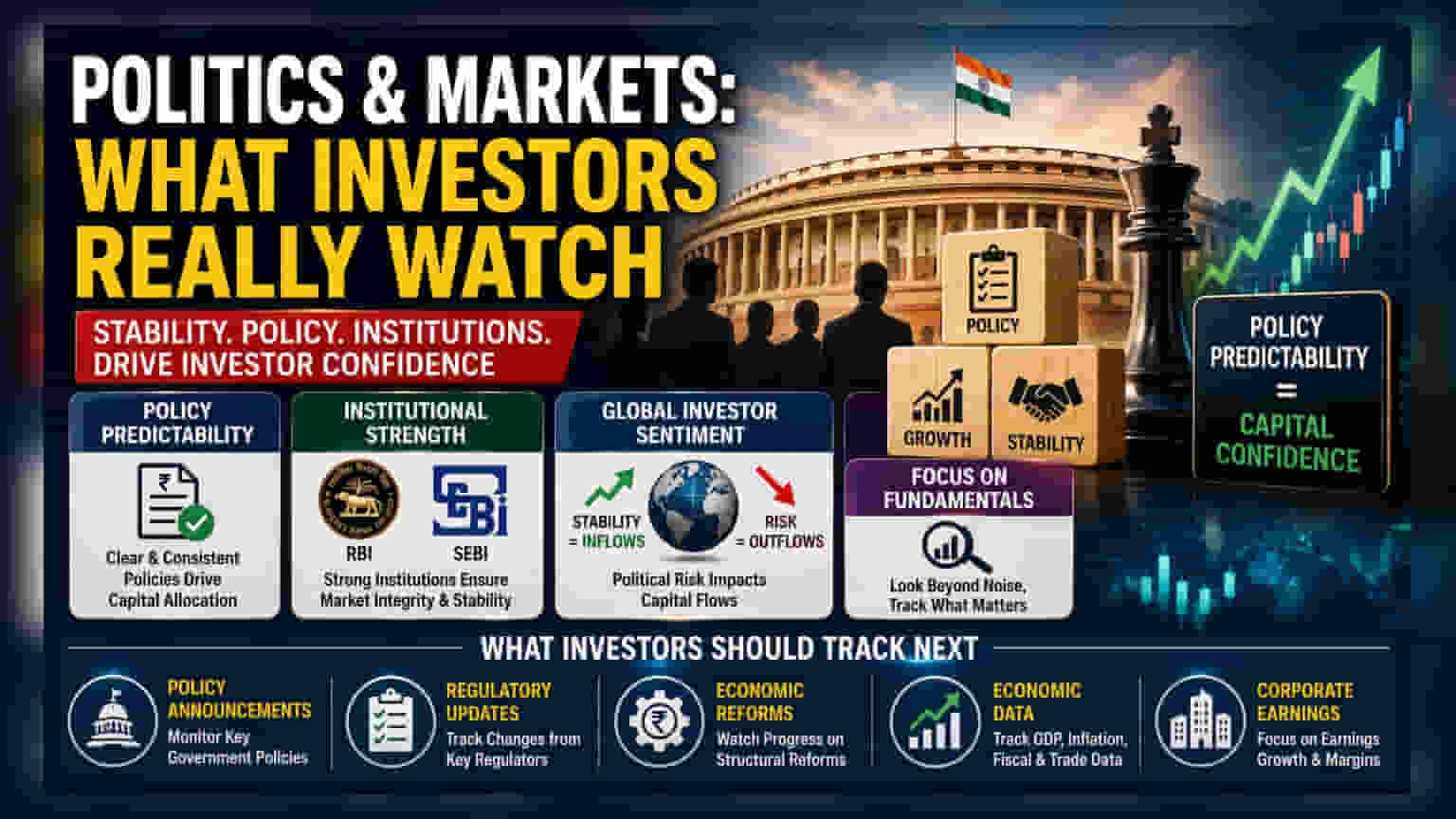
Global investors constantly evaluate political environments to gauge policy consistency and institutional stability. For Indian investors, the focus remains on how regulatory frameworks and stable governance influence long-term economic growth and capital inflows. Understanding these dynamics is essential for assessing the broader market environment.
How Investors View Political Environments
Global market analysts often study political frameworks to understand how they impact economic policy and the business environment. For investors in emerging markets, political stability is frequently viewed as a foundation for economic confidence. When political narratives evolve, the market focuses primarily on whether these changes affect the continuity of policy, the ease of doing business, and the reliability of regulatory frameworks. Investors typically seek a predictable environment where they can assess long-term risks without frequent or unexpected shifts in strategy.
Why Policy Predictability Matters
Predictability is a key metric for capital allocation. Whether it involves taxation, infrastructure spending, or industrial regulations, markets generally perform better when the policy direction is clear and consistent. When political discourse emphasizes national growth or civilizational resurgence, investors often look for evidence that this translates into practical economic reforms. The market reaction to any political shift is usually determined by whether it fosters an environment conducive to corporate investment or if it introduces uncertainty that could dampen growth prospects.
The Role Of Institutional Strength
Institutional strength is another major factor for long-term investors. Institutions such as the Reserve Bank of India (RBI) and the Securities and Exchange Board of India (SEBI) play a critical role in maintaining market integrity and financial stability. Investors monitor the independence and efficacy of these institutions to ensure that the regulatory environment remains robust, regardless of the broader political climate. A strong institutional framework is often seen as a guardrail that prevents political volatility from disrupting the financial systems that companies rely on.
Capital Flows And Global Sentiment
Foreign Institutional Investors (FIIs) regularly assess 'political risk' as a part of their standard country analysis. This assessment involves looking at factors such as social cohesion, legal reliability, and the strength of democratic institutions. If global sentiment suggests that political or social risks are increasing, it can sometimes lead to reduced capital inflows or increased market volatility. Conversely, if the country maintains a stable and transparent business environment, it tends to attract long-term investment, which supports asset prices and economic expansion.
What Investors Should Track Next
For investors, the most important monitorables include official policy announcements, regulatory updates, and the government's approach to key economic reforms. Keeping an eye on how institutions navigate political developments is also vital. Rather than reacting to daily political discourse, successful investors often focus on data-driven metrics, such as corporate earnings growth, government capital spending, and changes in the ease of doing business, to understand the true impact on the Indian market.