

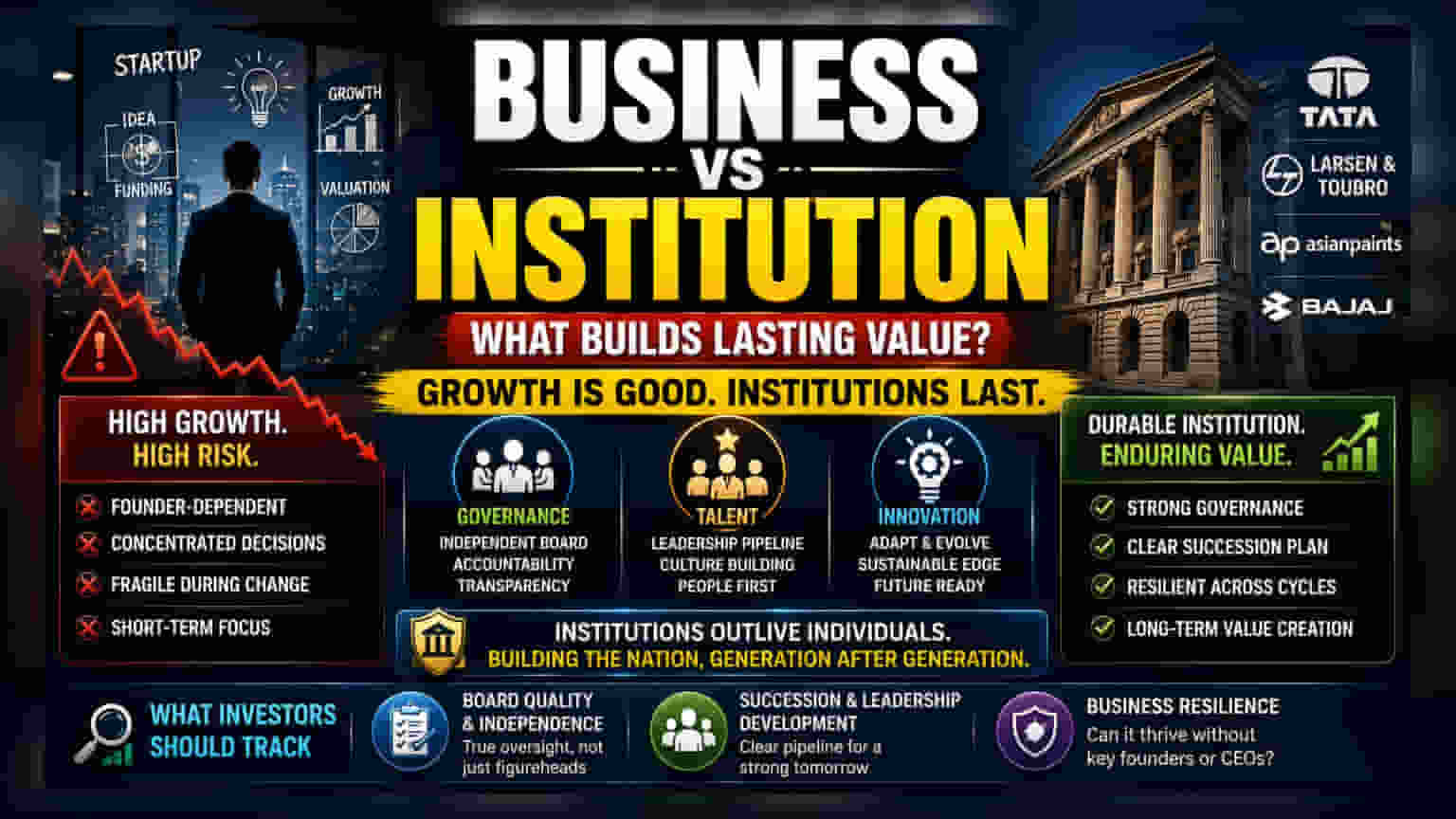
As India's market matures, experts are urging investors to look beyond short-term startup valuations. The focus is shifting toward identifying durable institutions that offer long-term stability through strong governance and clear succession planning, rather than companies reliant solely on founder charisma.
What Happened
Market experts have recently highlighted a critical distinction for investors: the difference between a high-growth business and a durable institution. While India’s economic scene is currently buzzing with entrepreneurship, capital inflows, and high valuations, there is a growing argument that enduring national strength comes from institutions, not just individual fortunes. These institutions are defined by their ability to survive across generations, maintain consistent values, and provide long-term economic stability, whereas many modern ventures remain overly dependent on the celebrity status or personal vision of their founders.
Why Governance And Succession Matter
For an investor, the difference between a business and an institution is often found in the boardroom. A company that relies entirely on a single charismatic leader faces a major risk: what happens when that leader steps down? True institutions—examples of which include legacy firms like Tata or Larsen & Toubro—invest in systems, culture, and talent that continue to function regardless of who sits in the top office. Investors looking for long-term safety may analyze whether a company has a robust succession plan. If a business appears to fall apart or lose its direction whenever there is a management change, it suggests the entity has not yet become an institution.
The Trap Of Founder-Dependence
In the startup and high-growth sectors, investors often chase valuations and rapid expansion. However, this strategy carries the risk of "founder-dependence." If the company’s competitive advantage, client relationships, or operational knowledge are held only by one person, the business is fragile. Institutionalized companies, conversely, distribute leadership and decision-making power. They prioritize building a sustainable culture over achieving quick, short-term financial targets. This makes them more resilient during economic downturns or leadership transitions.
Understanding Institutional Strength
Admired institutions earn their reputation through decades of consistent decisions. They build trust by focusing on three areas: governance, talent, and innovation. For shareholders, this means looking past the latest quarterly profit growth to understand how the company manages its assets and people. Strong governance frameworks serve as a moat, protecting the company from the internal crises that often destroy less disciplined businesses. When a company acts as a temporary custodian of wealth rather than a vehicle for a single individual's ambitions, it is more likely to create durable value for shareholders.
What Investors Should Track
Investors aiming to differentiate between short-term businesses and long-term institutions may monitor several indicators. First, check the independence and quality of the Board of Directors; are they truly overseeing management or just acting as figureheads? Second, look for clarity in succession planning and leadership development programs within the annual reports. Finally, observe whether the company’s business model is robust enough to handle the exit of its key promoters or CEOs without a significant drop in operational efficiency. Prioritizing these factors may help in building a portfolio that is more resilient over the long term.