

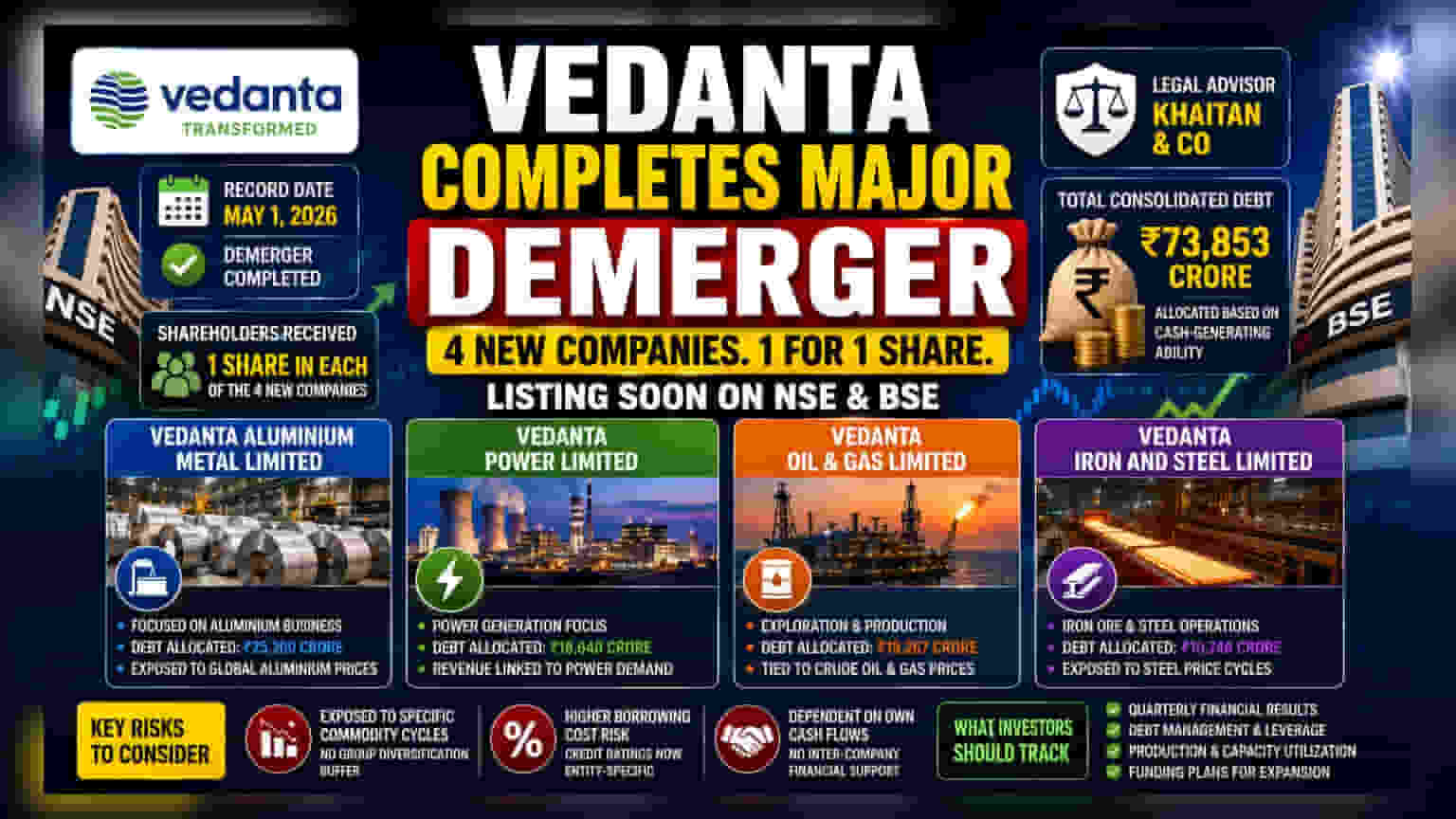
Vedanta Limited has split into four independent listed companies: Vedanta Aluminium, Vedanta Power, Vedanta Oil & Gas, and Vedanta Iron & Steel. This restructuring aims to simplify operations and unlock shareholder value, with a total consolidated debt of ₹73,853 crore now allocated across the new entities. Investors who held Vedanta shares as of May 1, 2026, now hold equity in each of these four distinct businesses.
What Happened
Vedanta Limited has officially completed a major corporate restructuring by demerging its diversified business into four separate, independent entities: Vedanta Aluminium Metal Limited, Vedanta Power Limited, Vedanta Oil & Gas Limited, and Vedanta Iron and Steel Limited. This vertical split means that shareholders of the original Vedanta Limited have received shares in each of these four new companies on a one-for-one basis. The process was completed following a record date of May 1, 2026, and all four entities are now set for listing on the National Stock Exchange (NSE) and Bombay Stock Exchange (BSE). The process was legally advised by Khaitan & Co.
The Debt Allocation Logic
A critical part of this restructuring is the distribution of the company’s total consolidated debt, which stood at approximately ₹73,853 crore. This debt has been assigned to the four new companies based on their specific cash-generating ability and financial profile. For investors, this is a major change. Previously, the debt was tied to the overall group performance. Now, each entity carries its own debt burden. This means the financial health of each company will depend entirely on its own operational efficiency, revenue, and ability to manage its specific loan obligations without relying on the cash flow of other business units.
Strategic Shift: From Conglomerate to Pure-Play
The primary reason for this split is to transition from a single, complex conglomerate into four "pure-play" companies. A pure-play company focuses on just one industry. The management’s goal is to allow each business—whether it is aluminium, power, oil and gas, or iron and steel—to operate independently. This structure is intended to give investors a clearer view of each business's performance. It also allows the management of each entity to make decisions tailored to their specific market, rather than competing for capital within the larger group. For example, the oil and gas business will now be evaluated solely on energy prices and production, rather than being overshadowed by the performance of the metals business.
Risks to Consider
While the split aims to simplify the business, it introduces new risks for shareholders. Each of the four entities is now heavily exposed to the specific commodity cycle of its sector. If, for instance, global oil prices fall, the Vedanta Oil & Gas entity will face direct pressure without the buffer of a diverse portfolio to support it. Additionally, there is a risk regarding the cost of borrowing. As individual companies, their credit ratings will be determined by their own balance sheets rather than the group’s combined strength. If an entity is perceived as riskier on its own, it may face higher interest costs on its allocated debt.
What Investors Should Track
The most important factor for investors now is how each entity manages its distinct balance sheet. Shareholders should watch for the quarterly financial results of each company to see if the debt allocation is manageable relative to their individual earnings. Monitoring operational updates and production capacity utilization in each specific vertical will also be crucial. Finally, pay attention to any future updates regarding how these companies plan to fund their expansion projects, as they will no longer be able to rely on inter-company transfers as easily as they did when they were part of one large entity.