 Whalesbook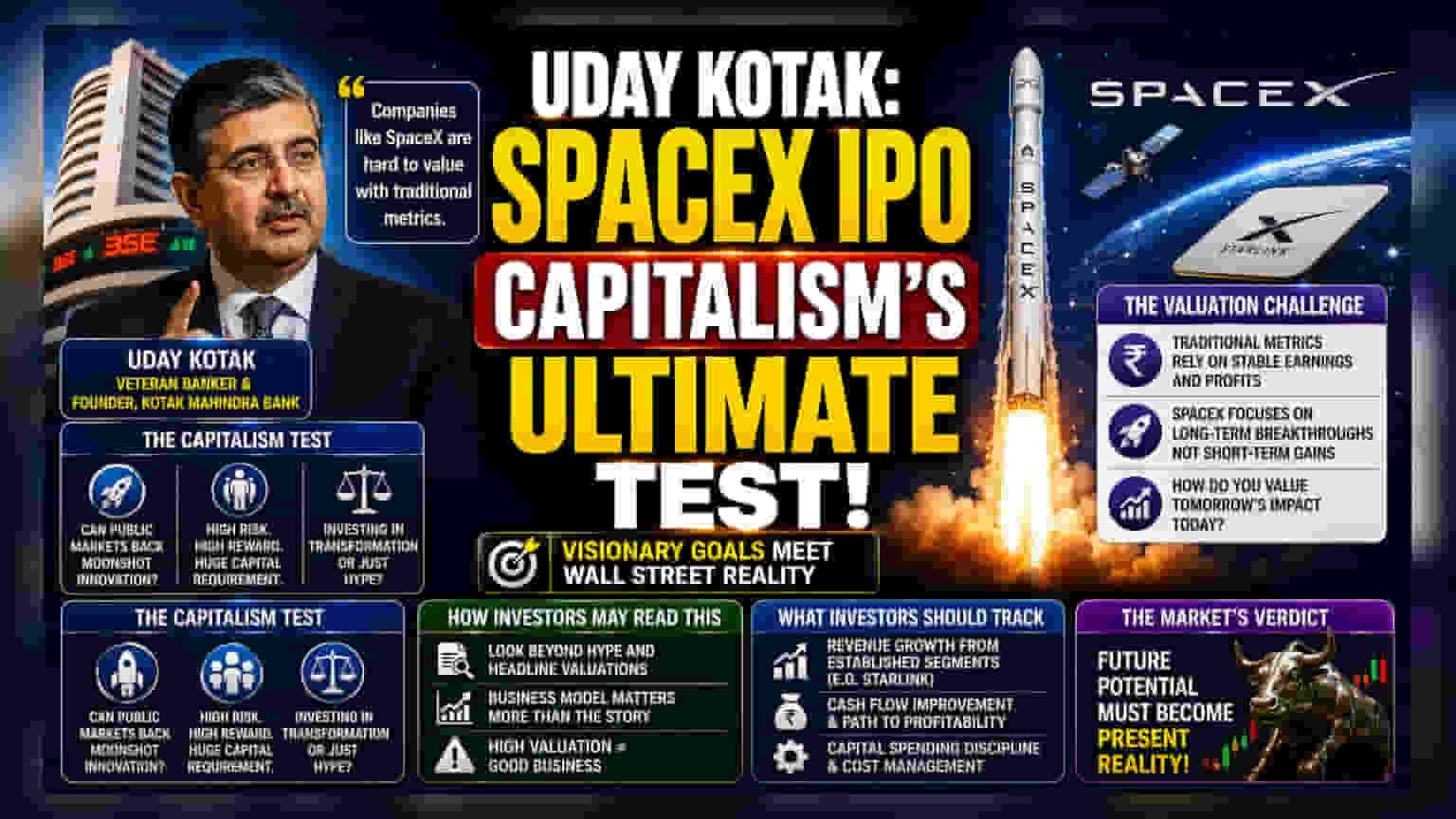


Veteran banker Uday Kotak says a potential SpaceX IPO would be a major test for modern markets. He argues that standard financial tools struggle to value companies betting on humanity's future, raising questions about whether such 'moonshot' ventures offer real returns or risk becoming market bubbles.
What Happened
Veteran Indian banker Uday Kotak has highlighted the potential Initial Public Offering (IPO) of SpaceX as a defining moment for modern capitalism. In recent comments, Kotak suggested that companies like SpaceX, which focus on highly ambitious, long-term goals, are difficult to evaluate using traditional financial metrics. He views the possibility of such a massive company entering public markets as a test to see if investors can reconcile the company's visionary goals with standard measures of profitability and value.
The Valuation Challenge
For investors, the debate centers on how we value companies. Traditional market metrics—such as Price-to-Earnings (P/E) ratios or current dividend yields—rely on stable, predictable earnings. However, SpaceX operates in an industry where success is measured by long-term technological breakthroughs, such as satellite internet (Starlink) and space exploration, rather than short-term profit growth.
Kotak’s perspective highlights a growing divide. Private investors, such as venture capital firms, often fund companies based on future potential and market disruption. Public markets, however, are often less patient. When a company with a high 'moonshot' valuation goes public, it faces intense scrutiny from institutional and retail investors who expect clear financial results. If the company cannot show consistent cash flow or profit growth, the stock price can face significant pressure.
The Capitalism Test
Kotak’s use of the term 'capitalism's ultimate test' refers to whether public markets can successfully accommodate these high-risk, high-reward ventures. In a typical market, investors put money into companies that produce goods or services with a known return. A business like SpaceX, which requires immense capital spending to achieve future goals, represents a different category. If the company goes public, it forces the market to decide if it is truly investing in transformative innovation or if the high valuations are simply driven by hype and speculative bubbles.
How Investors May Read This
For those watching from the Indian market, this discussion serves as a reminder to look beyond headline valuations. Whether it is a space exploration company or a domestic tech startup, the business model matters more than the hype. Investors often see 'high valuation' and assume it means a 'good business.' However, Kotak’s caution suggests that without a clear path to profitability, even the most ambitious ventures can struggle to justify their price tags when market sentiment shifts.
What Investors Should Track
Investors should always watch the fundamental drivers of any business, regardless of its vision. For companies similar in nature—those burning cash for future growth—the most important indicators are usually operational milestones. Key monitorables include consistent revenue growth from established segments, like satellite services, as well as the ability to manage debt and control spending. The market’s reaction to such companies often depends on whether they can prove their 'future potential' is becoming a 'present reality' through concrete, profit-generating results.