 Whalesbook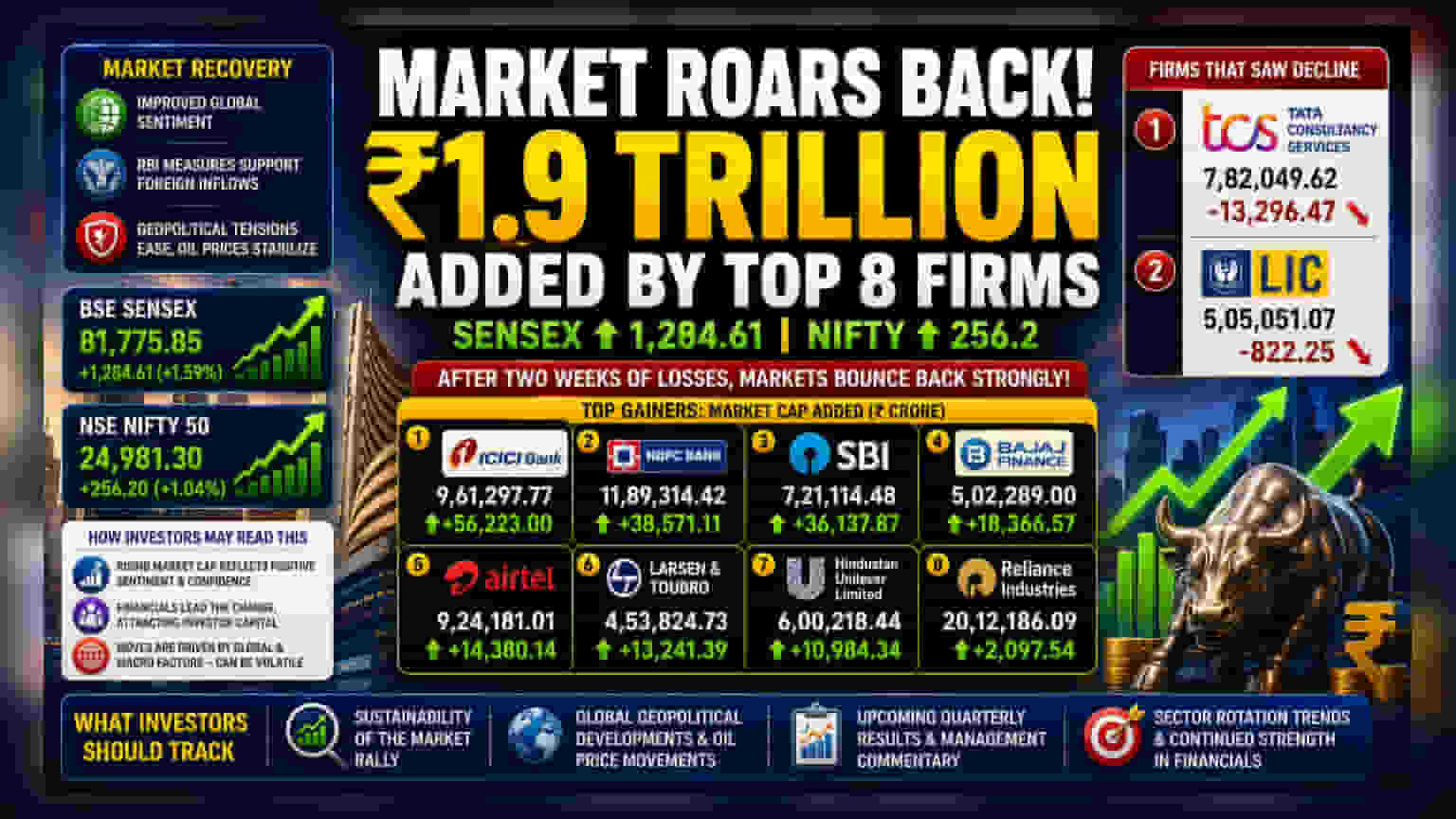


India’s top ten companies collectively added ₹1.9 trillion to their market value last week, led by a strong rally in financial stocks like ICICI Bank and HDFC Bank. The recovery follows a two-week losing streak, supported by better global sentiment and policy measures. Investors are now watching if this momentum can sustain amidst shifting global tensions and RBI's currency steps.
What Happened
Last week, India's stock market witnessed a significant recovery, with eight of the ten most valued companies in the country collectively adding ₹1.9 trillion to their market capitalization. This surge in value occurred as both the BSE Sensex and the NSE Nifty posted strong gains, with the Sensex rising by 1,284.61 points and the Nifty climbing by 256.2 points. The rally was a notable shift in sentiment after the market had spent the previous two weeks in a losing streak.
The Market Recovery
Several factors supported this positive movement in the domestic equity markets. Market sentiment improved due to a more optimistic global outlook and supportive measures from the Reserve Bank of India aimed at helping foreign currency inflows. Additionally, hopes that geopolitical tensions might ease, particularly regarding a potential peace deal involving the US and Iran, helped stabilize global markets and energy prices, giving Indian investors more confidence to return to the market.
Financial Stocks Lead the Gains
Financial companies were at the forefront of this valuation jump. ICICI Bank was the standout performer, with its market capitalization increasing by ₹56,223 crore to reach ₹9,61,297.77 crore. HDFC Bank followed this trend, adding ₹38,571.11 crore to its value, bringing its market cap to ₹11,89,314.42 crore. State Bank of India also showed robust growth, contributing an additional ₹36,137.87 crore to its market valuation.
Other major companies also saw their values rise during this period. Bajaj Finance added ₹18,366.57 crore to its market cap, while Bharti Airtel saw an increase of ₹14,380.14 crore. Larsen & Toubro and Hindustan Unilever also recorded gains of ₹13,241.39 crore and ₹10,984.34 crore, respectively. Even Reliance Industries, which remains India’s most valued firm, saw its market capitalization climb by ₹2,097.54 crore.
Firms That Saw Valuation Decline
While the broader market trend was positive, not all top-tier companies saw their market value grow. Tata Consultancy Services (TCS) experienced a decline, with its market capitalization falling by ₹13,296.47 crore to settle at ₹7,82,049.62 crore. Similarly, Life Insurance Corporation of India (LIC) faced a decrease in its valuation, which dropped by ₹822.25 crore to ₹5,05,051.07 crore.
How Investors May Read This
Changes in market capitalization are driven by daily fluctuations in stock prices. While a rise in market cap generally reflects positive investor sentiment and confidence in the company’s future performance, it is often tied to broader market indices. For individual investors, these figures show which sectors—in this case, banking and finance—are currently attracting the most capital. However, because these moves are often influenced by global sentiment and macro-economic factors like currency flows and geopolitical news, they can be volatile and change quickly.
What Investors Should Track
Moving forward, investors may want to keep an eye on how these market trends evolve. The key monitorables include the sustainability of this rally, as global geopolitical developments can quickly change the direction of equity markets. Investors often look for consistent performance rather than just weekly fluctuations. Additionally, upcoming quarterly results and commentary from company management regarding business growth will provide a clearer picture of whether these valuation increases are supported by strong fundamental business health or primarily by temporary market optimism.