 Whalesbook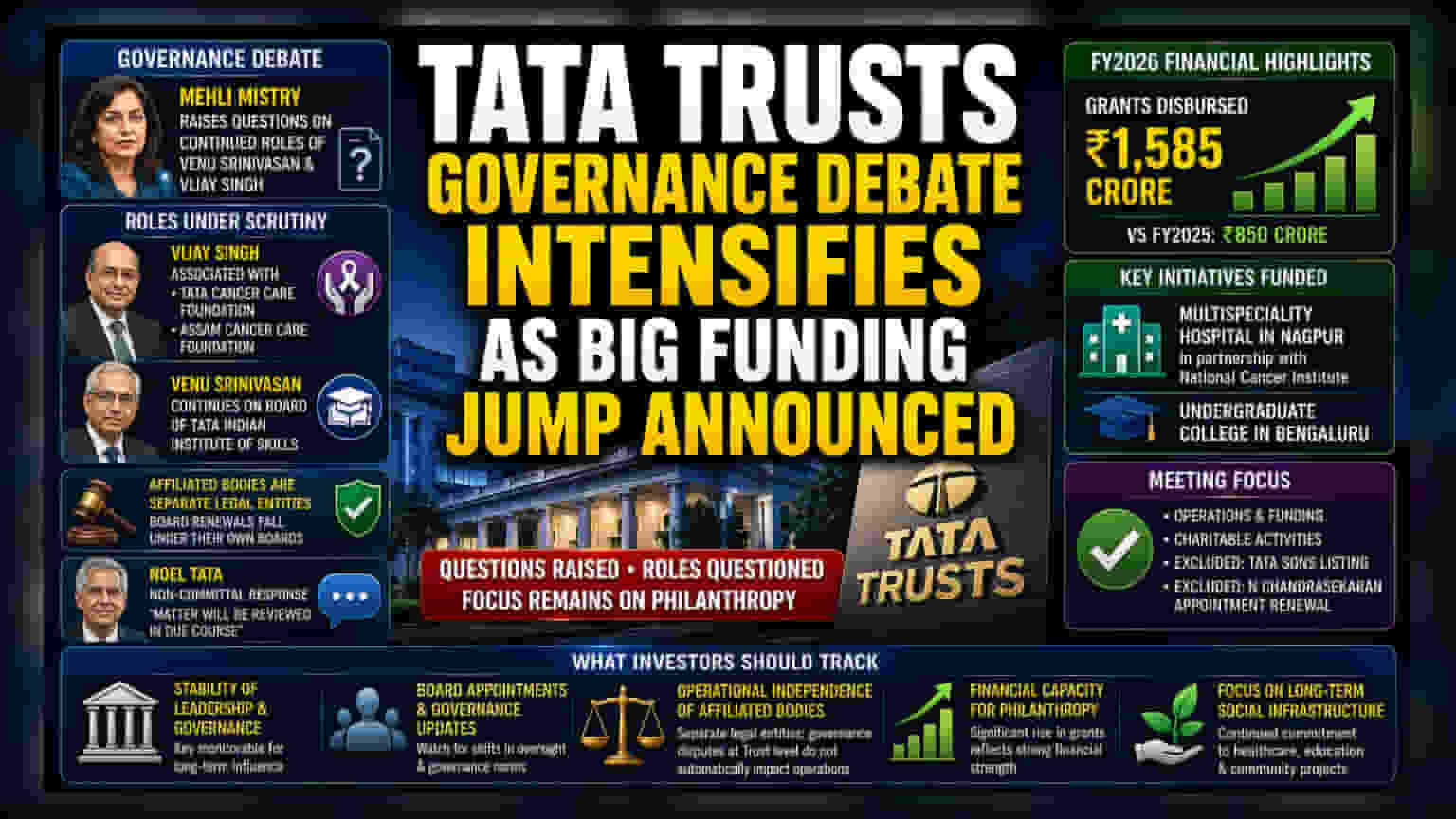


What Happened
The Tata Trusts are currently in the spotlight due to internal discussions regarding governance and board compositions. Mehli Mistry, a director at the M Pallonji Group and a trustee of the Tata Education and Development Trust (TEDT), has formally raised questions about the continued involvement of Venu Srinivasan and Vijay Singh in various affiliated organizations. This challenge emerged after the recent decision not to renew the terms of Srinivasan and Singh on the main TEDT board. Mistry has questioned whether individuals who are no longer on the main trust board should continue to hold positions in the associated entities that the trust supports.
The Governance Debate
The individuals in question currently maintain significant roles in separate, affiliated institutions. Vijay Singh remains associated with the Tata Cancer Care Foundation and the Assam Cancer Care Foundation, while Venu Srinivasan continues to serve on the board of the Tata Indian Institute of Skills. Mistry cited his own experience, noting that he voluntarily stepped down from several affiliated bodies after his trusteeship at the Sir Dorabji Tata Trust and the Sir Ratan Tata Trust concluded. However, the legal reality is that these affiliated bodies operate as distinct legal entities. Consequently, decisions regarding board renewals for these specific organizations fall under the authority of their respective boards rather than the main trust. Noel Tata, acting as Chairman, provided a non-committal response to these queries, indicating that the matter would be reviewed at a later time.
FY2026 Financial Highlights
In a separate meeting, the board of the Sir Dorabji Tata Trust (SDTT) focused on its financial and charitable activities. The trust announced that it had disbursed grants totaling Rs 1,585 crore for the fiscal year 2026. This represents a substantial increase compared to the Rs 850 crore distributed in the previous fiscal year, reflecting a higher commitment to its philanthropic goals. The meeting, which saw full attendance, prioritized discussions on funding a new multispeciality hospital in Nagpur, managed in partnership with the National Cancer Institute, and a new undergraduate college in Bengaluru. The agenda strictly focused on these operational and funding matters, deliberately excluding topics such as the potential listing of Tata Sons or the renewal of N Chandrasekaran’s appointment as Chairman of Tata Sons.
Governance and Investor Context
For investors and observers, the stability and clarity of governance within the Tata Trusts are key monitorables. While the Trusts are independent of the publicly listed Tata Group companies, the leadership and decisions made at the Trust level often have a symbolic and strategic influence. The debate over board positions reflects ongoing shifts in how the Trusts manage oversight and leadership continuity. It is important to note that the organizations in question function as separate legal entities, meaning the governance disputes at the Trust level do not automatically result in operational changes at the affiliated foundations.
What Investors Should Track
Investors may continue to watch for updates regarding board appointments and any broader shifts in governance norms within the Tata group’s ecosystem. The primary monitorable remains the stability of the leadership structure and how the Trusts balance their oversight responsibilities with the operational independence of their affiliated bodies. Furthermore, the significant rise in charitable grants highlights the Trusts' ongoing financial capacity and their evolving focus on major infrastructure and social projects, which remains a core aspect of their long-term mission.