 Whalesbook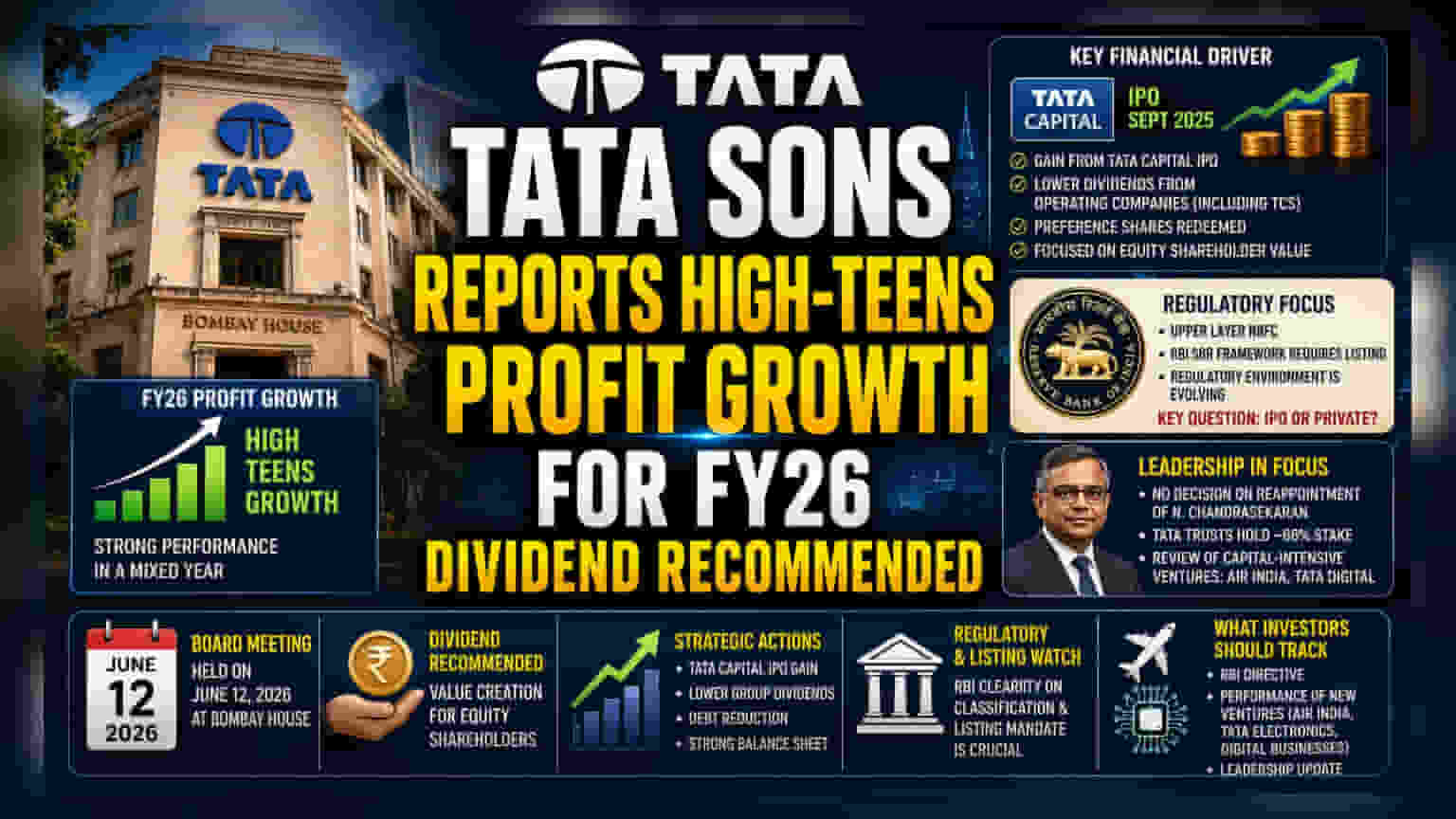


Tata Sons reported high-teens profit growth for FY26, supported by proceeds from the Tata Capital IPO. The board recommended a dividend for equity shareholders while continuing to navigate RBI's mandatory listing rules and internal discussions on leadership renewal.
What Happened
Tata Sons, the principal investment holding company of the Tata Group, convened its board of directors on June 12, 2026, to finalize its financial results for the fiscal year ended March 31, 2026. The company reported profit growth in the high-teens range, a notable performance given the mixed financial environment of the past year. Along with the financial results, the board recommended a dividend for equity shareholders. The meeting, held at the company's headquarters, Bombay House, also addressed routine administrative matters, including the remuneration for directors and key management personnel.
Financial Performance and Strategy
The growth in profitability for FY26 was driven largely by strategic financial actions rather than just core dividend income from operating companies. The company benefited significantly from the sale of shares in Tata Capital through an Initial Public Offering (IPO) in September 2025. This one-time gain helped offset lower dividend payouts from several operating companies within the group, including Tata Consultancy Services (TCS), which faced a more moderate year. Tata Sons previously redeemed its preference shares to reduce debt and align with regulatory expectations, a move that left the company focused on delivering value to its equity shareholders.
The Regulatory and Listing Focus
The financial results arrive amidst ongoing regulatory attention. Tata Sons is classified as an 'Upper Layer' Non-Banking Financial Company (NBFC) by the Reserve Bank of India (RBI). Under the RBI’s Scale-Based Regulatory (SBR) framework, upper-layer NBFCs are generally mandated to list their shares on public exchanges. While Tata Sons has sought to remain a private entity—taking steps such as retiring standalone debt to change its risk profile—the regulatory environment has evolved significantly, with recent RBI amendments creating further complexity for such holding companies to maintain their unlisted status. Market observers continue to track whether the company will be required to proceed with an IPO or if it can maintain its private structure, a factor that remains a central point of interest for the broader Tata ecosystem.
Leadership and Internal Dynamics
The board meeting concluded without discussions on the reappointment of Chairman N. Chandrasekaran for a third term, an issue that has been pending for several months. While the board focused on annual accounts and dividends, leadership renewal remains a point of deliberation. Recent discussions within the Tata Trusts—the principal shareholder holding approximately 66% of Tata Sons—have reportedly touched upon the performance of capital-intensive, loss-making group ventures, including Air India and Tata Digital. Investors and observers often monitor these internal dynamics, as they influence the group's long-term capital allocation and strategic direction.
What Investors Should Track
For investors monitoring the broader Tata Group, the key monitorable is the clarity from the Reserve Bank of India regarding the company's regulatory classification and any directive on the listing mandate. Additionally, the operational performance of the group’s newer, capital-intensive businesses—such as Tata Electronics, Air India, and digital ventures—will be critical, as these units require significant funding and impact the group's overall dividend-paying capacity. Finally, any formal update regarding the leadership tenure at the holding company will provide clarity on the group's strategic continuity in the coming years.