

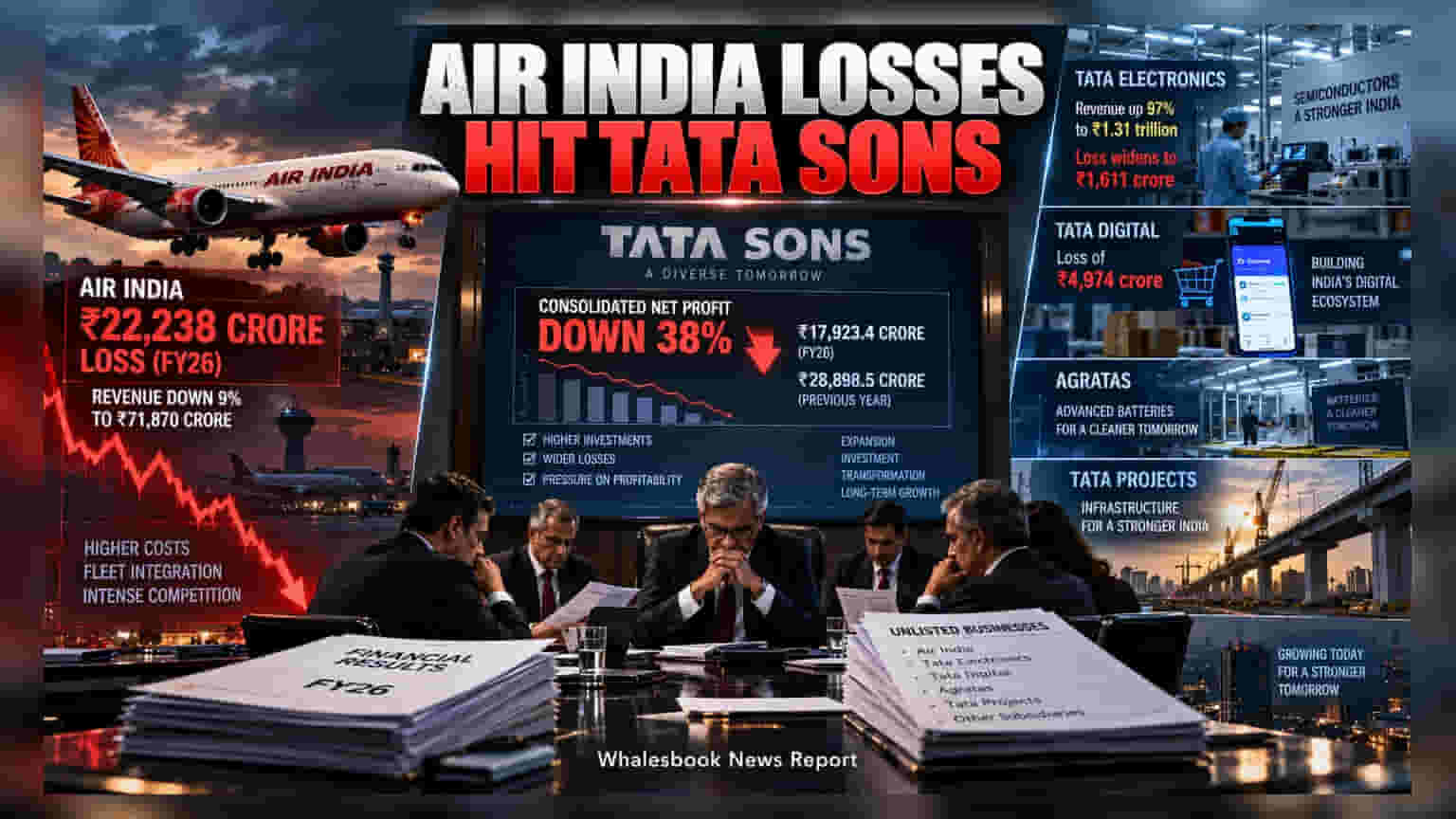
Tata Sons reported a 38% decline in consolidated net profit to ₹17,923 crore for FY26, driven by heavy losses in unlisted subsidiaries like Air India and Tata Electronics. While revenue grew, massive capital spending in new ventures pressured overall earnings. Investors should distinguish these holding company figures from the independent financial performance of Tata Group’s listed entities.
Tata Sons saw its consolidated net profit fall by 38% to ₹17,923.4 crore in FY26, down from ₹28,898.5 crore in the previous year. This performance highlights the challenge of balancing aggressive expansion in new, capital-intensive ventures with overall profitability. While the parent company’s standalone net profit—bolstered by income from brand fees and the sale of a stake in Tata Capital—actually rose by 21.8% to ₹31,961 crore, the consolidated picture reflects the significant financial drag from the group's unlisted subsidiaries.
Air India remained the largest contributor to this loss. The airline’s net loss widened to ₹22,238 crore in FY26, compared with ₹10,859 crore in the previous year. Revenue for the airline also declined by 9% to ₹71,870 crore. This trend reflects the high costs associated with fleet integration, operational restructuring, and intense competition in the aviation sector. Air India alone accounted for nearly 70% of the combined losses reported by the seven loss-making subsidiaries within the group.
In the technology and manufacturing space, Tata Electronics demonstrated rapid growth but at the cost of short-term profitability. Its revenue surged by 97% to reach ₹1.31 trillion, a clear sign of the company’s massive scale-up in manufacturing operations. However, this heavy investment phase led to a wider net loss of ₹1,611 crore, up from ₹970 crore in FY25. Similarly, Tata Digital continued to operate with significant losses, reporting a deficit of ₹4,974 crore as it scales its digital ecosystem.
Despite these challenges, certain unlisted segments remained profitable and provided some cushion. Tata AutoComp Systems reported net earnings of ₹1,091 crore, and Tata AIG General Insurance posted a profit of ₹1,008 crore. Furthermore, Tata International successfully turned around to post a profit of ₹73 crore, reversing a loss from the previous year. These pockets of stability demonstrate the group's diverse business model, though they were not enough to offset the combined ₹27,854 crore loss across 16 major unlisted subsidiaries.
For investors, it is important to distinguish between the performance of Tata Sons as a holding company and the individual performance of the group’s listed entities. Companies like TCS, Tata Motors, Tata Steel, and others maintain their own balance sheets and publicly traded stock performance, which are not directly reflected in this consolidated holding company report. The key monitorable for the market will be the execution timeline and eventual path to profitability for the newer, capital-heavy ventures like Air India and Tata Electronics, as their ability to generate cash flow remains central to the group's long-term financial health.