

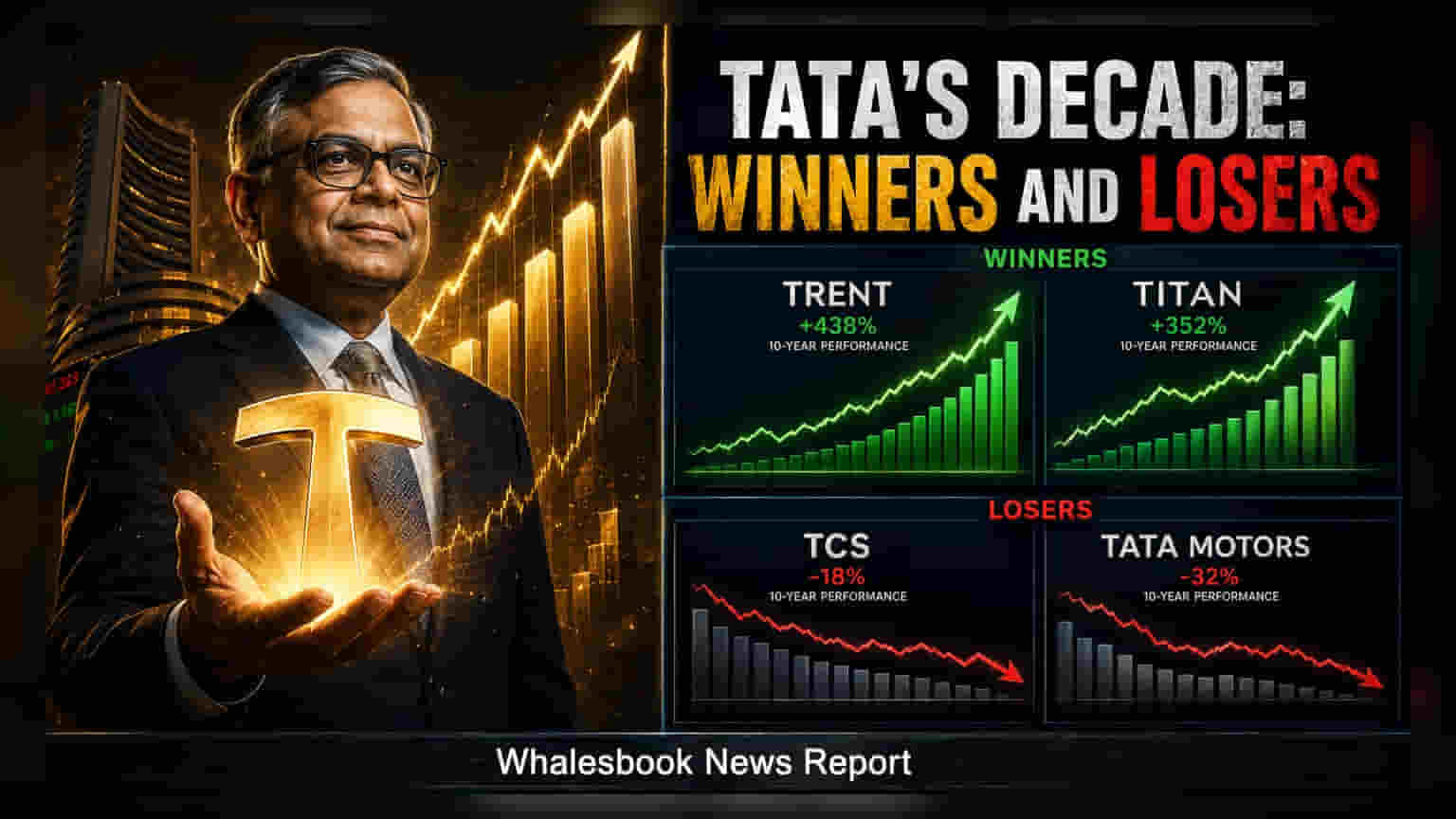
Tata Sons Chairman N. Chandrasekaran has announced he will not seek a third term, with his tenure ending on February 20, 2027. Markets reacted with selling pressure on August 12, 2026. While the group’s market value grew 3.3 times under his leadership, performance has been uneven, with consumer brands soaring while IT giants trailed the broader Nifty 50 index.
Tata Group investors witnessed a day of volatility on August 12, 2026, following the announcement that N. Chandrasekaran will not seek a fresh term as Chairman of Tata Sons when his current tenure concludes on February 20, 2027. The news triggered immediate selling pressure across several group stocks, reflecting uncertainty regarding the leadership transition and the future strategic direction of the conglomerate.
A Decade of Mixed Returns
Under Chandrasekaran’s leadership, which began in February 2017, the Tata Group saw its combined market capitalization grow approximately 3.3 times, reaching a valuation of roughly ₹26-27 trillion. However, when comparing this growth to the broader market, the group's listed entities have shown mixed results. The overall market capitalization of the group has compounded at an annual rate (CAGR) of 12.4%, which slightly trails the Nifty 50’s 13.2% performance over the same period. This suggests that while absolute wealth creation has been substantial, the group as a whole has not outperformed the benchmark index during his tenure.
Consumer Success vs IT Stagnation
The group’s performance reveals a clear divide between different business segments. Consumer-facing companies have been the primary drivers of value. Trent and Titan have delivered exceptional growth, with Trent in particular seeing its market capitalization compound at over 30% annually, making it a standout performer. Tata Consumer Products has also contributed positively, benefiting from robust demand in the retail and lifestyle segments.
Conversely, traditional giants like Tata Consultancy Services (TCS) have acted as a drag on the group’s overall index-beating potential. TCS, which was a core focus area under Chandrasekaran’s earlier leadership, has seen more modest market cap growth. This lag is largely attributed to broader headwinds in the global IT services sector, where companies have struggled with cautious technology spending and the ongoing uncertainty surrounding the adoption of generative AI tools.
Risks and Future Monitorables
Investors are now facing two distinct sets of challenges. First, there is the risk associated with leadership succession. As one of India's largest conglomerates, the continuity of strategy is vital, and the market often dislikes uncertainty regarding top-level management changes.
Second, there is a valuation risk. Several of the group's star performers, particularly in the retail segment, are trading at high price-to-earnings (P/E) multiples. If earnings growth fails to keep pace with these high valuations, these stocks may face correction pressure. Additionally, the IT segment’s path to recovery remains tied to global demand, which has yet to show a strong turnaround. Looking ahead, investors will be closely watching the succession roadmap for Tata Sons and whether the group can sustain the momentum in its consumer businesses while finding new growth levers for its legacy IT and manufacturing divisions.