

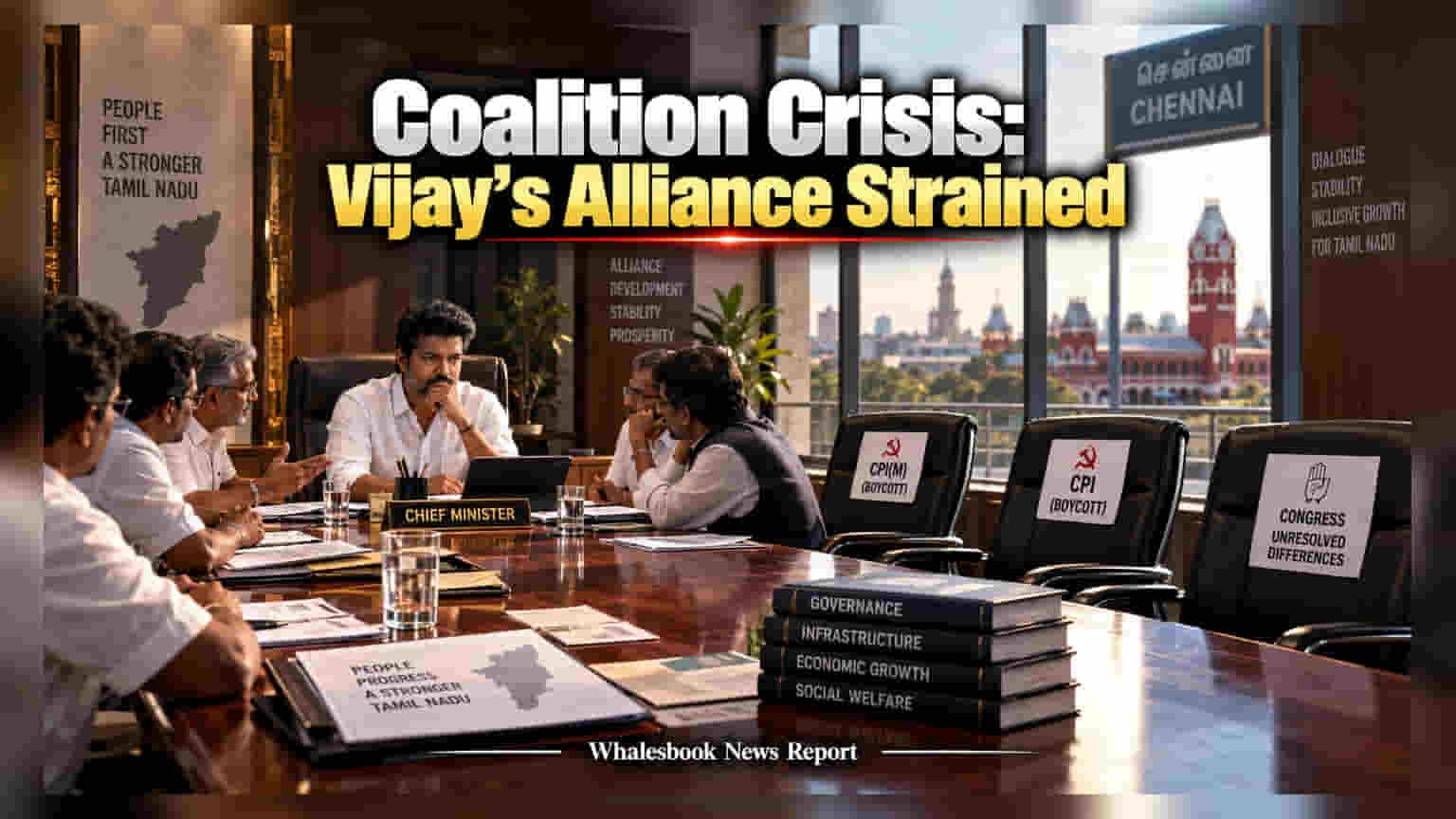
Tamil Nadu Chief Minister C. Joseph Vijay is holding a crucial meeting on September 9 to solidify his coalition government. The alliance faces friction as Left parties boycott the talks, and tensions rise with Congress over national leadership. This instability poses questions for the state's legislative agenda and policy predictability, which are key for regional business sentiment.
Tamil Nadu Chief Minister C. Joseph Vijay is chairing a critical alliance coordination meeting at the Tamilaga Vettri Kazhagam (TVK) headquarters in Chennai on September 9, 2026. The primary objective of the session is to formalize a joint steering committee and finalize a Common Minimum Programme for the government. The meeting is a significant effort to establish a unified administrative agenda following the party's emergence as the single largest entity in the recent state legislative assembly elections.
The Alliance Coordination Challenge
Despite the push for unity, the administration is managing internal friction from key coalition partners. Both the Communist Party of India (Marxist) and the Communist Party of India (CPI) are boycotting the gathering. This marks the second instance since July 1 that the Left parties have chosen to distance themselves from formal alliance proceedings. The Left leadership has stated that their support for the government remains strictly issue-based. They have expressed unwillingness to join a formal political apparatus without receiving cabinet representation, opting instead to maintain the independence required to critique government policies regarding agriculture, labor, and public welfare.
Leadership Disputes and Legislative Math
Beyond the Left's boycott, the government faces a public rift with the Indian National Congress regarding national political strategy. The disagreement centers on the 2029 Lok Sabha elections, with some TVK legislators publicly advocating for Chief Minister Vijay as a potential prime ministerial candidate. This stance has drawn immediate opposition from the Tamil Nadu Congress Committee. Congress Minister S. Rajesh Kumar has emphasized that the party continues to support Rahul Gandhi for the national opposition leadership. He further signaled that any move to prioritize the Chief Minister’s national candidacy could compel the Congress to re-evaluate its participation in the state cabinet.
Impact on Governance and Policy
The Chief Minister’s administration relies on a coalition, including the Congress, VCK, IUML, and MDMK, to maintain a working majority in the legislative assembly. Because the government operates with a narrow margin, any withdrawal of support from key alliance partners could affect the stability of the legislative agenda. For the business community and broader economic observers, political stability is a primary indicator of policy continuity. A fragmented alliance can often lead to delays in major infrastructure projects, budget approvals, and regulatory decisions.
Investors and observers will be tracking the government's ability to navigate these internal disagreements in the coming weeks. The primary monitorable will be whether the administration can maintain the necessary legislative numbers to pass upcoming bills and whether the coalition can reach a consensus on cabinet representation and the long-term governance strategy. Any further escalation between the TVK and the Congress, or a continued boycott by the Left, may serve as a signal of potential policy gridlock in the state.